Last Updated: November 4, 2026
Quick Summary
You can improve hockey stickhandling at home with 15 to 20 minutes of daily practice using a stick, a puck or ball, and about 2 square metres of floor. Short daily reps beat long occasional sessions, and a slick shooting pad or synthetic ice gives you the consistent surface that builds soft hands.
- A weighted puck should be used for slow, deliberate cupping reps, not speed work.
- A Swedish ball wobbles when your blade angle is off, giving instant feedback on quiet hands.
- Do not advance a drill stage until you can complete it clean for 30 seconds without looking down.
- Track touch count, head-up time and drill speed each week to measure progress.
- Fix a death grip by loosening the top hand and rolling the blade.
Table of Contents
- Why Home Stickhandling Practice Actually Works
- What You Need Before You Start: Space, Stick and Surface
- The Best Hockey Stickhandling Training Aids for Home Use
- How to Improve Soft Hands in Hockey
- A Daily Stickhandling Routine for Hockey Players
- Drills That Build Quick Touches and Puck Control
- Troubleshooting Common Stickhandling Form Errors
- Tracking Progress and Taking Your Hands to the Ice
- Frequently Asked Questions
Why Home Stickhandling Practice Actually Works
Improving hockey stickhandling skills at home works because puck control is a repetition sport. Your hands learn through thousands of small touches, not a few big sessions.
Here is the part most guides get wrong. They treat stickhandling as a warm-up. It is not.
The good news? You do not need much. A stick, a puck, a ball, and about 2 square metres of floor will do.
What You Need Before You Start: Space, Stick and Surface
Three things matter before your first rep: room to move, a stick cut to your height, and a surface that lets the puck slide. Get those right and home practice becomes easy to repeat.
- Space: A hallway or basement corner works. You need room for the stick plus a step in each direction.
- Stick: A stick that is too long forces your hands high and kills your feel.
- Surface: Smooth concrete or a shooting pad beats carpet every time.
Setting Up a Stickhandling Surface in a Small Space
Small spaces are not a barrier. They are a filter: they force quick touches and tight control, which is exactly what game-speed stickhandling demands.
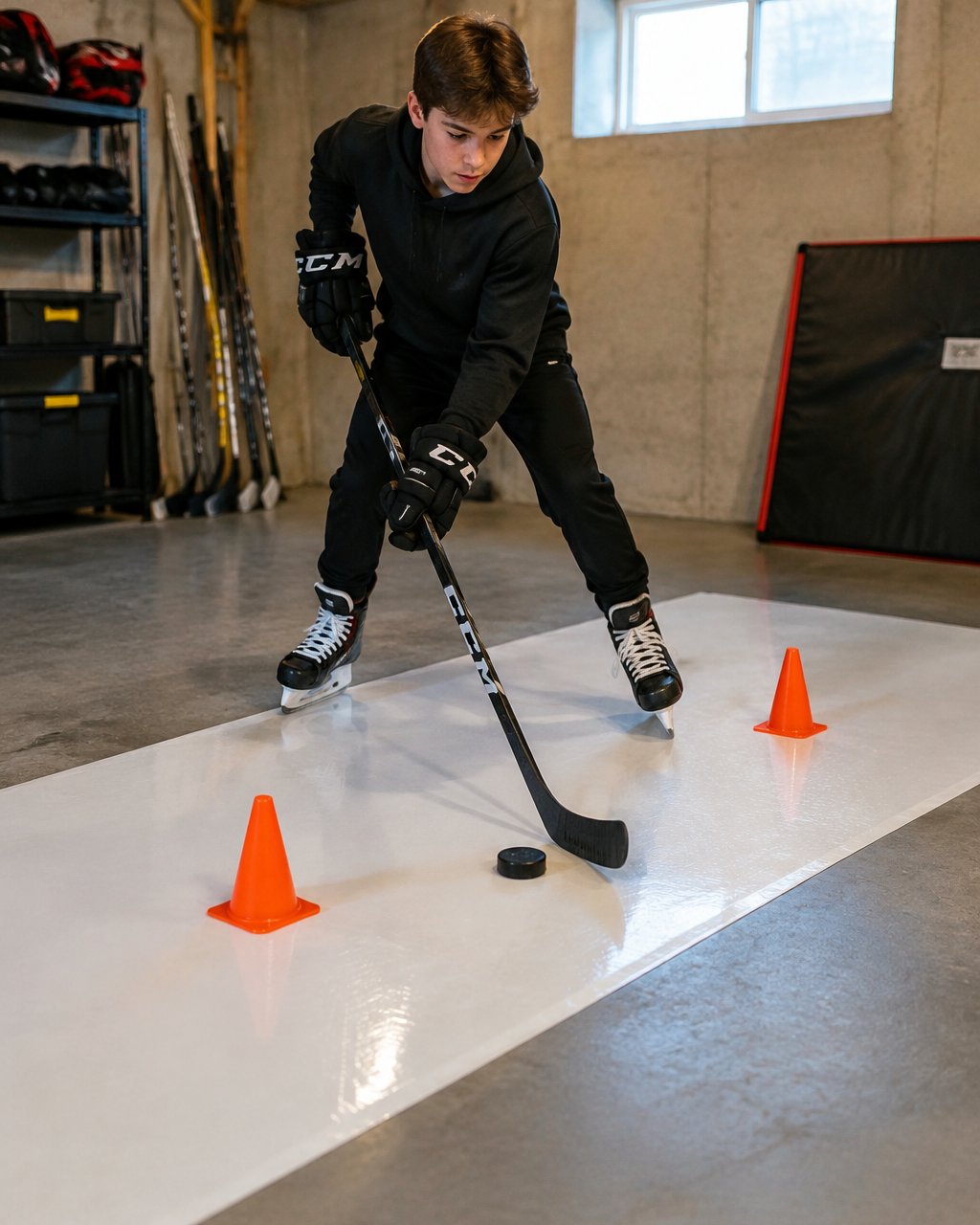
A simple setup works well for most players:
- A sheet of synthetic ice or a slick shooting pad against one wall
- Two small cones or water bottles as gates
- A phone on a tripod for video feedback
- A tennis ball for quiet, low-bounce reps
If you want more quality reps without leaving the house, synthetic ice hockey practice gives players sharper mechanics and confident skill transfer when they return to the rink each week.
The Best Hockey Stickhandling Training Aids for Home Use
The best hockey stickhandling training aids are simple, cheap, and hard to break. Fancy gadgets do not build soft hands. Repetition does.
Here is a useful set of aids, in order of value, with the mechanism behind each one:
- A weighted puck or steel ball. The extra mass slows your hands down and forces the wrist and forearm to do the work instead of the shoulder. Use it for slow, deliberate cupping reps, not for speed work. A common pattern is two minutes weighted, then two minutes with a regular puck to feel the difference.
- A Swedish ball or wooden ball. It rolls true and sits heavier than a puck, so any rattle in your blade shows up immediately. If the ball wobbles, your blade angle is off. This is the best feedback tool for quiet hands.
- A reaction ball. It bounces unpredictably, which trains hand-eye coordination and forces your eyes up. This is the one aid that directly builds the cognitive load most home guides ignore.
- Small cones or water bottles. They create gates for tight turns and lateral movement. Space them narrower than you think you need; the constraint is the point.
- A shooting pad or sheet of synthetic ice. It gives you a consistent, fast surface so the puck slides instead of catching. On carpet, you learn to stab; on a slick pad, you learn to cushion.
Skip anything that promises fast results with no reps. There is no such thing.
Watch out: a weighted puck used at full speed teaches you to drag rather than cushion. Keep weighted work slow and separate from your quick-touch drills.
How to Improve Soft Hands in Hockey
Soft hands in hockey come from one habit: catching and cushioning the puck instead of stabbing at it. Soft hands are about giving with the puck, then moving it. Players with soft hands keep the puck close, quiet, and under control.
Three things build that feel:
- Cushion on receive. Pull the blade back slightly as the puck arrives.
- Quiet blade. The puck should not rattle. Smooth is fast.
- Eyes up. You cannot have soft hands with your head down.
For a deeper look at hand positioning and the top hand, these at-home hockey training tips break down the details.
Cupping the Puck, Wrist Rotation and the Top Hand
Cupping the puck means rolling the blade over the puck so it sits in a pocket of the blade.
The top hand drives everything. It controls the blade angle, the roll, and the reach.
Try this: hold the stick with your top hand only and roll the blade back and forth over a ball. Feel the wrist rotation.
For a focused breakdown of top-hand mechanics, read grip hand positioning and why it matters.
A Daily Stickhandling Routine for Hockey Players
A daily stickhandling routine for hockey players should take 15 to 20 minutes and hit the same skills every day. Short and daily beats long and occasional. Muscle memory is built by frequency, not by marathon sessions.
Here is a routine we like:
- 2 minutes: Figure-eights, slow, eyes up
- 3 minutes: Wide dribbles, side to side
- 3 minutes: Quick touches in front, small and fast
- 3 minutes: Toe-drags and cupping reps
- 2 minutes: Reaction ball or wall ball
- 2 minutes: Free play, deking at game speed
Do it in the same spot, at the same time, most days. Habit beats motivation.
If you want more at-home ideas to fold into your week, shooting at home training tips pair well with this routine.
Drills That Build Quick Touches and Puck Control
Quick touches and puck control are built with drills that shrink your time on the puck.
Stage 1, Stationary control (slow, eyes up).
- Quick touches: Move the puck side to side in front of you, as fast as you can control. Start at half speed and build.
- Toe-drags: Pull the puck back with the toe of the blade, then push it forward. Keep the puck within a stick-length of your feet.
- Figure-eights: Weave the puck around two objects in a figure-eight. Slow and quiet beats fast and rattly.
Stage 2, Movement and gates.
- Gate dribbles: Move through small cones with the puck glued to your blade. Narrow the gates as you improve.
- Wall ball: Pass a ball against a wall and catch it on the blade. This is the single best drill for cushioning on receive.
Stage 3, Cognitive load (the gap most home guides miss).
Once the mechanics are clean, add a decision to the drill.
- Number call: Have a partner hold up fingers while you handle. Call out the number without looking down. Start with one hand, then two.
- Color gate: Tape two colors on the wall. A partner calls a color and you must move the puck to the matching side within one touch.
- Reaction ball catch: Bounce a reaction ball off the wall and catch it on your blade. The unpredictable bounce forces your eyes up and your hands to adjust.
- Random cone course: A partner points to the next cone; you react and move the puck there. No pre-planned route.
Progression rule. Do not advance a stage until you can complete the drill clean for 30 seconds without looking down. Clean first, fast second.
Watch out: if you add cognitive load before the mechanics are clean, you will groove a head-down habit.
Troubleshooting Common Stickhandling Form Errors
Most stickhandling form errors come down to four habits. Fix them and your hands get quieter and faster almost overnight.
| Problem | What It Looks Like | The Fix |
|---|---|---|
| Head down | Eyes on the puck, no scanning | Call out numbers or colors while you handle |
| Death grip | Knuckles white, stiff wrists | Loosen the top hand, roll the blade |
| Puck too far out | Reach over control | Keep the puck close to your feet |
| Flat blade | Puck rattles and rolls away | Cup the puck, roll the wrist |
A common mistake is practicing fast before practicing clean. Slow, correct reps build the right pattern. Fast, sloppy reps build the wrong one.
Watch out: if you feel wrist or forearm pain, stop and rest. Soreness from new reps is normal. Sharp pain is not.
Tracking Progress and Taking Your Hands to the Ice
Tracking progress turns home practice into real improvement. If you cannot measure it, you cannot tell whether it is working. Keep it simple.
Track three things each week:
- Touch count: How many clean touches can you do in 30 seconds?
- Head-up time: How long can you handle without looking down?
- Drill speed: How fast can you finish your cone course cleanly?
Write the numbers down. Small gains add up, and seeing them keeps young players motivated.
When your hands feel ready, take them to the ice. Game-speed reps under a coach’s eye are the fastest way to turn home work into real skill. Our competitive player development pathway shows how we build that next step for serious athletes.
At Pro Stride Hockey pairs off-ice work with on-ice coaching in small groups, with a 2:1 player-to-coach ratio in 1-on-1 sessions and a maximum of four players per session. Our video analysis and shooting lane facility let players see exactly what their hands are doing. A parent shared that her son “perfected his stride and my daughter gained confidence with her ringette shot.” That is the goal: hands that show up when it counts.
Frequently Asked Questions
How long should I practice stickhandling at home every day?
Short, focused sessions beat long ones. Fifteen to twenty minutes a day of deliberate hockey stickhandling, with your head up and your hands out in front, builds muscle memory faster than an hour of casual puck handling once a week. Break it into two blocks if that fits your schedule: ten minutes of stationary drills and ten minutes of movement drills. Consistency matters more than duration, so pick a time you can repeat daily and track how many clean touches you complete each session.
What equipment do I need for off-ice stickhandling practice?
You need a stick, a puck or training ball, and a smooth surface. A stickhandling pad or a sheet of smooth board protects your stick blade and gives consistent puck feel. Add small cones or pucks as obstacles, and a Swedish ball or weighted ball to build hand-eye coordination and quick touches. A mirror helps you check that your head stays up. You do not need a rink or a shooting lane to start; a garage, basement or driveway with about two metres of clear space is enough for most stationary drills.
Can I improve my puck control without a shooting pad?
Yes. A shooting pad makes the puck glide more predictably and saves your stick blade, but you can build puck control on smooth concrete, a garage floor or a piece of melamine board. Use a training ball on rougher surfaces because it rolls more slowly and forces softer hands. Keep the drills the same: quick touches, cupping the puck, and lateral movement. When you move to a pad later, your hands will adjust quickly because the movement pattern is already in place.
How do I transition my home stickhandling skills to the ice?
Home practice builds the movement pattern; game-speed reps make it usable. After your daily routine, add drills where you move your feet, change direction and keep your head up, because stationary stickhandling alone will not transfer. Video yourself so you can see whether your hands stay out front and your blade stays cupped under pressure.
Your hands will only get as good as the reps you give them. Build a small space, grab a puck, and start today. At Pro Stride Hockey, we help youth hockey and ringette players turn home practice into real skill with personalized coaching, video analysis, and our specialized shooting lane facility. Get started with Pro Stride Hockey and turn your home reps into game-ready hands.
