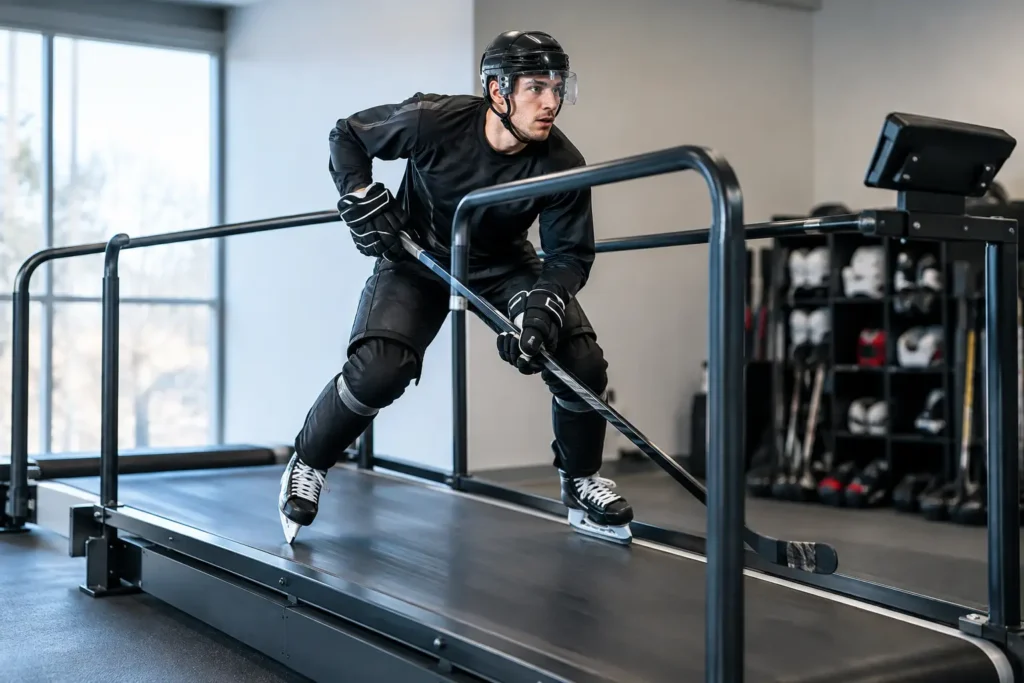
A skating treadmill does not make a player faster simply because they skate hard on it. Its value comes from something most team practices cannot provide: enough controlled repetitions for a coach to see a flaw, explain it, correct it, and have the athlete repeat the improved movement immediately. This skating treadmill review looks at where this training delivers real results for hockey players, where it has limits, and how families can tell whether it is the right investment.
What a Skating Treadmill Actually Trains
A hockey skating treadmill is a motorized synthetic-ice surface that moves beneath the athlete. Rather than traveling down the rink, the player skates in place while a coach controls the speed and watches the stride from close range. That controlled environment makes it easier to isolate the movements that drive efficient skating: knee bend, ankle flexion, hip extension, recovery, edge pressure, arm action, and body position.
On the ice, a player may take hundreds of strides during a practice but receive little specific feedback on any one of them. The puck moves, drills rotate, and coaches must manage an entire group. On a treadmill, the stride is the drill. There is no place for a rushed recovery or shallow knee bend to hide.
For young players, this can be especially useful. They often understand a cue such as “get lower” or “push through the ice,” but they need help connecting that instruction to what their body is actually doing. Repetition with patient coaching turns a general cue into a movement pattern they can recognize and reproduce.
Skating Treadmill Review: The Biggest Benefits
The strongest case for treadmill work is technical repetition with immediate correction. A coach can slow the belt down while an athlete learns a new position, then gradually increase the demand as the movement becomes more stable. That progression matters. Asking a player to sprint before they can hold a strong skating posture usually reinforces the same inefficient habits at a faster pace.
Video analysis adds another layer. When athletes can see their stride on a display immediately after skating, feedback becomes more concrete. A player may feel that their knees are bent, for example, yet video may show that they rise too early in the recovery. Seeing the difference helps athletes take ownership of the adjustment instead of relying only on verbal reminders.
Treadmill sessions also create a measurable training environment. Coaches can assess whether a player maintains posture as speed increases, whether one leg is producing less force than the other, and whether fatigue causes the stride to shorten or the upper body to collapse forward. Those details help shape a progression that fits the athlete rather than giving every player the same skating prescription.
For players returning from an injury, controlled skating may also be a useful part of a professionally approved return-to-play plan. The key is control. Belt speed, work intervals, and skating posture can be managed closely, while the coach watches for compensation patterns. It is not a replacement for medical guidance, but it can support a gradual return when cleared by the appropriate health professional.
Where Treadmill Training Has Limits
A treadmill is a powerful tool, not a substitute for ice time. Hockey is played in changing situations: players accelerate, stop, turn, cross over, react to pressure, handle pucks, and make decisions while tired. A treadmill cannot fully replicate edge work in a tight turn, game-speed transitions, or the awareness required in a competitive shift.
That is why the best results come when treadmill work supports on-ice development. The athlete learns how to create a stronger, more efficient stride in a controlled setting, then practices applying it during skating drills, small-area games, and full practices. Technical work builds the foundation. Ice time teaches the player when and how to use it.
There is also a learning curve. Some players feel awkward during their first session because the surface moves beneath them and the coach is asking them to pay attention to details they normally ignore. That is not a red flag. It is often the first sign that the athlete is becoming more aware of their mechanics. Still, quality coaching is essential. A treadmill session should not be a test of who can survive the highest speed. It should be a structured progression built around safe posture, purposeful effort, and correct technique.
What Parents Should Look for in a Session
The equipment matters, but the coaching environment matters more. Before booking, parents should ask how athletes are assessed, how feedback is delivered, and whether the session is adjusted for age and skill level. A beginner needs a different starting point than a junior player chasing another step in acceleration.
Small coaching ratios are a major advantage because they protect the quality of feedback. In a large group, players may spend more time waiting than receiving correction. In a private or small-group setting, the coach can identify one or two priority changes, demonstrate the movement, and give the athlete enough repetitions to make progress before the session ends.
A productive session should have a clear purpose. One player may need more knee bend and forward body angle. Another may need to improve their recovery under the body instead of swinging the skate wide. A stronger skater may be ready to maintain mechanics through higher-speed intervals. The details differ, but the process should remain consistent: assess, teach, repeat, review, and progress.
At Pro Stride Hockey, that process is supported by a purpose-built 3,600-square-foot training facility, immediate video feedback on a 55-inch display, and private instruction built around a 2:1 player-to-coach ratio with no more than four athletes. The goal is not to overwhelm players with ten corrections. It is to give them a clear focus they can carry into their next ice session.
Who Benefits Most From a Skating Treadmill?
Players who are working hard but not seeing the speed gains they expect are often strong candidates. The issue is not always effort. It may be that force is leaking through an upright posture, limited hip extension, or an inefficient recovery. Correcting those patterns can help an athlete get more out of the strength and conditioning work they are already doing.
Young players can benefit because early technical habits tend to follow them. A supportive, low-pressure setting gives them time to build confidence in proper positions before they become harder to change. Advanced players benefit differently. They may use the treadmill to refine stride symmetry, sustain technique at demanding speeds, or identify small mechanical limits that become meaningful at higher levels of play.
Team sessions can be valuable as well, provided the objective is focused. A team does not need every player to skate identically. It needs each athlete to improve their own efficiency while learning the habits that support better pace, stronger puck races, and more consistent shifts.
How to Get More From Each Session
The athlete should arrive ready to work, listen, and be coached. Treadmill training rewards attention. One focused correction applied over dozens of repetitions can create more change than a session spent chasing speed without purpose.
Players should also take their feedback back to the rink. After a session, choose one cue to use during the next practice, such as staying low through the push or recovering the skate underneath the body. Trying to remember every detail at once creates confusion. One clear priority creates a better chance of transfer.
Progress should be judged over several sessions, not one workout. Improved posture, smoother recovery, stronger balance, and more confidence at speed are meaningful wins even before they show up as a dramatic change on the scoreboard. The players who improve most are usually the ones who commit to the details, accept correction, and keep applying the work when they return to the ice.
A skating treadmill is not a shortcut. It is a focused training tool that gives athletes something rare in youth hockey: time to build a better stride on purpose. For the player willing to repeat the right movement, that time can become more power, better skill, and more speed when the game demands it.