Table of Contents
- Benefits of 2 to 1 Hockey Coaching: More Reps, More Feedback
- 2-to-1 vs 1-to-1 vs Group Coaching: A Direct Comparison
- Private vs Group Hockey Training: Where 2-to-1 Fits
- Benefits of Small Group Hockey Clinics With a 2-to-1 Ratio
- Personalized Hockey Training Programs Built Around Two Players
- Who Benefits Most From 2-to-1 Coaching (And Who Should Skip It)
- Conclusion
- Frequently Asked Questions
Last Updated: October 7, 2026
Benefits of 2 to 1 Hockey Coaching: More Reps, More Feedback
The benefits of 2 to 1 hockey coaching come down to one idea: two players share one coach’s full attention, so every rep gets watched, corrected, and repeated.
Hockey development runs on repetitions and feedback. When a coach splits attention across twelve skaters, most of those reps happen unsupervised.
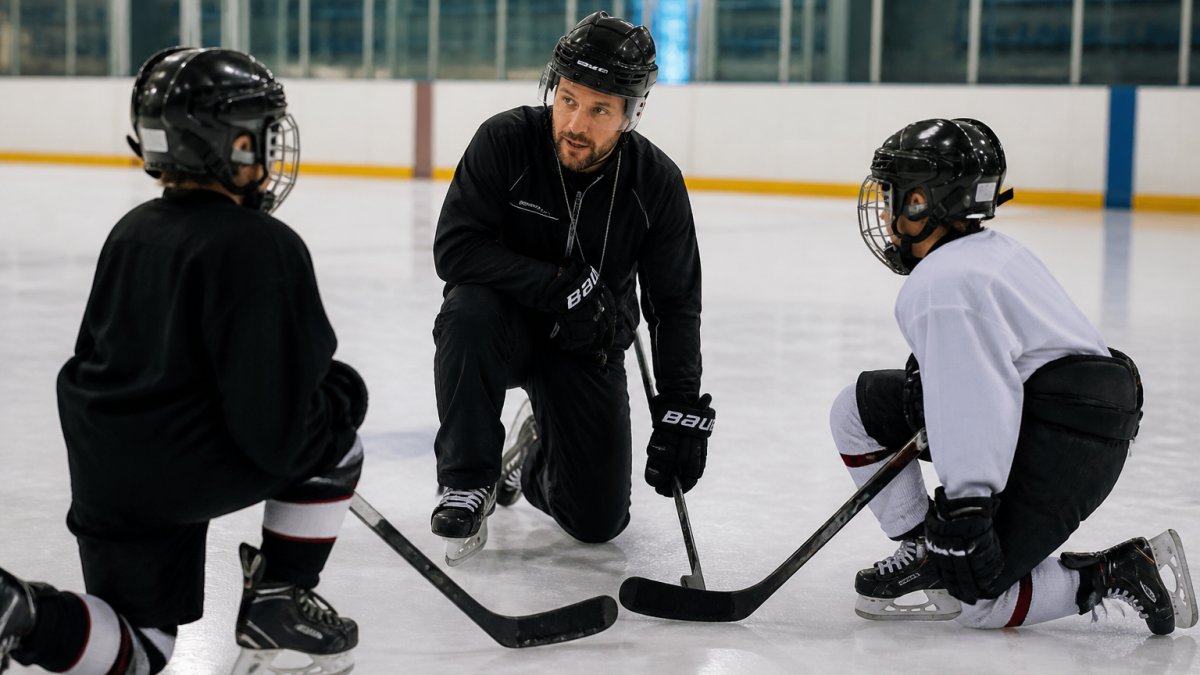
The 2-to-1 model gives each player roughly half a coach’s attention instead of a fraction of it. That is the entire value proposition, and everything else flows from it.
2-to-1 vs 1-to-1 vs Group Coaching: A Direct Comparison
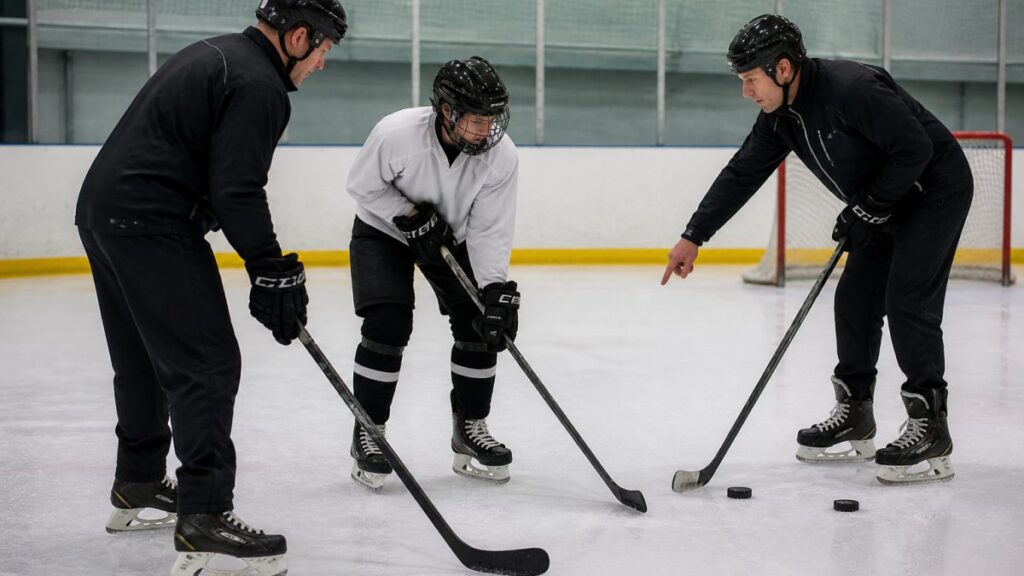
2-to-1 hockey coaching is a training format where one coach works with two players at once, balancing individual attention against shared cost and built-in competition. It sits between private lessons and group clinics, and it borrows the best of both.
Here is how the three formats stack up on the variables that actually drive development:
| Format | Attention per Player | Feedback Frequency | Peer Learning | Cost Split | Best For |
|---|---|---|---|---|---|
| 1-to-1 | Full coach focus | Every rep, immediate | None | Highest per player | Fixing one specific flaw fast |
| 2-to-1 | Roughly half a coach | Most reps, near-immediate | Constant, built in | Shared between two | Skill development with a partner |
| Group (6+) | A small slice each | Occasional, delayed | Social, unstructured | Lowest per player | Team tactics, social play |
Individual attention matters most in the early stages of learning a skill. Once a player can execute a drill correctly, peer learning takes over. Two players pushing each other through a sprint drill will work harder than one player alone, and that competitive edge is free.
The Trade-Offs Nobody Lists
Every format has a cost beyond the invoice. Here is the honest ledger:
- 1-to-1: Maximum attention, but no peer pressure and no partner to read live pressure from. A player who trains only alone can look sharp in drills and hesitate in games.
- 2-to-1: The pairing is the variable. A mismatched pair, one player far ahead of the other, forces the coach to run two plans at once, and both players lose reps. A well-matched pair gets near-private attention plus game-like competition.
- Group (6+): Lowest cost and easiest scheduling, but feedback frequency drops sharply. In a shooting drill with ten players, a player may get one correction every several minutes, and bad habits can set in between corrections.
Cost, Scheduling, and Value Compared
The 2-to-1 format usually costs less per player than private lessons because two families split the ice and the coach’s time. Scheduling is the trade-off: you and a partner must agree on a slot, and a last-minute cancellation by one player can leave the session in limbo. Group coaching is the cheapest and easiest to schedule, but the attention per player drops sharply.
A practical way to judge value is cost per quality repetition. Private lessons deliver the most attention per rep but at the highest cost. Group sessions deliver the lowest cost per hour but the fewest coached reps per hour.
Pair players of similar age and skill when you book a 2-to-1 session. A mismatched pair forces the coach to split the plan in two, and both players get less out of it.
The 2-to-1 format is not a compromise between private and group training, it is a distinct format with its own trade-offs. Choose it when the player is ready to refine skills and benefits from a partner, not when they need to fix one flaw fast or when scheduling flexibility is the priority.
::: Transitioning from this focused pairing toward the broader dynamics of small group training allows athletes to apply those refined technical abilities within a more complex, game-like environment.
Private vs Group Hockey Training: Where 2-to-1 Fits
Private vs group hockey training is usually framed as a straight choice, but the 2-to-1 ratio is the middle path most families overlook. Private training maximizes attention and cost.
For players working on skating mechanics, shooting technique, or position-specific skills, the middle path often fits best. These skills need close observation, but they also benefit from a training partner who provides live pressure.
That is why we lean on this format so heavily. The Hockey Canada long-term player development framework emphasizes age-appropriate training that balances skill work with game-like pressure, and a two-player setup delivers both at once.
Benefits of Small Group Hockey Clinics With a 2-to-1 Ratio
The benefits of small group hockey clinics built around a 2-to-1 ratio show up in three places: repetitions, feedback, and engagement. A coach can run a shooting drill with two players and give each one a real correction on every rep. In a large clinic, that same drill becomes a line of players waiting their turn.
Small groups also raise engagement. Two players competing on a timed drill stay locked in. Ten players waiting in line start chatting and losing focus.
- More reps per minute: less standing around, more touches
- Constant feedback: corrections land while the rep is fresh
- Peer pressure: a partner pushes effort higher
- Coach focus: the coach sees every mistake, not just the loud ones
Do not confuse a small clinic with a private lesson. If a session quietly fills to eight or ten players, the ratio is gone and so is most of the benefit. Ask how many players will be on the ice before you commit.
Personalized Hockey Training Programs Built Around Two Players
Personalized hockey training programs should start with an assessment, not a template. When a coach works with two players, they can build a plan that targets each one’s gaps while still running shared drills. The plan covers skating, shooting, and decision-making.
A typical 2-to-1 session structure looks like this:
- Warm-up and stride work (10-15 minutes): both players work edge control and stride mechanics on the ice, with the coach correcting posture and push direction.
- Individual skill block (15-20 minutes): one player shoots while the other works edge control, then they swap. The coach gives a correction on each rep, not just at the end.
- Shared pressure drill (15-20 minutes): a live competition drill where one player defends and the other attacks, then they switch roles. This is where decision speed and gap control get tested.
- Video review and feedback (5-10 minutes): the coach reviews one or two clips per player and sets the focus for the next session.
Example Paired Drills
- Give-and-go shooting: Player A passes to Player B, who shoots, then they swap. The coach watches release speed and shot placement on every rep.
- 1-on-1 gap control: One player defends while the other attacks, then they switch. The coach tracks whether the defender closes the gap before the attacker reaches the blue line.
- Timed crossover sprint: Both players race a crossover drill against the clock. The coach logs times and compares them across sessions.
Measuring Progress Without Guesswork
Progress tracking keeps the plan honest. Coaches log concrete indicators rather than vague impressions:
- Repetitions per session: how many quality reps each player completed, not just how long they were on the ice.
- Successful skill execution: for example, how many of ten shot attempts hit the target, or how many crossover sequences held form under speed.
- Decision speed: how quickly a player reads a 1-on-1 and chooses to close the gap or contain.
- Confidence markers: a simple rating the coach and player agree on before and after a block, tracked across sessions.
ParticipACTION’s guidance on youth physical activity notes that regular, structured activity builds both fitness and confidence in young athletes, and structured tracking is how you confirm that shift.
“My son perfected his stride and my daughter gained confidence with her ringette shot.” — Tara Mayne, Pro Stride Hockey parent
That kind of feedback is what progress tracking is meant to capture. It is not just about a faster lap; it is about a player who trusts their own skills.
Players who are past the beginner stage and refining skating, shooting, or position-specific skills, and who respond to a training partner and measurable feedback.
Who Benefits Most From 2-to-1 Coaching (And Who Should Skip It)
Players who thrive in 2-to-1 coaching are those ready to refine skills, not just learn them. If a player can already skate and handle the puck, the format sharpens what is there. If they are still learning to stop, a group or introductory program may serve them better first.
Best fit:
- Competitive players refining technical skills
- Players who respond to a training partner
- Families who want more attention than a group clinic offers
- Players working on position-specific skills like defensive positioning
Skip it if:
- The player is brand new to skating
- You need maximum one-on-one attention for a single flaw
- Scheduling a partner is impossible
For the players in the middle, the format is often the best value on the ice. It delivers the coaching attention of private lessons at a fraction of the cost, and the partner adds a competitive edge that solo training cannot match.
Competitive youth and adult players who want close coaching attention and a training partner to push them, without the full cost of private lessons.
Conclusion
Finding the right training format is a real challenge for hockey families, especially when every program promises the same results. The 2-to-1 model delivers on its promise through a simple mechanism: more reps, more feedback, and a partner who raises the bar. Pro Stride Hockey delivers personalized instruction with a 2:1 player-to-coach ratio in 1-on-1 sessions and a maximum of four players per session, ensuring improved skating speed, enhanced goal-scoring ability, and increased athletic confidence.
Frequently Asked Questions
How long are 2-to-1 coaching sessions?
Session length varies by program and age group. Check with the specific academy for exact timing before you book.
Is 2-to-1 coaching better than private lessons?
Neither is universally better. Private lessons win when a player needs to fix one specific flaw fast. The 2-to-1 format wins when a player is refining skills and benefits from a training partner and a lower cost per player.
What age groups benefit most from 2-to-1 coaching?
Players who can already skate and handle the puck get the most from the format. Younger or newer players often do better in an introductory group first, then move into a 2-to-1 setup as their basic skills solidify.
How do I know my player is actually improving?
Ask how the academy tracks progress. Look for logged metrics like stride efficiency and shot release, video review, and honest feedback from the coach. Concrete markers beat vague praise every time.
Frequently Asked Questions
How does a 2-to-1 player-to-coach ratio improve skill retention?
A 2-to-1 ratio means each player gets roughly half the coach’s attention in every drill, so mistakes are caught and corrected within seconds rather than minutes. That immediate feedback loop is what drives retention: players repeat the corrected movement while it is still fresh. Compared to a group clinic of eight or more skaters, a two-player format also delivers far more repetitions per session, and repetition with correction is what turns a new skill into a habit.
Is 2-to-1 coaching more effective than traditional team practices?
They serve different purposes. Team practices build systems, team tactics, and competitive conditioning, while 2-to-1 coaching isolates individual skills like stride efficiency, puck control, and shooting mechanics. Most competitive players need both. The advantage of 2-to-1 is that the coach can adjust every drill to two specific players, tracking development goals and progress over weeks rather than running one drill for twenty skaters.
What should parents look for in a private hockey training academy?
Check the coach-to-player ratio first, since it determines how much individual attention your child actually receives. Ask how progress is measured, whether video analysis is included, and what the session structure looks like from warm-up to cool-down. Look for a clear development plan rather than a drop-in skate, and ask for testimonials from families whose players are at a similar age and level. Pricing should be transparent before you commit.
Is 2-to-1 coaching worth it for a recreational player, not just elite athletes?
Yes, with the right expectations. Recreational players often need the most help with basic skills like skating and puck control, and a small-group format gives them room to make mistakes without an audience. The pace can be adjusted to the player’s level, so it does not feel like overkill. The main requirement is willingness to work; progress depends far more on effort and consistency than on a player’s current tier.