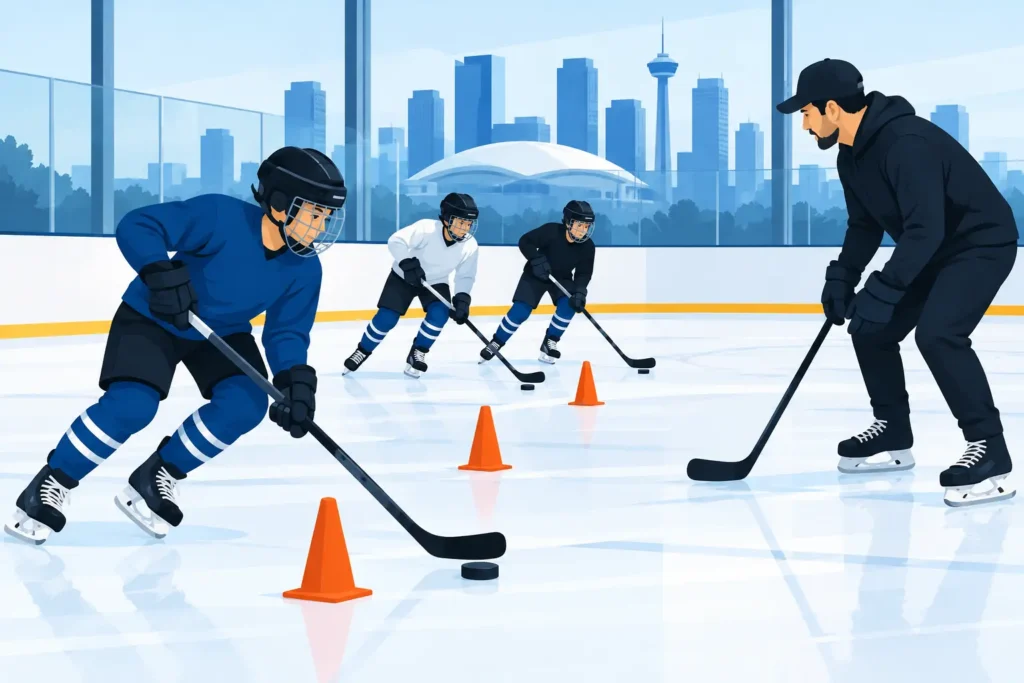
A player can finish a full team practice exhausted and still leave without one coach correcting the part of their stride that is costing them speed. That is the gap small group hockey training Edmonton families are looking to close. The right environment gives athletes more than extra work. It gives them precise repetitions, coaching they can apply immediately, and the confidence that comes from seeing a skill improve.
For youth players, development is rarely limited by effort alone. It is limited by how often a player receives individual feedback while performing the movement. A small-group format creates the space to identify the issue, demonstrate the correction, repeat it with purpose, and build a habit that carries onto the ice.
Why smaller groups create better hockey habits
Hockey is fast, but skill development should not be rushed. In a large practice, a player may get only a few meaningful touches or skating reps before the drill changes. Coaches are managing lines, systems, pace, and the needs of an entire roster. Team practice remains essential, but it cannot always provide the volume of personalized correction an athlete needs.
Small-group training changes the learning environment. Coaches can watch a player’s knee drive, ankle position, body angle, hand placement, puck position, or shooting release closely enough to coach the details. Instead of hearing a general instruction such as “get lower,” the athlete can learn what getting lower means in their own stride and how to repeat it correctly.
That level of attention matters because young players often compensate when a movement feels difficult. A player may generate speed by overusing the upper body, lose balance through the crossover, or shoot with the puck too far from the body. Those workarounds can produce a result in the moment, but they limit power and consistency over time. Early, patient correction helps athletes build cleaner movement patterns before inefficient habits become automatic.
The benefit is not only technical. A smaller setting gives athletes room to ask questions, make mistakes, and reset without feeling lost in a line. For a newer player, that can make skill training feel attainable rather than intimidating. For an advanced player, it creates the accountability needed to move beyond comfortable repetitions.
What small group hockey training in Edmonton should include
Not every small group delivers the same value. A low player count matters, but the coaching plan matters more. Players should know what they are working on, why it affects their game, and what successful execution looks like.
A focused session usually begins with an assessment of the athlete’s current movement. Coaches look for where force is being lost, where posture breaks down, or where timing affects the result. From there, the session should progress from demonstration to controlled repetitions and then to more demanding, game-relevant execution.
Skating mechanics that build usable speed
Speed is not simply about moving the legs faster. It comes from producing force in the right direction, recovering efficiently, and maintaining a powerful position through each stride. Off-ice skating treadmill work can make these details easier to see and coach because the athlete completes repeated strides without losing the coach’s attention to the flow of a drill.
Immediate video analysis adds another layer. When players can watch their stride on a 55-inch display right after performing it, verbal feedback becomes more concrete. They can see whether their hips are rising, whether they are fully extending through the stride, or whether their arms are supporting balance and acceleration. The goal is not to overload an athlete with every technical point at once. It is to identify the one or two changes that will create the biggest improvement.
For younger athletes, the emphasis may be balance, posture, and confidence. For older players and junior prospects, training may focus more closely on stride efficiency, acceleration mechanics, edge control, and sustaining power under fatigue. The principles are connected, but the coaching should match the player’s stage of development.
Shooting repetitions with a purpose
A player does not become a better shooter by simply firing pucks as fast as possible. Productive shooting training breaks down the mechanics behind a quick, accurate release: hand separation, load, puck position, weight transfer, follow-through, and the ability to change the release point.
A synthetic-ice shooting lane allows players to get meaningful puck repetitions without spending most of the session retrieving pucks or waiting for turns. That volume is valuable only when the quality stays high. If the shot is consistently pulled wide or lacks power, the coach needs to identify why before the athlete repeats the same mistake another 30 times.
Specialized shooting sessions, including Tim Turk Shooting Only instruction, can give players a clear framework for improving release mechanics and goal-scoring confidence. The strongest results come when athletes understand that shooting is not a trick or a one-day fix. It is a skill built through deliberate repetition and attention to detail.
Skills that connect to game situations
Off-ice development should support on-ice performance, not become disconnected from it. Players need to understand where a skill applies: accelerating to win a loose puck, creating separation through a crossover, getting a shot away before a defender closes, or receiving a pass in position to attack.
That is why training should include progression. An athlete may first practice a movement slowly enough to own the mechanics. Then the coach can add pace, movement, decision-making, or a more demanding puck-control element. The progression teaches players to use the skill instead of merely displaying it in a controlled setting.
The right group is not always the biggest challenge
Parents often assume their player should train with the fastest or most advanced group available. Sometimes that is the right fit. More often, the best group is one where the athlete is challenged without being overwhelmed and receives enough feedback to make progress.
A player who is still learning basic skating posture may need a different emphasis than a U15 player preparing for a higher level of competition. Age matters, but it is not the only factor. Skating foundation, confidence, attention span, goals, and willingness to accept coaching all matter too.
Training with a friend can be motivating, especially for younger players, as long as both athletes have compatible needs. A small group can create positive competition: players push the pace, celebrate improvement, and learn that disciplined work is part of hockey. But if one player requires constant technical instruction while another needs advanced progressions, separate sessions may produce better results.
This is where an athlete-centered approach makes a difference. The coach should adapt the drill, feedback, and pace without lowering the standard. Players need encouragement, but they also need honest direction. Confidence grows when an athlete understands that a correction is not criticism. It is a path to better performance.
How parents can evaluate a training environment
Before committing to a program, look beyond the word “small.” Ask how many athletes are on the floor, how feedback is delivered, and whether coaches can explain the purpose behind each drill. A productive environment is organized, active, and demanding, but it should never feel chaotic.
Families should also look for measurable signs of progress. That might be cleaner skating posture, more balance through turns, a faster shot release, greater consistency hitting targets, or more confidence in games. Progress is not always a dramatic overnight jump. Often, it shows up first in the player’s ability to recognize and correct their own habits.
Facility design matters as well. A purpose-built setting with a skating treadmill, video tools, a synthetic-ice shooting lane, and a skills area gives coaches more ways to isolate and train specific details. At Pro Stride Hockey, the 3,600-square-foot training facility is designed to keep athletes moving while giving coaches the visibility needed for real-time correction.
Turning training time into on-ice confidence
The most effective small-group sessions give players a simple focus to carry into their next practice or game. It may be driving through the full stride, keeping the chest over the puck on a release, or arriving in a better athletic position before making a play. One clear cue is easier to apply under pressure than a long list of reminders.
Consistency also matters more than occasional intensity. One strong session can reveal what needs work, but recurring training gives the body time to learn, adapt, and retain the movement. Athletes who commit to the process begin to trust their mechanics. That trust shows up when the game speeds up.
The best next step for a player is not to chase every new drill. It is to train in a setting where coaching is specific, repetitions have a purpose, and hard work is connected to a skill they can use when the puck drops.