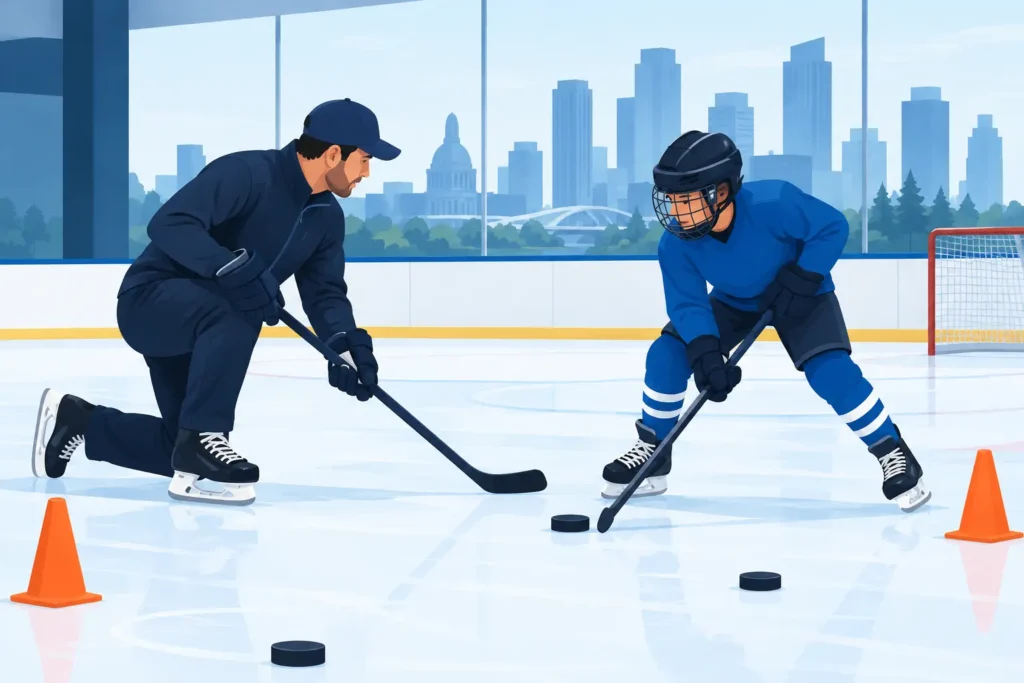
A player can work hard at every team practice and still leave with the same stride inefficiency, rushed release, or missed shooting detail. That is where private hockey lessons Edmonton families can rely on make a real difference. Individualized coaching creates the time and space to identify one athlete’s limiting factor, correct it with purpose, and repeat the new movement until it holds up under pressure.
For young players, that might mean learning how to generate power without standing too tall. For an older athlete, it may be cleaning up a release that looks good in a shooting lane but breaks down when the puck arrives off the heel of the stick. Progress is not about collecting drills. It is about coaching the details that create faster, more confident hockey.
Why private coaching changes development
Team practices matter. They teach game awareness, compete habits, systems, and the ability to make decisions around other players. But even a well-run team practice has limited time for individual correction. A coach managing a full roster cannot stop every rep to adjust knee bend, explain edge pressure, or rebuild a player’s hand position on the puck.
Private instruction fills that gap. It gives an athlete focused repetitions and immediate feedback without waiting through long lines or trying to apply a generic cue to a personal movement pattern. The goal is not to replace team hockey. It is to give players the technical foundation that lets them get more from their team practices and games.
At Pro Stride Hockey, private sessions are built around a 2:1 player-to-coach ratio, with no more than four athletes in a session. That coaching capacity matters. Players are seen, corrected, and encouraged in real time rather than being left to repeat the same mistake at a higher volume.
What private hockey lessons in Edmonton should address
The best program for a player depends on age, experience, physical development, and the area that will create the biggest on-ice return. A beginner may need balance and body control before chasing top-end speed. A competitive U15 player may need more explosive starts, better hip position, or a release that can beat a goaltender from a limited scoring window.
A productive private session starts with observation. Coaches should watch how the athlete moves, not simply hand out a drill. Is the stride recovering under the body? Is the player creating force through the ice or reaching behind themselves? Does the shot transfer weight efficiently? Can the athlete receive a pass cleanly before shooting?
Once the issue is clear, training becomes more specific. Instead of telling a player to “skate harder,” a coach can demonstrate the exact body position, create a drill that isolates the movement, and build repetitions that make the correction feel natural.
Skating mechanics and speed
Skating is the engine behind every other hockey skill. A player with an efficient stride can arrive first, maintain position through contact, and preserve energy late in a shift. Yet speed is not just about moving the legs faster. It comes from posture, hip mobility, knee and ankle angles, edge control, force application, and recovery.
Off-ice skating treadmill training gives athletes a valuable opportunity to slow the process down and study it. Players can work on their stride in a controlled setting while a coach delivers precise instruction. Video displayed immediately on a 55-inch screen helps athletes connect a verbal cue with what their body is actually doing.
That visual feedback can be especially useful for players who understand a correction but cannot yet feel it. When they see an upright torso, a short extension, or an inefficient recovery, the target becomes clear. Then the work is simple, even if it is not easy: make the adjustment and repeat it with intent.
Shooting mechanics that transfer to games
Shooting more pucks helps, but only if the athlete is practicing useful mechanics. A player who repeats a poor sequence can become more comfortable with a flaw rather than more effective as a scorer.
Private shooting instruction focuses on the pieces behind a faster, more deceptive release: puck placement, hand separation, loading the stick, weight transfer, lower-body stability, and follow-through. It also challenges athletes to shoot in different positions, off movement, and after receiving the puck. Game scoring rarely gives players the perfect setup.
A synthetic-ice shooting lane and skills area allow for high-quality repetition without wasting time retrieving pucks or waiting for ice availability. For athletes looking to focus entirely on their release, specialized Tim Turk Shooting Only sessions provide an opportunity to train shooting details with a clear purpose.
The value of immediate video feedback
Players often need more than a verbal correction. They need to understand why the correction matters and what success looks like. Video analysis shortens that learning curve.
A coach might show a player that their skating extension finishes too early, reducing power into the ice. They may compare a rushed wrist shot with a rep where the hands stay connected to the puck longer. Seeing the difference gives athletes ownership of their development. They are not just being told what to change. They can recognize the change themselves.
Video should support coaching, not replace it. A screen cannot build confidence, assess effort, or adapt a drill when a young player is frustrated. The strongest sessions combine technology with patient instruction, clear demonstrations, and a coach who knows when to challenge and when to simplify.
Choosing the right private session format
One-hour private sessions work well because they provide enough time to assess, teach, repeat, and reinforce without asking young athletes to train past the point of quality. Still, the ideal frequency depends on the player and the goal.
An athlete preparing for tryouts may benefit from a concentrated training block. A player rebuilding mechanics after a growth spurt or time away from the game may need regular sessions that prioritize movement quality. A motivated younger player might progress best with occasional instruction paired with simple at-home practice between sessions.
Parents should look for a program that explains what the athlete is working on and why. Measurable progress does not always mean a stopwatch result after one lesson. It can mean a player holds a better position on the treadmill, produces more consistent puck contact, or carries new confidence into a weekend game. Those changes create the foundation for bigger performance gains.
How players get more from their training
The athlete who improves fastest is not necessarily the most advanced player in the room. It is usually the one who arrives ready to learn, listens carefully, and treats each repetition as a chance to improve one specific detail.
Players should bring a growth mindset to private coaching. Some adjustments feel awkward before they feel powerful. A new stride position can feel slower at first. A rebuilt shooting motion may temporarily reduce comfort while the body learns a better sequence. That is normal. Quality coaching keeps the athlete moving forward without rushing the process.
Parents can support development by asking simple, useful questions after a session: What did you work on? What felt different? What is one thing you can practice this week? The conversation should reinforce effort and learning, not turn every session into a test.
A stronger player starts with a clear plan
Private hockey development is most effective when it gives an athlete a clear next step. The player who needs more power should know which skating position to train. The player who wants a quicker release should understand the mechanical detail holding it back. The player working toward a higher level should leave with confidence built on real, repeatable skill.
The right training environment makes improvement visible, challenging, and attainable. When every rep has a purpose and every correction is matched to the athlete, players build more than speed or shot power. They build the belief that disciplined work can change their game.