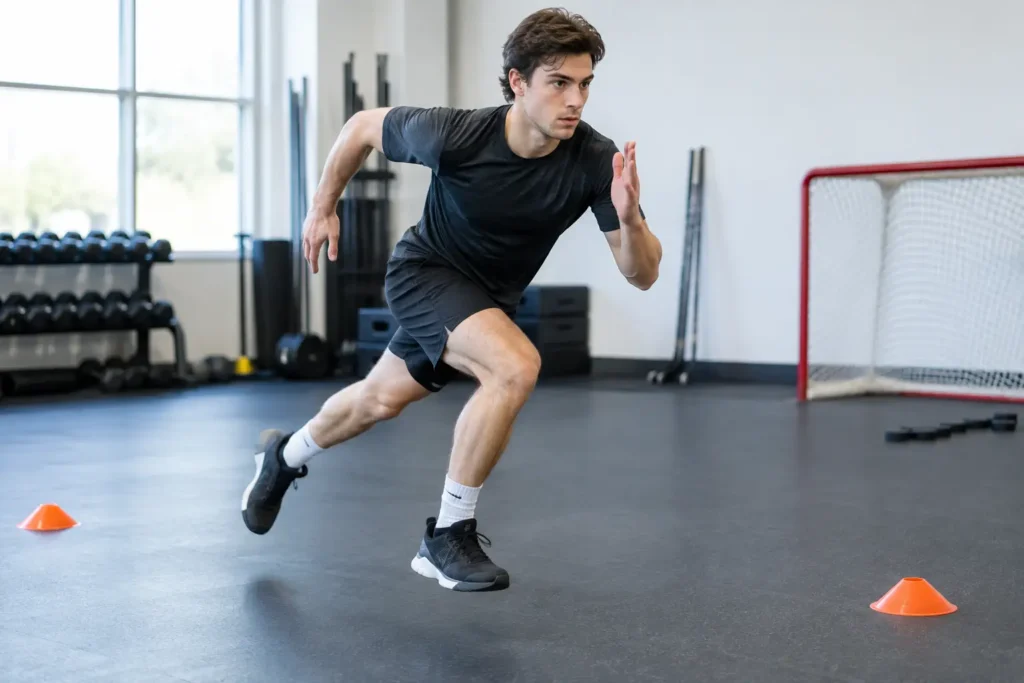
A faster hockey stride is not just about moving your feet quicker. It is about creating force into the ice, recovering efficiently, and staying balanced enough to use that speed in a game. If you are asking how to improve hockey stride, start by looking beyond effort. Most players can work hard. The players who separate themselves learn how to apply that effort through clean mechanics.
For young athletes, stride development can be one of the highest-value areas of training. Better skating improves puck races, defensive recoveries, transitions, shot preparation, and confidence with the puck. It also gives players more options. When you trust your feet, you can play with your head up and make better decisions under pressure.
Build Power From the Edge, Not the Toe
A powerful stride begins with the blade. Many developing players push primarily off the toe or allow their skate to slide sideways without creating meaningful pressure. That produces a busy-looking stride, but not much speed.
The goal is to load the inside edge of the pushing skate, then drive through the full blade as the leg extends out and slightly back. Think of the skate blade as your connection to the ice. If that connection is weak or rushed, the stride leaks power.
A player should feel pressure build through the hip, knee, ankle, and blade before releasing into the next stride. The upper body stays stable while the lower body does the work. If the shoulders are swinging side to side or the hands are reaching across the body, energy is being wasted.
For younger players, this often starts with simple edge-control work. Slow, deliberate pushes are more valuable than racing through a drill with poor posture. Advanced players need the same foundation, but they must learn to apply it at game speed, under fatigue, and while handling a puck.
Get Low Enough to Create Force
One of the clearest differences between an efficient stride and an inefficient one is knee bend. A player who skates too upright has limited room to extend the leg and generate power. Their first few steps may look quick, but they usually lose speed as the distance increases.
A strong skating stance includes bent knees, a forward chest angle, hips loaded behind the knees, and weight centered over the blades. The athlete should feel athletic, not folded over. Looking down at the ice is not the answer. Keep the eyes up and let the legs do the work underneath the body.
Depth matters, but it depends on the player’s age, strength, mobility, and skating situation. A deep stance is useful for acceleration, turns, and battling for position. In a full-speed crossover or open-ice rush, the body position may rise slightly. The key is control. Players should be able to move through different skating positions without losing balance or edge pressure.
Off-ice strength supports this position. Strong glutes, hips, hamstrings, and core muscles help an athlete hold a loaded skating posture longer. But strength alone does not fix a stride. A player still needs repetition and coaching to transfer that strength into the correct movement pattern.
Finish Every Push and Recover Cleanly
A common stride issue is cutting the push short. The player pushes, brings the foot back too early, and starts the next stride before the first one has delivered full power. This creates extra steps and limits top-end speed.
Focus on full extension. The pushing leg should finish long before it recovers under the body. The recovery skate should return low and close to the ice, not swing high behind the player. A low recovery is quicker, more efficient, and keeps the athlete ready to place the blade back on the ice for the next push.
The return path matters as much as the push. When a skate recovers wide, the player often loses balance and has to correct before the next stride. When it returns directly under the hips, the player can reload immediately.
A useful coaching cue is: push wide, recover narrow. It is simple enough for a younger player to understand and precise enough to help an experienced athlete clean up inefficient movement.
Use Drills That Expose Technical Gaps
The best skating drills do not just make a player tired. They reveal where technique breaks down. Start slowly enough that the athlete can feel the edge, posture, and full extension. Then increase speed only when the movement stays clean.
These four drill categories build a stronger stride:
- One-leg edge pushes: Glide on one skate and use the other leg to create controlled, full pushes. This teaches balance and makes it harder to hide weak edge pressure.
- Wide-stride power drills: Use a lower stance and exaggerated lateral pushes to develop full extension and hip drive. Quality matters more than distance covered.
- Acceleration starts: Practice the first three to five strides from different positions. Players should drive forward with purpose rather than standing up after the first push.
- Resisted skating: Light resistance can help athletes feel what it means to apply force into the ice. Resistance should be controlled, not so heavy that it changes mechanics.
Puck handling can be added once the skating pattern is stable. If a player loses posture every time a puck is introduced, slow the drill down. The goal is not to separate skating from hockey. The goal is to build skating mechanics that hold up when the game gets fast.
Train Acceleration and Top Speed Differently
Acceleration and top speed are connected, but they are not identical skills. Acceleration is the ability to create speed quickly, often from a stop, a turn, or a battle along the boards. It demands a forward body angle, powerful first pushes, and aggressive edge pressure.
Top speed requires a more efficient stride cycle. Players need full extension, a quiet upper body, clean recovery, and the ability to keep producing force without bouncing up and down. An athlete who wins the first three steps may still get caught if their full-speed stride is short and inefficient.
Training should include both. A player who needs more jump in puck races should spend extra time on starts and first-step mechanics. A player who gets separation but cannot maintain it should focus on stride length, recovery path, and skating endurance. Personalized coaching matters because the visible problem is not always the real problem.
Let Video Show What the Player Cannot Feel
Skating happens fast. Players often believe they are getting low, finishing their stride, or returning their skate under the body when video shows something different. That is not a failure. It is a useful starting point.
Immediate video feedback helps athletes connect a coaching cue with what their body is actually doing. A player may see that their pushing foot is turning out too early, their torso is rising between strides, or their arms are creating unnecessary rotation. Once the issue is clear, the correction becomes more specific.
At Pro Stride Hockey, skating treadmill training and immediate video analysis give athletes the chance to repeat a movement, see it, adjust it, and repeat it again. That cycle is especially valuable in small coaching groups, where an instructor can identify the detail holding a player back instead of giving every athlete the same generic drill.
Avoid Chasing Speed Before You Own the Pattern
Trying to skate faster with an inefficient stride usually reinforces the problem. Players begin reaching, overstriding, standing up, or spinning their feet without gaining meaningful speed. More effort does not always mean more power.
Build the pattern first. Train the correct body position, edge pressure, extension, and recovery with enough repetition that the movement becomes dependable. Then challenge it with starts, puck control, lateral movement, decision-making, and fatigue.
Parents can support this process by looking for progress beyond a stopwatch. Faster times matter, but so do stronger posture, smoother edges, fewer wasted steps, and greater confidence in game situations. A player who begins attacking loose pucks, carrying speed through the neutral zone, or recovering defensively with control is showing real stride development.
The next shift is the best place to apply what you train. Focus on one stride detail, commit to it with purpose, and let disciplined repetitions turn better mechanics into game-changing speed.