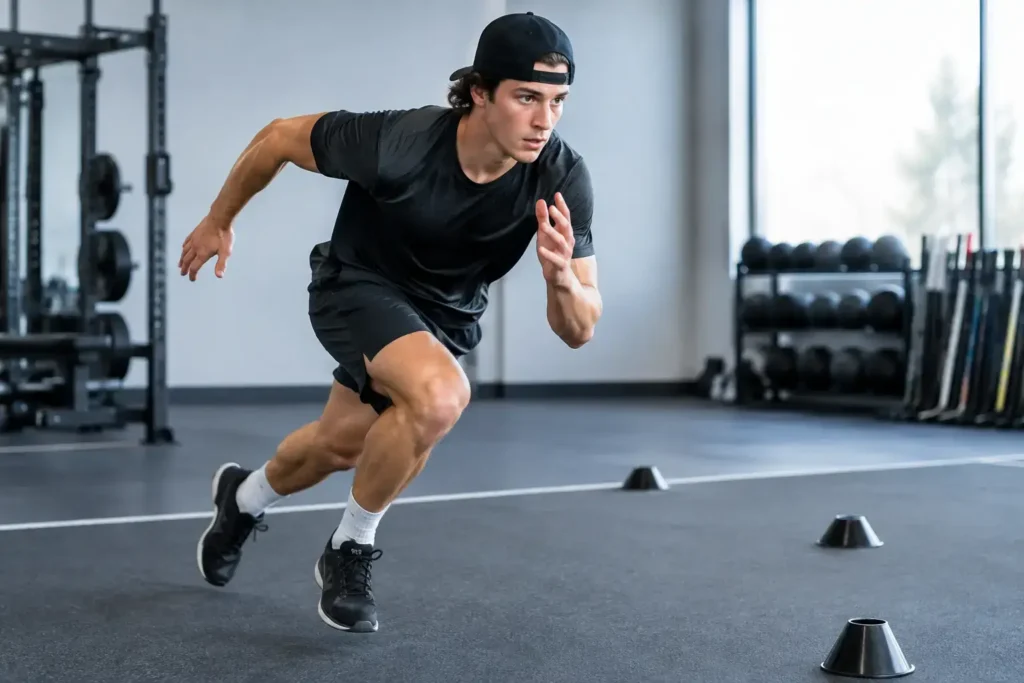
A player can work hard for an entire shift and still lose the race to a loose puck by half a stride. That first three-step burst is often the difference between creating an odd-man rush and chasing the play. Learning how to train hockey explosiveness means building the ability to apply force quickly, in the positions hockey actually demands.
Explosiveness is not simply jumping higher or lifting heavier. For hockey players, it is the combination of skating mechanics, lower-body strength, rotational control, balance, and timing. The goal is to produce more force into the ice without losing body position, puck control, or the ability to react to the next play.
What Hockey Explosiveness Looks Like on the Ice
Explosive players do not always look like they are working the hardest. Their first steps are efficient. Their hips stay loaded, their edges grip the ice, and their upper body remains quiet enough to scan the play and handle the puck.
On the ice, explosiveness shows up when a player accelerates out of a stop, wins a battle along the wall, changes direction to defend a cutback, or gets a quick release off before a goalie can set. A powerful stride matters, but the ability to repeat short, high-quality efforts matters just as much.
That distinction is important for young athletes. Long conditioning sessions can build effort and general fitness, but they do not automatically improve first-step speed. Explosive training should be focused, technically sound, and performed with enough recovery that each repetition stays sharp.
Start With Skating Mechanics
The fastest route to more explosive skating is often better technique. A player who pushes straight back with a shallow knee bend will struggle to generate force, regardless of how strong they are in the gym. Hockey acceleration begins with the angles created at the ankle, knee, and hip.
In the first few strides, athletes need a low body position, a strong forward lean, and a full extension through the skating leg. The push should travel through the edge, not just through the toes. Each stride needs to move the body forward rather than bouncing it upward.
A useful coaching cue is to think about driving the ice away. Players should feel pressure build through the whole blade before extending the leg. If they rush the stride or stand up too early, they lose the leverage needed for a powerful start.
Video feedback is especially valuable here. A player may feel low and aggressive while actually skating too upright, overreaching, or allowing the knees to collapse inward. Immediate review helps athletes connect what they feel with what their stride is doing. At Pro Stride Hockey, that connection can be developed through skating treadmill work and real-time video analysis, where technique can be corrected before poor habits become automatic.
Train Both Forward and Lateral Power
Hockey is not a straight-line sport. Players need forward acceleration, but they also need the lateral force to crossover, stop, start, and defend. Include work that reflects both demands.
Forward starts should focus on the first three to five strides. Lateral starts can begin from an athletic stance, with the player pushing hard off one leg and accelerating sideways or into a crossover. Stop-and-start drills are also valuable because they teach players to absorb force before producing it again.
Quality matters more than volume. Six strong three-stride starts with full recovery will develop more speed than twenty tired starts where stride length, posture, and edge control fall apart.
Build Strength That Transfers to Hockey
Strength gives an athlete more force to use, but only when it is trained with good movement patterns. For younger players, bodyweight control is the starting point. They need to squat, hinge, brace, land, and balance before loading movements heavily.
Single-leg strength is particularly valuable because skating is a series of powerful one-leg pushes. Split squats, step-ups, single-leg Romanian deadlifts, and controlled lateral lunges can help players build strength while improving hip and knee control. The objective is not to chase a number on a bar. It is to create stable, powerful positions that transfer to the ice.
Athletes who are ready for supervised resistance training can benefit from squats, trap-bar deadlifts, and sled pushes. These movements can develop lower-body force without trying to turn a hockey player into a powerlifter. Proper coaching, age-appropriate loading, and consistent technique should always come first.
Core training also matters, although endless sit-ups are not the answer. Hockey players need to resist unwanted rotation while transferring force from the legs through the torso and into the stick. Planks, carries, dead bugs, and controlled rotational exercises build the connection needed for stronger strides and harder, more stable shots.
Use Plyometrics to Train Fast Force Production
Plyometrics teach the body to produce force quickly. They are useful, but they should be introduced progressively. A player who cannot control a basic landing should not be performing repeated high-box jumps.
Start with low-impact jumping and landing drills. Snap downs teach athletes to land with bent knees and hips. Broad jumps build horizontal power that relates well to acceleration. Lateral bounds develop the side-to-side force needed for skating, while pogo hops can improve ankle stiffness and quickness when performed with control.
The landing is as important as the jump. Players should land quietly, keep their knees tracking over their toes, and hold the position briefly before the next repetition. If a young athlete lands loudly, collapses inward, or loses balance, reduce the difficulty and rebuild the movement.
Plyometric sessions should be short and fresh. Two or three exercises, performed for a few quality sets, are enough for most youth players. Do them before conditioning or heavy fatigue work, not after it.
Turn Explosive Work Into a Weekly Plan
The best program is the one a player can complete consistently around practices, games, school, and recovery. Most developing players do not need daily explosive training. Two focused off-ice sessions per week, paired with intentional skating work, can create meaningful progress.
A practical week might include one strength-focused session with single-leg work, core control, and a few jumps. A second session can emphasize acceleration drills, lateral bounds, and movement quality. On-ice or treadmill sessions should then reinforce low starts, first-step mechanics, edge pressure, and powerful crossovers.
Avoid stacking hard lower-body work immediately before a game. A player may complete the workout, but heavy fatigue can reduce skating quality and increase the chance that poor movement patterns show up on the ice. If the schedule is crowded, shorten the session rather than forcing more volume.
For athletes in season, maintenance is often the right goal. For athletes in the offseason, there is more room to develop strength and movement capacity. The training plan should change based on age, game schedule, training history, and whether the player is rebuilding after injury.
Do Not Train Speed While Exhausted
There is a place for conditioning in hockey, but it is not the same as explosiveness training. If every sprint, jump, and skating start is performed while exhausted, the athlete practices moving slowly. That can be useful for building resilience, but it will not maximize first-step power.
Give explosive drills enough rest. Short acceleration efforts may need 30 to 60 seconds between repetitions, while harder jumps or resisted sprints may need more. Athletes should finish a session feeling that they produced quality work, not that they survived it.
Sleep, nutrition, and recovery are part of the program as well. Young players grow, attend school, play multiple sports, and often have demanding hockey schedules. Better results come from a sustainable plan, not from adding more work every day.
Measure the Details That Matter
Parents and players naturally want to see progress. The most useful markers are simple and repeatable: time over a short skating distance, number of powerful strides to reach speed, jump quality, single-leg control, and video comparisons of skating posture.
Progress will not always appear as a dramatic change in one week. Often, it first shows up in cleaner starts, better balance through contact, or the confidence to attack a puck race. Those details build game speed over time.
Explosiveness is earned through focused repetitions, not random intensity. Train strong positions, move with purpose, recover well, and keep bringing better mechanics back to the ice. The next loose puck will give the player a chance to show the difference.