Last Updated: November 24, 2026
Quick Summary
Hockey lessons are worth it when the program matches your player’s stage, because structured sessions give young players repeated, focused reps on skating and shooting that busy team practices rarely have time for. Check the player-to-coach ratio, session structure, and how coaches measure progress before you register.
- Pro Stride Hockey caps sessions at four players and offers a 2:1 player-to-coach ratio in one-on-one sessions.
- Three short off-ice sessions of 15-20 minutes a week beat one long weekend session for reinforcing movement patterns.
- The first month of lessons typically follows a four-week arc: assessment, isolated correction, adding pace, then check and reset.
- Judge progress by the specific skill the coach is correcting, not by goals, points, or teammate comparisons.
- A player is ready to progress when balance, stride, release, and head-up puck control are consistent.
Table of Contents
- How to Choose Hockey Lessons That Fit Your Player
- Skating Treadmill Training: Off-Ice Work That Transfers On-Ice
- Private Hockey Coaching Benefits for Youth and Ringette Players
- Off-Ice Hockey Training Exercises to Do Between Lessons
- Hockey Shooting Technique Drills for Pucks and Rings
- What to Expect in Your First Weeks of Hockey Lessons
- Book a Session and See the Difference
- Frequently Asked Questions
How to Choose Hockey Lessons That Fit Your Player
Parents ask us one question more than any other: are hockey lessons actually worth the time and money? Our answer is that the value depends largely on whether the program fits your player’s stage. A structured learn hockey lessons program gives young players repeated, focused reps on skating and shooting that a busy team practice rarely has time for. Below, we break down how to judge a program before you register.
Match the Program to Your Player’s Stage
A first-year skater and a competitive player need very different things. Beginners need balance, edge control, and confidence with a puck. Competitive players need stride efficiency, shooting power, and decision-making under pressure. Ask any provider how they group players, and be wary of one-size-fits-all answers. Small group sizes matter here: Pro Stride Hockey caps sessions at four players and offers a 2:1 player-to-coach ratio in one-on-one sessions.
Questions to Ask Before You Register
Before you commit, get clear answers on these points:
- What is the player-to-coach ratio, and how large are groups?
- How is the session structured, and how much time is spent on skating versus shooting?
- What is the session length and how many weeks does the program run?
If a provider hesitates on ratios or progress tracking, keep looking. For a broader framework on evaluating any academy, read how to choose a hockey academy before you register.
Skating Treadmill Training: Off-Ice Work That Transfers On-Ice
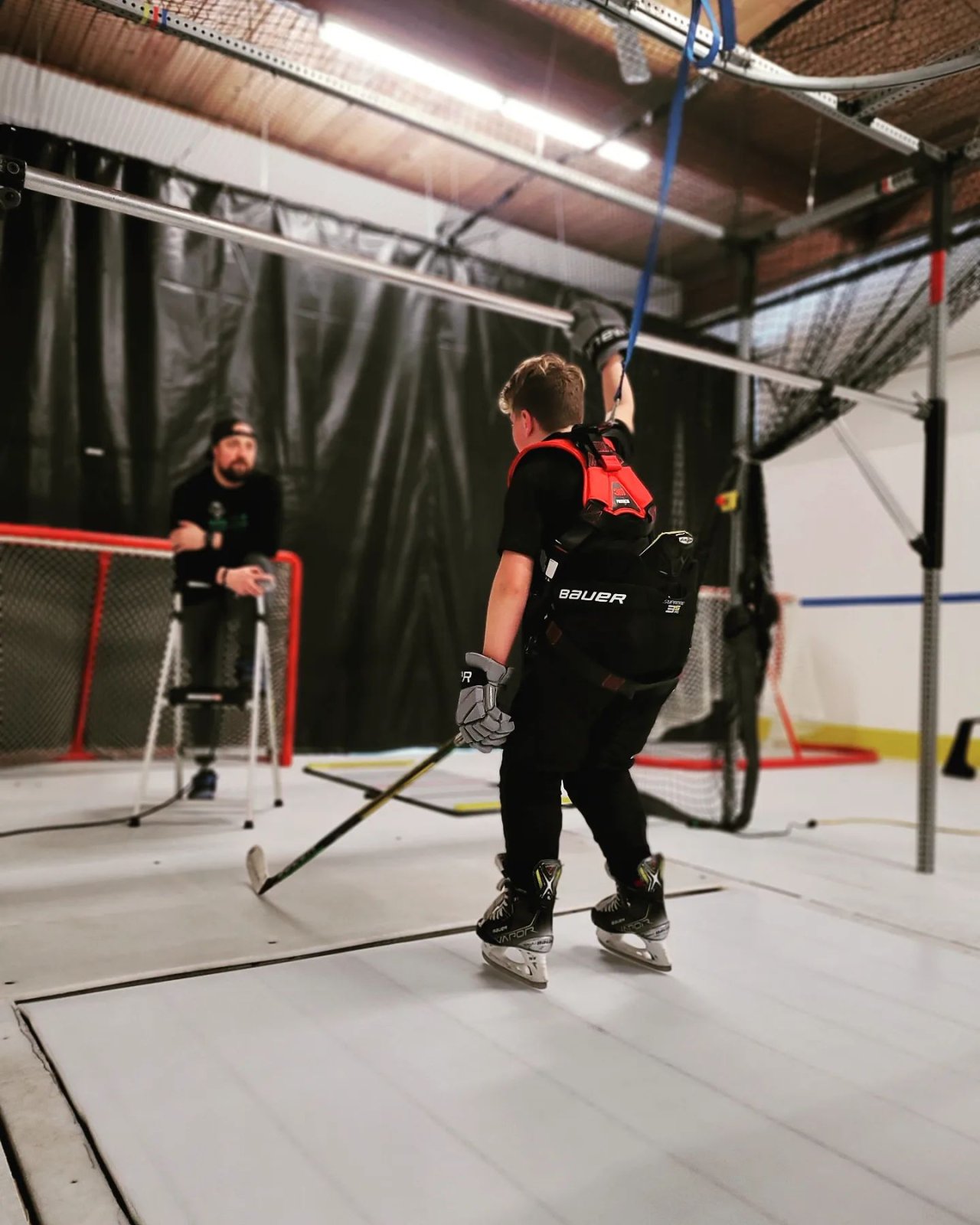
Skating treadmill training is off-ice stride work performed on a motorized treadmill built for skates, letting a player repeat the same stride motion with a coach correcting technique.
What Stride Work on a Treadmill Feels Like
One of our clients, Lindsay Axelson, put it simply: she had never been on a skate treadmill before, and our coach taught her a lot about stride efficiency. If you are researching treadmill programs, our guide on what to look for in a skating treadmill academy covers the details that separate serious facilities from casual ones.
Private Hockey Coaching Benefits for Youth and Ringette Players
Private hockey coaching benefits come down to the individual attention a player receives, since a small-ratio session gives each player direct coaching.
That matters for ringette players too. Ringette shooting uses a different release and follow-through than a puck shot, and players need ring-specific reps to build a reliable shot. To understand how small ratios change the coaching dynamic, see our breakdown of the benefits of 2 to 1 hockey coaching.
Off-Ice Hockey Training Exercises to Do Between Lessons
Off-ice hockey training exercises keep skills sharp between sessions, and most need very little space. Consistency beats intensity here: three short sessions of 15-20 minutes across a week do more for stride and shooting than one long weekend session, because the movement patterns get reinforced often enough to stick. The goal between lessons is not to learn something new, it is to rehearse what the coach already corrected so the next session starts from a higher baseline.
A Simple Weekly Between-Session Plan
A workable pattern for a youth player is three off-ice days per week, each built around one focus so the player is not trying to fix everything at once:
- Day 1, Stickhandling and puck control (15 minutes): 5 minutes of stationary puck control moving the puck wide of the feet and back, then 5 minutes of walking or slow-jogging puck carries, then 5 minutes of figure-eight patterns around two objects. Keep the head up as much as possible; if the player has to stare down, slow the pace rather than speed it up.
- Day 2, Shooting reps (15-20 minutes): 20-30 wrist shots against a net or shooting pad, split into three sets. Set one focuses on quick release (catch and release in one motion), set two on accuracy toward a target, set three on weight transfer. Ringette players run the same structure with a ring, adjusting the release point and follow-through for the ring’s flight rather than a puck’s roll.
- Day 3, Balance and dryland stride (15 minutes): single-leg holds (three sets of 20-30 seconds per leg), lateral hops (three sets of 8-10 per side), walking lunges, and lateral bounds that mimic the push-and-recover pattern of a skating stride. These build the stability that edge control depends on.
Making the Space Work
Most of this fits in a driveway, basement, or garage. A shooting pad protects the stick blade from concrete and gives a consistent surface for puck or ring reps; a tarp or net behind the target saves the walls. For balance and stride work, a clear 2-by-3-meter patch of floor is enough. Ringette players should use a ring-specific stick and a ring rather than a puck for shooting reps, since the release mechanics differ.
Common Mistakes to Avoid
A common mistake is practicing only the fun part, shooting, and skipping balance work. The players who improve fastest do both, because a stable base is what lets a shot stay accurate when a player is moving.
Watch out: practicing a flawed movement hundreds of times between lessons cements the error rather than fixing it. If a player is unsure whether their stride or release matches what the coach taught, keep between-session reps light and confirm the technique at the next lesson before ramping volume.
Tying It Back to Lessons
Between-session work is most useful when it targets the specific correction from the last lesson. Ask the coach what single thing the player should rehearse at home, and keep the home plan to that one focus plus general balance. Players who arrive at their next session having rehearsed the correction tend to move through fundamentals faster, which is why the between-session habit matters as much as the lesson itself.
Hockey Shooting Technique Drills for Pucks and Rings
Hockey shooting technique drills should teach the mechanics of a quick, accurate release before adding power. The best youth shooters load the stick, snap the wrists, and follow through toward the target, and they practice it thousands of times.
Our specialized shooting lane facility gives players a dedicated space to practice shooting technique. If you want ring-specific ideas to use at home, our list of ringette shooting drills you can do off the ice gives you a full practice plan.
What to Expect in Your First Weeks of Hockey Lessons
The first weeks of hockey lessons focus on assessment and fundamentals, not instant results. What separates a productive start from a frustrating one is whether the player and parent know what progress should look like week to week, so here is a realistic picture, plus the signals that tell you when a player is ready to move up.
A Typical Four-Week Arc
Most practitioners find the first month follows a predictable shape, though every player moves at their own pace:
- Week 1, Assessment: The coach watches the player skate (or work the skating treadmill) and shoot, then names the single biggest inefficiency to address first. For a beginner that is often balance and edge control; for a returning player it is often stride efficiency or release speed.
- Week 2, Isolated correction: The player repeats one movement slowly with feedback, for example, loading and pushing through a full stride on the treadmill, or catching and releasing a shot in one motion. Reps are deliberate, not fast.
- Week 3, Adding pace: Once the movement holds at slow speed, the coach adds speed or a decision element (shoot on the move, change direction mid-stride) and watches whether the technique survives.
What Progress Actually Looks Like
Progress in the first weeks is usually visible in small, specific ways rather than in goals or points: a player holds an edge through a turn without wobbling, gets a shot off a half-second faster, or keeps their head up while carrying a puck. Parents should expect a mix of instruction, drill work, and feedback, and some discomfort, because pushing a player slightly past their comfort zone is how stride and shooting change.
Signs a Player Is Ready for the Next Level
Rather than guessing, look for concrete readiness markers. A player is generally ready to progress when they can:
- Hold a stable single-leg balance and control edges through turns without falling repeatedly.
- Complete a full stride with a consistent push-and-recover pattern at speed.
- Get a shot away with a repeatable release and reasonable accuracy toward a target.
When most of these are consistent, the next step is usually more speed, more decision-making under pressure, or a smaller player-to-coach ratio to sharpen technique, not simply more of the same introductory drills.
How to Track Progress Between Lessons
Ask the coach what the current focus is and what a good rep looks like, then note it down. Families often ask how often to train; our guidance on hockey training frequency helps you plan a weekly schedule that fits your season, and pairing that schedule with a clear focus from each lesson is what turns attendance into improvement.
Watch out: judging progress by goals, points, or how a player compares to teammates hides whether the underlying stride and shooting mechanics are actually improving. Judge by the specific skill the coach is correcting, and let results follow.
Here is the four-week arc most players follow at the start of lessons.
| Week | Focus | What happens |
|---|---|---|
| Week 1 | Assessment | Coach watches skating and shooting, names biggest inefficiency |
| Week 2 | Isolated correction | One movement repeated slowly with feedback |
| Week 3 | Adding pace | Coach adds speed or a decision element |
| Week 4 | Check and reset | Compared against week-1 baseline, next focus set |
Book a Session and See the Difference
The gap between a player who practices with purpose and one who just plays is visible within a season. If your player is ready to work on stride technique on the skating treadmill and learn to shoot a puck or ring the right way, we can help. Pro Stride Hockey offers a 2:1 player-to-coach ratio in one-on-one sessions, a maximum of four players per session, comprehensive video analysis, and a specialized shooting lane facility.
Frequently Asked Questions
At what age should a child start hockey lessons?
Most children are ready for structured hockey lessons around ages four to six, once they can balance on skates and follow simple instructions. The focus at that age should be skating skills, edge control, and having fun, not competition. Older beginners and adults can start at any age too. Look for a program that groups players by skill level rather than age alone, so your child works with peers at a similar stage.
How do skating treadmills improve hockey performance?
A skating treadmill lets a player repeat the stride hundreds of times with a coach watching every rep. That repetition builds muscle memory for edge control, stride length, and balance far faster than scattered on-ice drills. Coaches can slow the belt down to isolate a flaw, then speed it up to test the fix.
What equipment is required for introductory hockey lessons?
At minimum, players need skates, a helmet with a cage, gloves, shin pads, hockey pants, elbow pads, and a stick. A properly fitted jock or jill strap is essential. For ringette players, add a ringette stick and the required facial protection. Check that skates fit snugly with no heel lift, and replace any cracked or loose protective gear before the first session. Many programs let you confirm equipment needs when you register.
Are private hockey lessons worth the investment for youth players?
Private hockey coaching benefits show up fastest when a player has one specific skill to fix, like a short stride or an inconsistent shot release. Small-group formats keep the cost lower while still giving each player regular feedback. Ask any program how many players share a coach and how progress is tracked before you commit.
