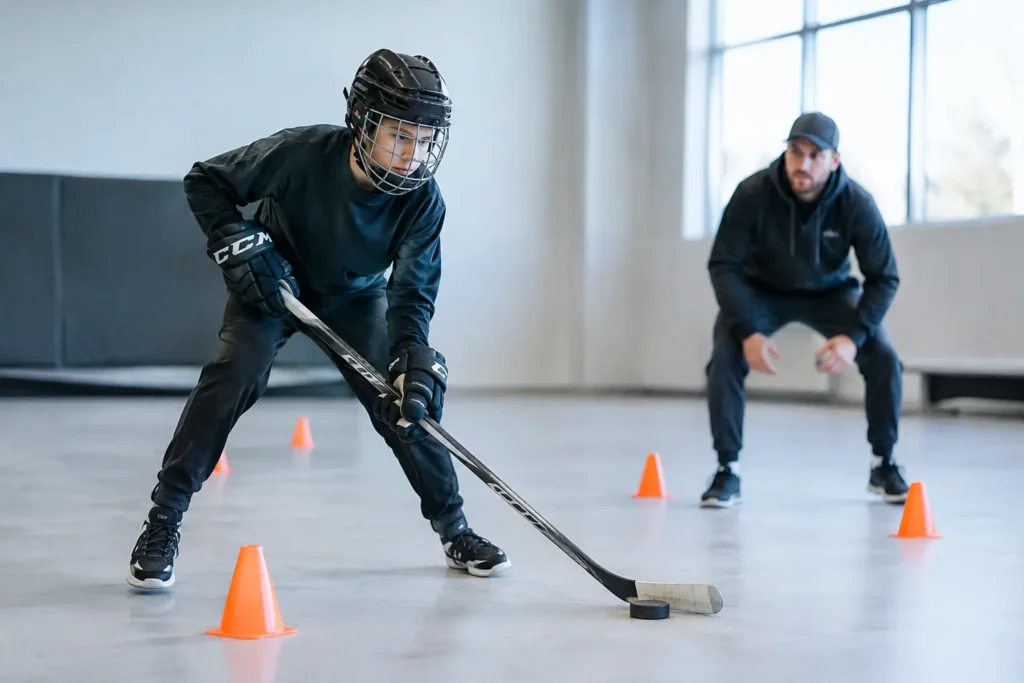
A strong hockey coaching review is not just a five-star rating or a comment that says a coach was great with kids. For a hockey family investing time, travel, and money into development, the review should answer a more useful question: Did the athlete receive instruction that created visible, repeatable improvement?
The best feedback reveals what happened in the session, how the coach responded to the player, and whether the training translated into more confidence and better execution. That matters whether your athlete is learning the foundations of a powerful stride or preparing for the pace and pressure of higher-level hockey.
What a hockey coaching review should measure
A meaningful review looks beyond whether a player had fun. Enjoyment matters, especially for young athletes, but productive training should also have a purpose. Players need to understand what they are working on, receive corrections they can apply immediately, and leave with a clearer sense of how to improve.
Parents should look for comments that describe specific outcomes. A review that mentions better knee bend, stronger edge control, a cleaner shooting release, or more confidence after returning from an injury is more informative than broad praise. Specifics show that the coach noticed the athlete as an individual rather than running the same generic session for everyone.
Progress over applause
Encouragement is part of great coaching, but encouragement without technical direction only goes so far. A quality coach can recognize effort while still identifying the next detail that needs attention. For skating, that might be hip position, ankle flexion, stride recovery, or arm drive. For shooting, it could be puck placement, weight transfer, hand position, or follow-through.
A useful review often describes this balance. The player felt supported, but they were also challenged. They received a correction, practiced it through focused repetitions, and began to feel the difference. That is how athletes build confidence that holds up when a game gets fast.
Real feedback in real time
The timing of feedback is a major difference between supervised practice and individualized skill development. A player can repeat a poor movement pattern hundreds of times if no one stops it early. The right correction, delivered clearly and patiently, can prevent that habit from becoming harder to change.
Look for reviews that mention coaches demonstrating a skill, explaining why it matters, and adjusting the instruction when an athlete does not get it right away. Every player learns differently. One athlete may respond to a visual demonstration, while another needs a simple physical cue or a slower progression before adding speed.
Video analysis can strengthen this process. Seeing a stride or shot on screen gives players a concrete reference point. Instead of hearing that they need to get lower, they can see their body position and compare it with the movement the coach is teaching. The goal is not to overwhelm athletes with information. It is to give them one or two priorities they can own.
Questions to ask after a coaching session
Before writing or relying on a review, consider what the session actually delivered. Parents do not need to be skating experts to notice whether coaching was organized and athlete-centered. Start with a few practical questions: Was the player active for most of the session? Did the coach provide individual corrections? Could the athlete explain what they worked on and why?
Also consider whether the session matched the athlete’s current needs. A first-year player may need balance, posture, and basic puck-control work before advanced speed drills make sense. An older competitive player may need more demanding skating mechanics, deception, shot release work, or game-applicable repetitions. Good coaching meets the player where they are, then raises the standard with a clear next step.
The coach-to-player ratio matters here. In a crowded group, even an experienced instructor has limited time to watch each athlete closely. Smaller groups create more opportunities for observation, correction, and repetitions with purpose. That does not mean large team practices have no value. They build systems, decision-making, and connection with teammates. But they rarely provide enough one-on-one attention to rebuild a stride or refine a shooting mechanic.
A well-rounded review can also mention the atmosphere. High standards should not mean intimidation. Young athletes improve most when they can make mistakes, ask questions, and attempt difficult skills without worrying that one bad rep defines them. Coaches should be direct, demanding, and respectful. That combination develops skill and emotional maturity together.
How to write a hockey coaching review that helps families
If you are sharing your own experience, write the review parents wish they could find before committing to training. Focus on the change you observed rather than trying to evaluate every detail of the facility or program.
Start with your athlete’s starting point. Perhaps they were struggling to generate power in their stride, lacked confidence shooting in games, or needed structured support while returning to play. Then explain what the coach did. Did they slow down the movement, use video, give home practice cues, or adapt the drill to keep the player progressing?
Finally, describe the result honestly. Improvement may show up as a stronger skating position, more accurate shots, better posture, or an athlete who is eager to practice because they understand what to work on. Not every change needs to be dramatic after one session. Technical development takes repetition. A credible review recognizes that progress is built over time while still noting meaningful early gains.
Details are especially helpful for families with similar needs. Mention the player’s age group or development stage, the type of training they attended, and whether the instruction felt appropriate for their ability. Avoid comparing children to one another. The most valuable measure is whether a player is moving forward from their own baseline.
Reading coaching feedback with the right perspective
Online reviews are useful, but they should be one part of the decision. Look for patterns across several comments. If multiple families mention responsive coaches, clear instruction, measurable improvement, and a positive environment, that carries more weight than one vague review.
It also helps to notice what a review does not say. A comment about a clean facility or friendly staff is positive, but it does not tell you much about development. Search for evidence of coaching quality: technical explanations, individual attention, thoughtful progression, and a player who understands how to improve.
Consider the training environment as well. Purpose-built tools can make instruction more effective when they are used with intent. A skating treadmill allows coaches to slow down and isolate stride mechanics. A synthetic-ice shooting lane can create high-volume repetitions without wasting time chasing pucks. Immediate video feedback turns a difficult movement into something athletes can see, understand, and adjust.
At Pro Stride Hockey, that environment is designed around focused skill work, with private sessions limited to a 2:1 player-to-coach ratio and no more than four athletes. The value is not simply access to equipment. It is the ability for a coach to observe, demonstrate, correct, and then give the athlete enough purposeful reps to make the correction stick.
Choose coaching that gives your player a next step
The right program depends on your athlete’s goals, age, learning style, and current skill level. A player preparing for tryouts may need a concentrated skating or shooting block. A younger athlete may benefit most from patient instruction that makes strong fundamentals feel achievable. A team may need shared work on skating speed, offensive-zone habits, or finishing around the net.
When you read a hockey coaching review, look for proof that the coach did more than keep players busy. The best feedback describes a training experience where athletes were seen, coached with purpose, and given a standard they could reach through disciplined work. That is the kind of instruction that helps a player carry more power, better skill, and greater confidence into the next shift.