Last Updated: October 25, 2026
Quick Summary
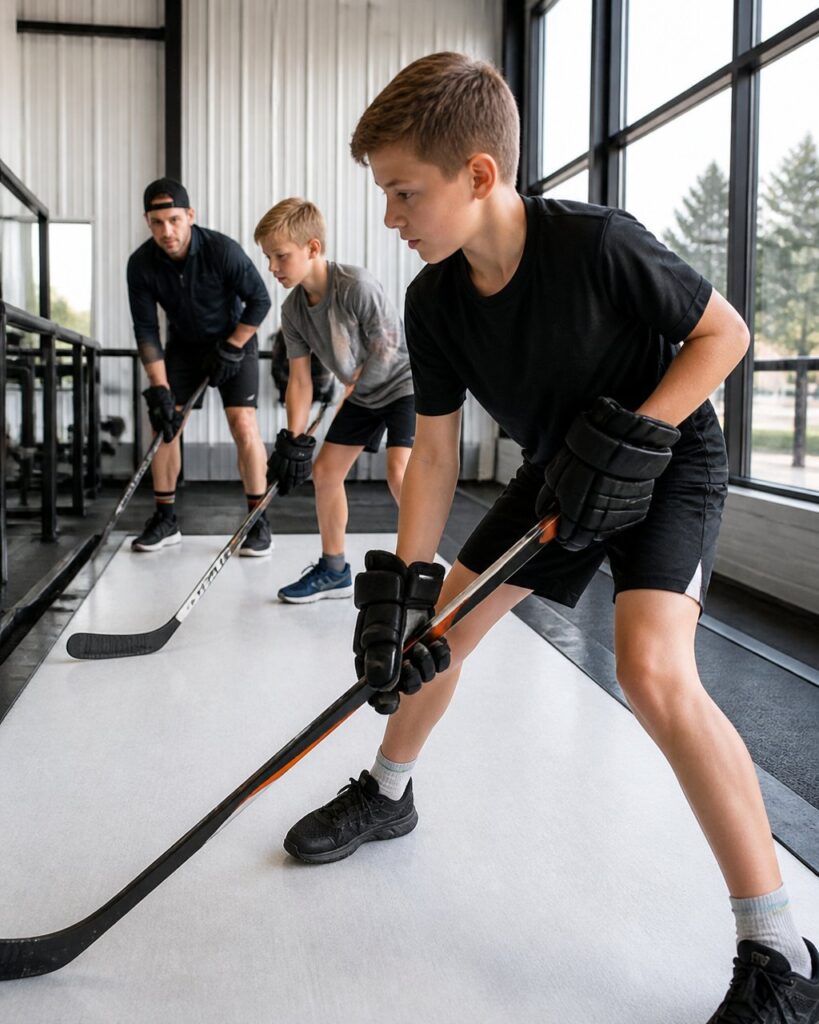
Hockey injury prevention means training off the ice so young bodies can handle the demands of the game, using warm-ups, balance work, mobility, strength, and rest. Fold these habits into every session rather than treating prevention as a separate workout. Short, consistent sessions protect young players better than occasional long ones.
- Run a five-minute dynamic warm-up with jumping jacks, leg swings, lunges, squats, arm circles, high knees, and lateral shuffles before every session and game.
- Build knee and ankle stability with single-leg holds of 20-30 seconds, single-leg RDLs, and slow box step-downs.
- In-season, keep two or three off-ice sessions a week at 15-20 minutes each, focused on warm-up, balance, and mobility.
- Add reps before load, and never add load and complexity in the same week.
- Young athletes should sleep 8-10 hours on training nights and take at least one full rest day each week.
Table of Contents
- Why Off-Ice Training Protects Young Hockey Players
- Youth Hockey Warm-Up Exercises to Do Before Every Session
- Hockey Balance Exercises for Young Players
- Hockey Hip Mobility Exercises for Better Stride and Turns
- Strength Exercises That Build Joint Stability
- Youth Hockey Recovery and Rest: The Missing Piece
- Common Technique Errors and Safe Modifications
- Building Your Injury Prevention Routine at Pro Stride Hockey
- Frequently Asked Questions
Why Off-Ice Training Protects Young Hockey Players
Hockey injury prevention starts long before a player steps on the ice.
Hockey injury prevention is the practice of training the body off the ice so it can handle the demands of the game on it. That means warm-ups, balance work, mobility, strength, and rest.
Here’s what most guides miss: injury prevention isn’t a separate workout. It’s a set of habits you fold into every session.
Youth Hockey Warm-Up Exercises to Do Before Every Session
A good warm-up raises body temperature, wakes up the joints, and prepares the muscles for fast movement (Revisiting the ‘Whys’ and ‘Hows’ of the Warm-Up: Are We Asking the Right Questions?). Skip it and you skate on cold tissue, which is exactly when strains happen.
For a full set of at-home options you can rotate through, see our guide to at home hockey training tips.
A Five-Minute Dynamic Warm-Up Sequence
This sequence takes five minutes and needs no equipment:
- Jumping jacks – 30 seconds, easy pace
- Leg swings, front to back – 10 per leg
- Leg swings, side to side – 10 per leg
- Walking lunges – 8 per leg
- Bodyweight squats – 10 reps
- Arm circles – 15 each direction
- High knees – 20 seconds
- Lateral shuffles – 20 seconds
Do this before every off-ice session and before games. Keep the pace smooth, not frantic. The goal is warm and ready, not tired.
Hockey Balance Exercises for Young Players
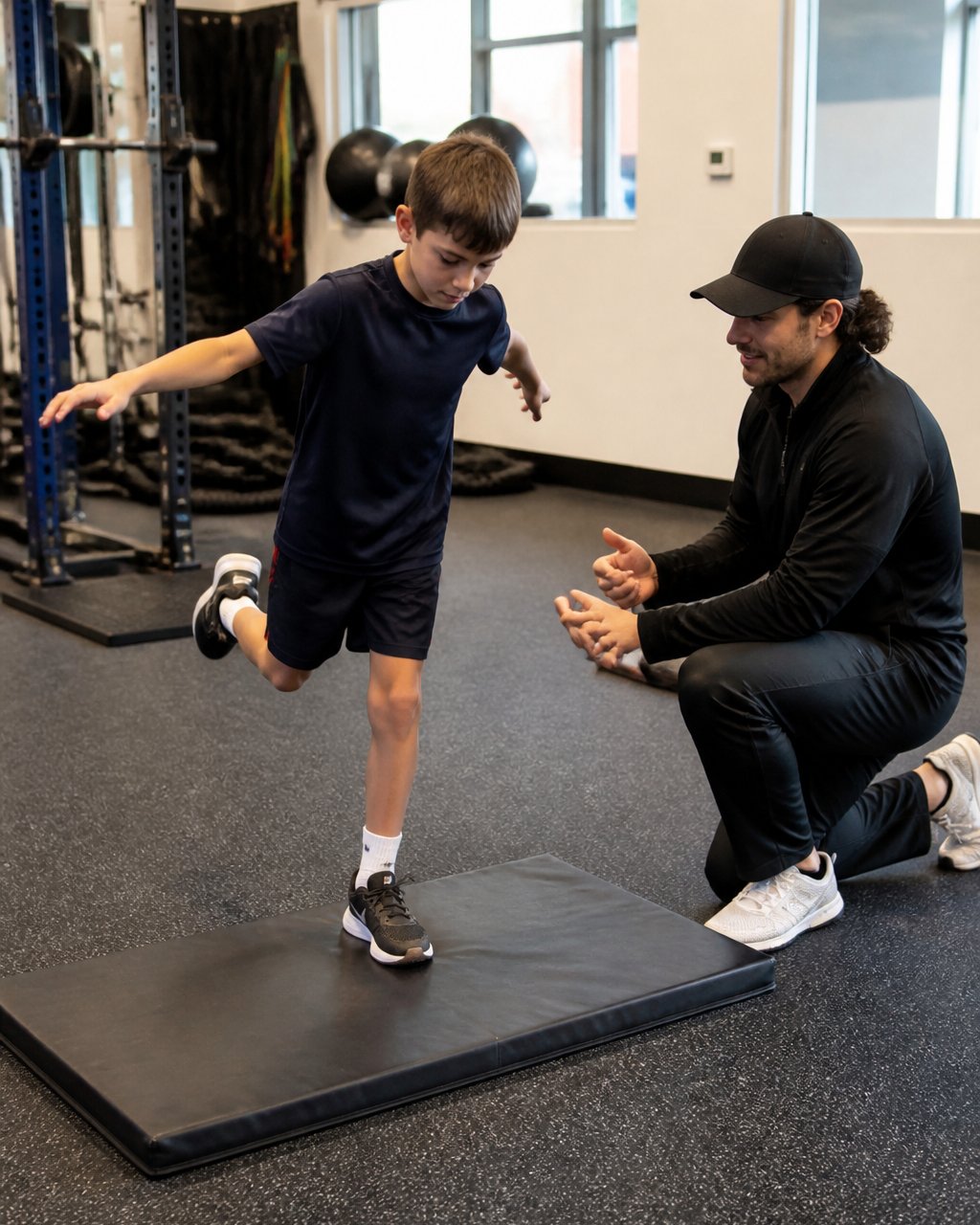
Balance is the quiet skill behind almost every hockey movement. A player who can hold a single-leg position with control can also hold an edge, take a hit, and land a stride without wobbling.
Single-Leg Holds and Step-Downs
These two exercises build the stability that protects knees and ankles:
- Single-leg hold: Stand on one foot with a slight knee bend. Hold for 20-30 seconds. Keep the hip level and the knee tracking over the toes.
- Single-leg RDL: Hinge at the hip on one leg, reaching the other leg back. Return to standing. Do 8 reps per side.
- Box step-downs: Stand on a low box on one leg. Lower the other heel slowly toward the floor, then press back up. Do 6-8 reps per side.
A common mistake is rushing these. Slow, controlled reps build real control. Fast, sloppy reps build bad habits.
Hockey Hip Mobility Exercises for Better Stride and Turns
Tight hips limit stride length and slow down turns. Young players spend hours in a skating crouch, which shortens the hip muscles over time. Mobility work gives that length back.
Try these before or after skating:
- Hip flexor stretch: Half-kneel and tuck the pelvis. Hold 30 seconds per side.
- 90/90 hip switches: Sit with both knees bent at right angles and rotate side to side. 8 per side.
- Lateral lunge hold: Step wide and sink into one hip. Hold 20 seconds per side.
- Glute bridge: Lie on your back and lift the hips. 12 reps.
To see how better hip mobility turns into more speed on the ice, read our breakdown on how to improve hockey stride.
Strength Exercises That Build Joint Stability
Strong muscles protect joints, but young players are not small adults. The right exercise, volume, and supervision change with age and stage of growth. A 7-year-old and a 15-year-old should not train the same way, even if they run the same circuit on paper.
Use the table below as a general guide. These are common patterns most youth strength coaches follow, not medical prescriptions. When in doubt, keep it lighter and more controlled.
| Age band | Focus | Volume per session | Supervision |
|---|---|---|---|
| 6-9 | Movement quality, bodyweight only, fun | 1-2 rounds, 6-8 reps | Constant adult eyes, short sessions |
| 10-12 | Bodyweight mastery, light added resistance | 2 rounds, 8-10 reps | Coached form checks every set |
| 13-15 | Controlled load, single-leg strength, landing mechanics | 2-3 rounds, 8-12 reps | Coached, with load progression only after clean form |
| 16+ | Progressive loading with qualified oversight | 3 rounds, 8-12 reps | Coach or trainer monitoring technique |
Bodyweight Basics by Joint
Different exercises protect different joints. Build a circuit that hits each area rather than repeating the same squat-and-push-up pattern:
- Knees: Squats (10-12 reps, chest up, knees tracking over toes) and split squats (8 per leg, front knee stacked over the foot). These train the muscles that control the knee under load.
- Hips: Glute bridges (12 reps, squeeze at the top) and hip hinges with a dowel on the back (8-10 reps) teach the hip to drive instead of the lower back.
- Shoulders: Push-ups (8-12 reps, body in a straight line) and band pull-aparts (12-15 reps) balance the pushing and pulling that shooting and checking demand.
- Trunk: Front planks (20-30 seconds, hips level) and side planks (15-20 seconds per side) build the bracing that protects the spine during contact and falls.
- Upper back: Inverted rows (8-10 reps using a low bar or table edge) and assisted pull-ups (3-5 reps) counter the rounded posture that long hours in a skating crouch encourage.
Do two or three rounds with rest between rounds. Good form matters more than extra reps, and a rep that loses position is a rep that teaches the wrong pattern.
Progressing Safely
Add reps before you add load. When a player can do clean sets at the top of the rep range with steady form, add a small amount of resistance or move to a harder variation, such as a single-leg squat to a box. Never add load and complexity in the same week.
Stop the set if a player reports joint pain (not muscle fatigue), if the knees cave inward, if the back rounds under load, or if a landing looks wobbly. Those are signs to reduce the exercise, not push through.
If you want to build stability and stride power with coached reps, our skating treadmill training is built for exactly that.
Youth Hockey Recovery and Rest: The Missing Piece
Rest is training. Young athletes grow, and growing tissue needs sleep and downtime to repair. Skip recovery and the best exercise plan falls apart. Most guides stop at “get more sleep.” The harder question is how to fit prevention work around a busy practice and game schedule without overloading a young player. Balancing this physical load requires a focused mindset, which is why integrating mental training strategies helps players maintain the discipline necessary to prioritize recovery alongside their demanding athletic commitments.
Fitting Prevention Work Around the Season
A common pattern that works for families and coaches:
- In-season: Two or three short off-ice sessions a week, 15-20 minutes each, focused on warm-up, balance, and mobility. Keep strength work to one or two of those sessions.
- Around games: Do the dynamic warm-up before every game. Skip heavy strength work the day before and the day of a game. Save longer strength sessions for days with no game.
- Off-season: This is when to build strength and address weaknesses, with more sessions per week and gradual progression.
- Tournament weekends: Treat back-to-back games as hard training days. Cut off-ice work to warm-up and light mobility only, and protect sleep.
Workload Warning Signs
Watch for these signals that a young player is carrying too much:
- Soreness that lasts more than a couple of days
- Declining performance or slower skating in practices
- Trouble falling asleep or unusual fatigue
- Loss of appetite or mood changes
- Nagging joint pain that does not settle with rest
Any of these is a reason to back off, not push through. Persistent joint pain, especially in a growing player, is a reason to see a qualified health professional rather than adjust the program alone.
Recovery Habits That Actually Move the Needle
- Sleep 8-10 hours on training nights; this is the single biggest recovery lever for young athletes
- Take at least one full rest day each week
- Rotate hard skating days with lighter skill days
- Eat protein and carbs within an hour after training
- Stretch tight areas after sessions, not before
- Keep school and travel demands in the plan; a player who is up late with homework is not recovering
In-season, short and consistent beats long and occasional. Two or three 15-minute sessions a week, plus a full rest day, protect a young player better than one big weekend workout.
Common Technique Errors and Safe Modifications
Most injuries in young players trace back to form, not bad luck. Here are the errors we correct most often, and how to fix them:
| Error | Fix | Why It Matters |
|---|---|---|
| Knees caving inward on squats | Push knees out over toes | Protects knee ligaments |
| Rushing balance reps | Slow down, hold each position | Builds real control |
| Skipping the warm-up | Five-minute dynamic routine | Prevents cold-tissue strains |
| Training hard every day | Add rest days and lighter sessions | Avoids overuse injuries |
| Lifting too heavy too soon | Master bodyweight first | Protects growing joints |
| Holding breath during reps | Breathe out on effort | Keeps form steady |
For players new to strength work, start with bodyweight only. Add reps before you add load. Coaches and parents should watch for rounded backs, locked knees, and wobbly landings.
Building Your Injury Prevention Routine at Pro Stride Hockey
A routine only works if you actually do it. The best plan for a young player is short, repeatable, and coached well enough that form stays clean.
That’s where Pro Stride Hockey comes in.
Parents tell us the difference shows. One shared how her son perfected his stride while her daughter gained confidence with her ringette shot.
Ready to put a safe, coached routine in place? Explore small group hockey training in Edmonton or private hockey lessons in Edmonton, and get your player started.
Frequently Asked Questions
What exercises help prevent injuries in young hockey players?
A mix of dynamic warm-ups, balance work, hip mobility, and bodyweight strength exercises offers the best protection. Focus on single-leg holds, lateral lunges, glute bridges, and controlled squats. These movements build joint stability and muscle balance that support the skating stride. Pair them with a proper cool-down and rest days. A consistent routine two to three times per week is more effective than occasional intense sessions.
How often should young hockey players do off-ice training?
Two to three sessions per week works well for most youth players during the season. Each session can run 20 to 30 minutes and focus on movement quality rather than volume. During the off-season, frequency can increase slightly, but always with at least one full rest day between strength sessions. Watch for signs of fatigue and adjust the training load as needed.
Should young hockey players train when they are sore or injured?
Mild muscle soreness after training is normal, but sharp pain or joint discomfort means stop and assess. Never push through an injury. Rest, ice if appropriate, and consult a healthcare professional for persistent issues. A qualified coach can modify exercises to keep players active while protecting the injured area. Recovery and rest are part of the training plan, not a break from it.
What strength exercises are safe for youth hockey players?
Bodyweight exercises like squats, lunges, push-ups, planks, and glute bridges are safe and effective when taught with proper form. Start with controlled repetitions and progress gradually. Avoid heavy loading until a player has mastered movement quality. A coach can check technique and adjust difficulty. Focus on lower-body strength, core conditioning, and single-leg stability for hockey-specific benefits.
Young players get hurt when their training ignores the basics: warm-ups, balance, mobility, strength, and rest. Pro Stride Hockey builds all five into every session, with small groups, video feedback, and coaching that keeps form clean. Get started with Pro Stride Hockey and give your player a training routine that protects them while it makes them faster.
