Last Updated: October 23, 2026
Quick Summary
A skating treadmill builds stride technique and efficiency by giving players repeatable repetitions with real-time coach feedback at a controlled pace. It turns skating into a daily skill instead of a sometimes-skill, stacking quality reps between ice sessions. Use it as a technique lab, not a replacement for the rink.
- Beginners should start with 10 to 15 minute sessions focused on technique, not fatigue.
- Add difficulty in this order: longer interval, faster belt, added skill, then less rest.
- Pro Stride Hockey caps sessions at four players with a 2:1 player-to-coach ratio.
- Track stride rate at a fixed belt speed and on-ice sprint time to confirm transfer.
- Skipping the beginner phase builds stride errors into muscle memory that are harder to fix later.
Table of Contents
- Why a Skating Treadmill Changes Off-Ice Training
- How a Skating Treadmill Builds Stride Technique and Efficiency
- Skating Treadmill Drills for Hockey Players
- Hockey Skating Treadmill Workout Duration and Progressive Planning
- Skating Treadmill vs On-Ice Training: Where Each One Fits
- Safety, Supervision, and Beginner Setup
- Who Benefits, Who May Not, and How to Measure Progress
- Conclusion
- Frequently Asked Questions
Why a Skating Treadmill Changes Off-Ice Training
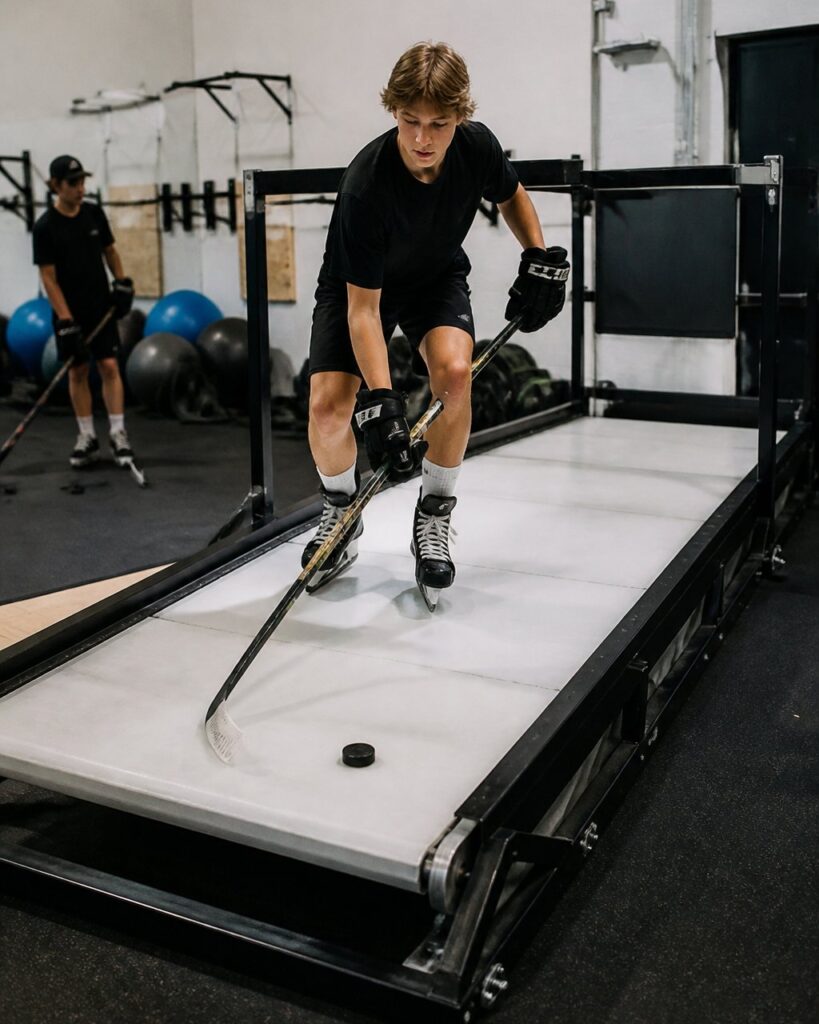
A skating treadmill is a training machine with a moving synthetic surface that lets players repeat skating strides indoors, without ice. We use a skating treadmill to work on skating stride technique and we also teach the proper way to shoot a hockey puck and a ringette ring.
Here is the core problem with most off-ice work. A player can spend an hour on dryland drills and never once practice a real stride. Stickhandling, shooting, and footwork all matter. But skating is the skill that carries everything else.
The skating treadmill fixes that gap. It gives players:
- Repeatable repetitions of the same stride, over and over
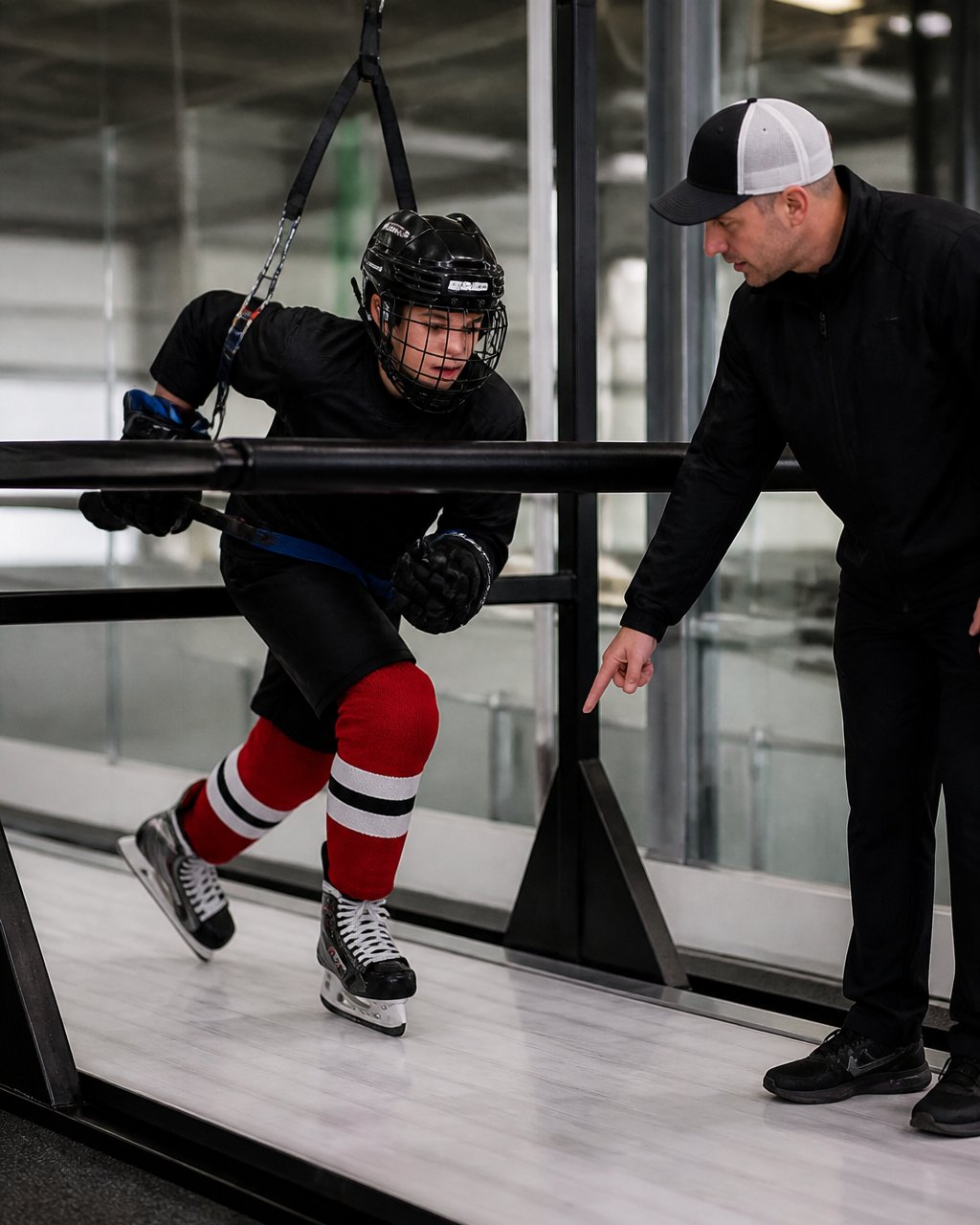
- Real-time feedback from a coach standing right beside them
- Controlled pace, so technique comes before speed
- Full gear work, including puck and ring skills
That last point matters more than most guides admit. A treadmill session is not just conditioning. It is a coaching environment.
How a Skating Treadmill Builds Stride Technique and Efficiency
Stride efficiency is the amount of speed a player gets from each push. A skating treadmill builds it by slowing the skill down and letting a coach correct stride errors on the spot.
On ice, a coach sees a stride for a second and then it is gone. On the treadmill, the coach can watch the same motion for minutes. That changes everything.
Common stride errors we correct include:
- Pushing out instead of pushing back
- Standing too upright through the hips
- Short, choppy strides with no full extension
- Weight stuck on the inside edge
Each error costs speed. Fixing them builds stride mechanics that carry back to the ice.
Ask your coach to film one stride from the side and one from behind. Most players feel like they are extending fully. The video usually shows otherwise. Seeing it once is often enough to fix it.
Stride analysis also builds edge control and agility. When the belt speed is steady, a player can focus on one edge at a time. That focus is hard to find in a busy practice.
Skating Treadmill Drills for Hockey Players
Skating treadmill drills for hockey players fall into two groups: stride and edge work, then puck skills layered on top. Start with clean technique, then add the puck once the stride holds. Most guides stop at a drill list.
A Complete Beginner Session (20 Minutes)
This is the structure we use for a player new to the belt. The coach controls speed the entire time.
- Warm-up (4 min): Slow, easy strides at a conversational pace. Focus on tall posture and full extension, not speed.
- Block 1, Stride holds (3 x 30 sec work / 30 sec rest): Steady pace, full push-back, arms in sync. Coach cues one correction per rep.
- Block 2, Single-leg pushes (3 x 20 sec per leg / 30 sec rest): One leg drives while the other glides. Watch for the hip dropping.
- Block 3, Edge transitions (4 x 20 sec / 40 sec rest): Inside to outside edge on the coach’s command.
A common pattern is that beginners fatigue in the last 10 seconds of each interval. Stop the set when form breaks rather than pushing through.
Stride and Edge Control Drills
These drills build skating power and acceleration:
- Long stride holds: 20 to 30 seconds of full extension at a steady pace
- Quick feet bursts: short, fast steps for 10 seconds, then reset
- Single-leg pushes: one leg drives while the other glides
- Crossover sets: controlled crossovers in each direction
Adding Puck Skills to Treadmill Work
This is where off-ice training gets interesting. Once a stride is stable, add a puck or a ring.
- Stickhandling while striding: keeps hands soft under fatigue
- Peripheral awareness work: coach signals, player reacts without looking down
- Shooting motion reps: practice the release while moving
- Ring control for ringette players: same idea, different implement
We use a specialized shooting lane to teach the proper release for both puck and ring. We also teach the proper way to shoot a hockey puck and a ringette ring. Multitasking under speed is a real game skill. The treadmill is one of the few places to train it safely.
Progression Rule
Add difficulty in this order: longer interval, then faster belt, then added skill (puck or ring), then less rest. Change one variable at a time. If technique holds for two full sessions at a given level, move up. If it breaks, drop back one step. This keeps the work progressive without turning sessions into fatigue contests.
Film one interval at the start and one at the end of each session. Comparing the two shows whether fatigue is changing the stride, a signal to shorten the set, not add one.
Hockey Skating Treadmill Workout Duration and Progressive Planning
Hockey skating treadmill workout duration should start short and build slowly. Beginners do best with 10 to 15 minute sessions focused on technique, not fatigue.
Here is how we would plan a progression:
| Phase | Session Length | Focus | Frequency |
|---|---|---|---|
| Week 1-2 | 10-15 min | Stride basics, balance | 1-2x per week |
| Week 3-4 | 15-20 min | Edge control, single-leg work | 2x per week |
| Week 5-8 | 20-30 min | Power, acceleration, puck skills | 2x per week |
| Week 9+ | 30 min | Full intensity, game-speed reps | 2-3x per week |
Two rules keep this safe. First, technique before intensity, every time. Second, stop while form is still good. A tired stride teaches bad habits.
Skipping the beginner phase is the most common mistake we see. A player who jumps straight to full-speed work builds errors into muscle memory, and those errors are much harder to fix later than to prevent.
Skating Treadmill vs On-Ice Training: Where Each One Fits
Skating treadmill vs on-ice training is not a contest. Each one does something the other cannot. The treadmill builds repeatable repetitions and focused technique. The ice builds game reads, contact, and full-speed decision-making. Optimizing these mechanical gains requires a commitment to physical restoration, which is why a daily cold plunge serves as an essential bridge between high-intensity sessions.
Use the treadmill for:
- Isolated stride correction
- High-rep technique work
- Video analysis and feedback
- Conditioning when ice time is scarce
Use the ice for:
- Game situations and small-area battles
- Timing with teammates
- Contact and puck battles
- Applying skills at full speed
The best players use both. Off-ice advantage comes from stacking quality reps between ice sessions, not replacing them.
The treadmill is a technique lab, not a replacement for the rink. Treat it as the place to fix a stride, then test that fix on the ice.
Safety, Supervision, and Beginner Setup
Safety comes first on a skating treadmill, and supervision is not optional. A coach should control the belt at all times, and beginners should start at a slow pace with a hand on a rail.
Setup basics for a new player:
- Full gear, including helmet and gloves
- A coach at the controls, every session
- A slow warm-up before any speed work
- A clear stop signal the player knows
Small-group coaching helps here. We cap sessions at four players with a 2:1 player-to-coach ratio, so every player gets eyes on their stride. Lindsay Axelson said: ‘I’d never been on a skate treadmill before and Adrienne taught me a lot about stride efficiency.’ That kind of hands-on guidance is the whole point.
Who Benefits, Who May Not, and How to Measure Progress
Most players benefit from skating treadmill work, but not everyone needs it at the same time, and the fit depends on age, skill level, position, training history, and injury status. Competitive players chasing skating speed gain the most. Recreational players who just want to get better also gain, as long as the plan fits their level.
Who Benefits Most
- Skaters with a specific stride flaw: the belt slows the motion enough for a coach to correct it.
- Players short on ice time: treadmill reps stack quality strides between practices.
- Players returning from a layoff: controlled pace rebuilds technique before speed.
- Ringette players: the same stride work transfers, and the shooting lane teaches ring release.
Who May Not Benefit Right Away
- Very young beginners still learning basic balance
- Players with an injury who have not been cleared to train
- Anyone who cannot commit to regular sessions
- Players who need game reads and contact more than isolated technique
A common pattern is that a player who is not yet stable on skates benefits more from general skating lessons first. The treadmill amplifies a stride; it does not replace the basics.
How to Measure Progress
Progress is measurable if you track the same things each session. Use repeatable metrics rather than a general sense of improvement:
- Stride rate: count pushes per 30-second interval at a fixed belt speed.
- Belt speed at fixed technique: note the fastest speed where form still holds.
- Interval duration: how long the player holds clean technique before form breaks.
- Technique consistency: coach scores the same three cues each session (push-back, hip position, arm sync).
- On-ice sprint times: time the same short sprint at team practice every few weeks.
Tara Mayne said: ‘My son perfected his stride and my daughter gained confidence with her ringette shot.’ That mix of skill and confidence is what steady, focused work produces, and the metrics above are how you confirm it is happening rather than assuming it.
Pick two metrics and track them every session. Stride rate at a fixed belt speed and on-ice sprint time together show whether treadmill work is transferring to the ice.
Conclusion
The hardest part of off-ice training is staying consistent when the rink is far away and ice time is limited.
At Pro Stride Hockey, we build that work into a full plan. Our 2:1 player-to-coach ratio means real feedback on every stride.
Ready to turn off-ice hours into on-ice speed? Book Now with Pro Stride Hockey and give your player the reps that actually change their game.
Frequently Asked Questions
What does a skating treadmill help with?
A skating treadmill helps players build repeatable stride mechanics in a controlled setting. Without ice friction and rink constraints, a skater can hold a single stride correction for dozens of reps while a coach watches from a fixed angle. That repetition supports stride efficiency, acceleration, edge control, and conditioning. Many programs pair treadmill work with video analysis so players can see the difference between a clean push and a wasted one, then repeat the cleaner version.
How often should a hockey player use a skating treadmill?
Frequency depends on age, training age, and the rest of the player’s schedule. Youth players often do one focused treadmill session per week during the season, with a second session added in off-season blocks. The key is spacing sessions so the player recovers and can hold technique, not just survive the workout. A coach who sees the player regularly can adjust volume based on how the stride looks late in a session.
Is skating treadmill training a replacement for on-ice practice?
No. A skating treadmill is an off-ice tool that isolates stride mechanics and conditioning. It cannot replicate game reads, contact, puck battles, or the timing of a real shift. Skating treadmill vs on-ice training is not a contest; the two work best together. Use the treadmill to correct and repeat technique, then take that cleaner stride to the ice where decision-making and pace get tested.
Can a skating treadmill help with hockey shooting and ringette shooting?
It can, when the session is built for it. Some training setups combine stride work with shooting reps so players learn to handle a puck or ring while moving. That multitasking builds peripheral awareness and forces the player to keep their head up. Shooting mechanics still need dedicated instruction, but adding a stick and puck to controlled skating work helps players transfer skills into faster game situations.
