Last Updated: November 1, 2026
Quick Summary
Developing elite hockey IQ for youth players means training game awareness as a skill, not a gift. Players learn to pre-scan, read defenders, teammates and the play before the puck arrives, with cues and drills matched to their age band. Short, repeatable sessions with one clear cue build faster reads than volume alone.
- Elite players make four reads before the puck touches their stick, starting with a pre-scan over both shoulders.
- Ages 6-9 build the scanning habit through small-area keep-away with two players and one puck.
- Ages 10-12 use two-option reaction drills where a coach’s cue tells the player which option is live.
- Ages 13-15 add short video clips of 30-60 seconds paused at key moments for player-led reflection.
- A practical weekly plan combines two at-home skill sessions, one small-group session and one video review.
Table of Contents
- What Elite Hockey IQ Looks Like on the Ice
- How to Improve Hockey IQ at Every Age
- Hockey Sense Drills for Youth Players You Can Run Anywhere
- Hockey Decision-Making Drills That Mirror Game Speed
- Hockey Video Analysis and Guided Reflection
- Building a Weekly Practice Schedule That Sticks
- Book a Session and See the Difference
- Frequently Asked Questions
What Elite Hockey IQ Looks Like on the Ice
Developing elite hockey IQ for youth players starts with a simple truth: the smartest player on the ice is rarely the fastest skater. Hockey IQ is the ability to read a developing play, predict what happens next, and make the right decision before the puck arrives. Cultivating this cognitive edge requires a commitment to purposeful youth sports where every drill and shift serves as a deliberate exercise in tactical decision-making.
The Four Reads That Separate Smart Players
Elite players make four reads before the puck touches their stick:
- Pre-scan: Check over both shoulders before receiving a pass to map pressure and open ice.
- Read the defender: Identify whether the defender is tight, backing off, or cheating toward a passing lane.
- Read your teammates: Find support behind and beside you before you need it.
- Read the play: Predict the next two seconds, not the current one.
The difference between a rushed pass and a clean breakout is usually one scan made a half-second earlier.
How to Improve Hockey IQ at Every Age
There is no single blueprint for how to improve hockey IQ, because a seven-year-old and a fifteen-year-old need different coaching cues, different session lengths, and different feedback. The mistake most families make is copying an older player’s routine. A better approach is to match the cognitive demand to the player’s stage, then add complexity only when the current level looks automatic.
Ages 6-9: Build the Scanning Habit
At this stage, hockey IQ work should look like play. The goal is not tactical awareness; it is making scanning and head-up puck control feel normal.
- Cue: “Eyes up before the puck arrives.” Say it every rep until the player says it back to you.
- Drill shape: Small-area keep-away with two players and one puck. No whistles, no lines, no laps.
- Off-ice tie-in: On a skating treadmill, have the player call out a color or number a coach holds up while holding stride technique. This pairs head-up awareness with stride mechanics early.
A drill that is too complex for a young player teaches hesitation, not hockey sense. If a player is guessing, simplify.
Ages 10-12: Introduce Decision Rules
This is where pattern recognition starts to stick. Players can handle simple if-then rules and begin to recognize the same picture across drills and games.
- Cue: “Pass, skate, or shoot, pick one before you catch it.”
- Drill shape: Two-option reaction drills where a coach’s cue (a hand signal or a verbal call) tells the player which option is live. Start at walking pace, then build to full speed over several weeks.
- Off-ice tie-in: In a shooting lane, alternate between a hockey puck and a ringette ring so the player learns to read the implement and adjust release. The decision rule stays the same; only the tool changes.
Ages 13-15: Add Video Review and Off-Puck Reads
At this stage, players can handle guided reflection and position-specific reads. This is where video review earns its keep.
- Cue: “Where was the open ice, and who was your support?”
- Drill shape: Position-specific small-area games (for example, two-on-two in a confined zone with a support player stationed at the wall). The support player must scan before the puck arrives.
- Off-ice tie-in: Short video clips (30-60 seconds) paused at key moments, with the player answering two questions before the coach offers an opinion. Player-led reflection beats coach-led lecture.
Ages 16+: Push Decision Speed Under Pressure
Older players need decision speed, not more information. The work shifts from learning reads to executing them when tired, pressured, and out of time.
- Cue: “Make the read before the pressure arrives.”
- Drill shape: Competitive small-group games with a live defender and a shot clock (a coach counts down from three). The player must decide and execute before the count ends.
- Off-ice tie-in: Skating treadmill intervals paired with a shooting decision at the end of each interval, so the player learns to make reads while fatigued.
Age bands are a starting point, not a rule. A confident 12-year-old may be ready for video review; a hesitant 15-year-old may need to go back to two-option drills. Match the demand to the player, not the birth year.
Age-appropriate drills matter more than volume. A player who leaves every session with one clear cue and one clean rep will progress faster than a player who runs ten drills and remembers none of them.
Each age band gets its own cue, drill shape, and off-ice tie-in, so match the demand to the player’s stage.
| Age band | Cue | Drill shape | Off-ice tie-in |
|---|---|---|---|
| Ages 6-9 | Eyes up before the puck arrives | Small-area keep-away, two players one puck | Call out a color or number on a skating treadmill |
| Ages 10-12 | Pass, skate, or shoot, pick one before you catch it | Two-option reaction drills with a coach’s cue | Alternate a hockey puck and a ringette ring |
| Ages 13-15 | Where was the open ice, and who was your support? | Position-specific small-area games with a wall support player | 30-60 second clips paused at key moments |
| Ages 16+ | Make the read before the pressure arrives | Competitive small-group games with a live defender and shot clock | Skating treadmill intervals with a shooting decision at the end |
Hockey Sense Drills for Youth Players You Can Run Anywhere
You do not need a full sheet of ice to build hockey sense drills for youth players. Parents can also find at-home hockey training tips to reinforce reads and decision-making between sessions. A driveway, a basement, a gym floor, or a skating treadmill works if the drill forces scanning and decisions. The key is that every drill has a clear read, a clear decision, and a clear feedback cue.
1. Scan-and-Catch
- Setup: A coach or parent stands behind the player with a ball or puck and tosses it from different angles.
- The read: Before the toss arrives, the player scans over both shoulders and calls out what they see behind them (for example, “open left” or “pressure right”).
- The decision: The player receives the puck and immediately moves it to the side they called.
2. Two-Option Reaction
- Setup: The player receives a pass and must decide within one second whether to pass or shoot based on a coach’s cue (a hand signal or a verbal call).
- The read: The cue tells the player which option is live.
- The decision: Pass or shoot, no hesitation.
3. Wall-Ball Reads
- Setup: The player passes a ball off a wall and pre-scans before the rebound returns.
- The read: The player must identify where the rebound will arrive and where the open space is.
- The decision: Receive the rebound and move it into the open space.
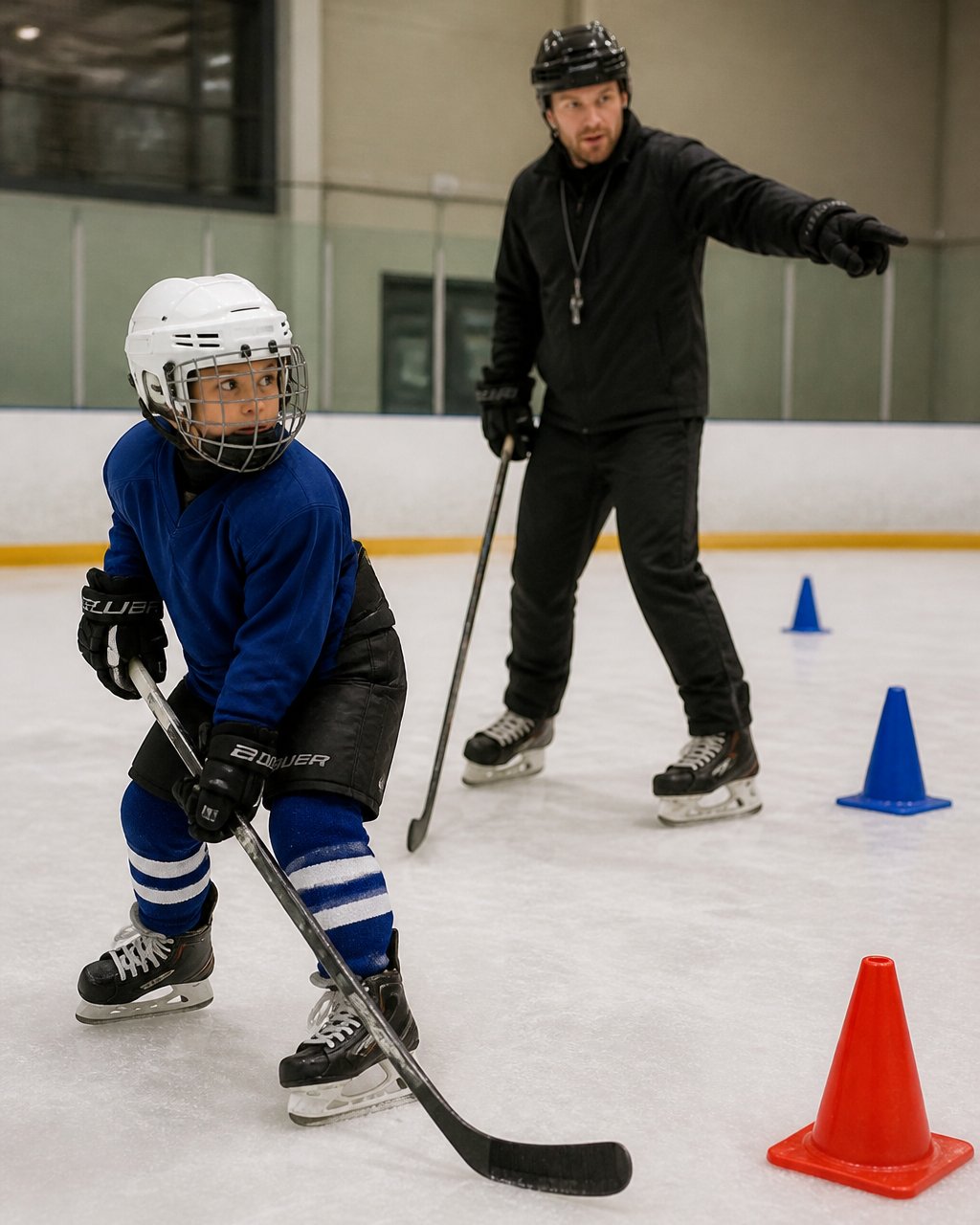
4. Obstacle Puck Control
- Setup: The player weaves through cones while keeping the head up, not watching the puck.
- The read: The player must track the next cone and any coach signal while controlling the puck.
- The decision: Choose a line through the cones based on the coach’s signal.
Slow reps teach slow reads. Start at walking pace to build the habit, but move to full speed within a few sessions. If a player can only succeed at half speed, the drill is too complex, simplify it rather than slowing it down permanently.
Small-Area Games That Force Quick Reads
Small-area games compress time and space, which is exactly what forces faster decisions. Two-on-two keep-away, three-on-three in a confined zone, and half-court puck battles all reward players who scan early and move the puck before pressure arrives. These game-like drills build the anticipation and reaction that show up in real games.
- Two-on-two keep-away: Rewards scanning and support positioning. The player without the puck must find open ice before the pass arrives.
- Three-on-three in a confined zone: Forces quick reads under pressure. The player must decide pass, skate, or shoot within one second.
- Half-court puck battles: Builds anticipation and reaction. The player must predict where the puck will go before the battle starts.
Measuring Progress Without Overloading the Player
You do not need a formal test to track hockey IQ. A simple rubric works: count how often the player scans before receiving (scan frequency), note whether the decision was clean or rushed (decision quality), and check whether the player found support positioning without being told. Track one indicator per week, not all three at once.
The best hockey sense drills are the ones a player can run alone, with a parent, or in a small group, and the ones where the player leaves with one clear cue. If a drill does not force a scan and a decision, it is a skill drill, not a hockey IQ drill.
Hockey Decision-Making Drills That Mirror Game Speed
The best hockey decision-making drills replicate the speed and chaos of a real shift. Static drills build technique; live decision drills build game awareness. We like drills that force a player to choose between passing options, skating into open ice, or shooting under defensive pressure.
A common mistake is running decision drills at half speed. Slow reps teach slow reads. Push the pace, add a defender, and let players make mistakes; that is where learning happens.
Hockey Video Analysis and Guided Reflection
Hockey video analysis turns vague feedback into a clear picture. Players watch their own shifts, pause on key moments, and answer guided questions: Where was the open ice? If your child is new to review, our step-by-step walkthrough on hockey video analysis for youth players shows how to start. Families ready to act on that feedback can explore hockey video analysis training to see how we turn every stride and decision into coaching cues.
Building a Weekly Practice Schedule That Sticks
Consistency beats intensity. A practical weekly plan might combine two at-home skill sessions, one small-group ice or off-ice session, and one video review. Families looking for a consistent small-group option can review small group hockey training to see how it fits a weekly routine.
Watch out: stacking too many sessions without rest leads to fatigue and sloppy reads. Recovery is part of the plan.
Book a Session and See the Difference
Building elite hockey IQ takes repetition, feedback, and the right environment. At Pro Stride Hockey, we pair a 2:1 player-to-coach ratio with a maximum of four players per session, comprehensive video analysis, and a specialized shooting lane facility to develop skating speed, goal-scoring ability, and athletic confidence. Parents comparing programs can start with our youth hockey training program overview before booking.
Frequently Asked Questions
What does hockey IQ mean for youth players?
Hockey IQ is a player’s ability to read a situation and choose the right action before the play arrives. For youth players it shows up as scanning before receiving a pass, keeping the head up, and knowing whether to pass, skate or shoot. It is not the same as raw skill. A player with strong hockey IQ reads defenders, teammates and open ice early, which buys time and space even against faster opponents.
How can a young hockey player improve their hockey IQ?
Start with habits that repeat every shift: scan over both shoulders before the puck arrives, keep the head up on carries, and talk on the ice. Add small-area games and decision-making drills where the player must choose fast. Video review helps too, because a player can pause a clip and ask what the next play should be. Off-ice work on stride and shooting frees up attention for reads, since technique stops demanding conscious thought.
What drills help develop hockey sense?
Small-area games are the most efficient tool. Two-on-two and three-on-three in tight space force constant scanning, quick puck decisions and support movement. Add passing-under-pressure drills where a coach signals pass, skate or shoot, plus puck-reception drills that reward the pre-scan. Keep sessions game-like: short reps, live defenders and a decision to make on every touch.
At what age should players start developing hockey IQ?
Reads can be taught as soon as a player can carry the puck. Younger players learn best through games and simple cues like head up and find open ice. Older players can handle video review, position-specific reads and reflection on their own decisions. The progression matters more than the starting age: layer complexity as the player matures rather than jumping to advanced tactical work too early.
How often should youth players practice hockey IQ skills?
Short and frequent beats long and rare. A few small-area games or decision drills in every on-ice session, plus ten minutes of video review at home each week, builds the habit without overloading a competitive schedule. During the season, one focused skill session a week alongside team practice keeps development moving. Off-ice stride and shooting work supports this by making the physical side automatic.
Can watching hockey games improve a player’s hockey IQ?
Yes, if the player watches with a purpose. Pausing a clip to predict the next pass, tracking one player’s off-puck movement, or counting how often a defenceman scans before the puck arrives turns passive viewing into practice. Guided reflection after the game, with two or three specific questions, does more than watching hours of highlights.
How can off-ice training support hockey IQ development?
Off-ice work removes the physical load so a player can focus on reads when they hit the ice. Stride work on a skating treadmill builds efficient technique, and shooting reps groove release and accuracy. When skating and shooting stop needing full attention, the player has more capacity to scan, anticipate and make better puck decisions in game situations.
