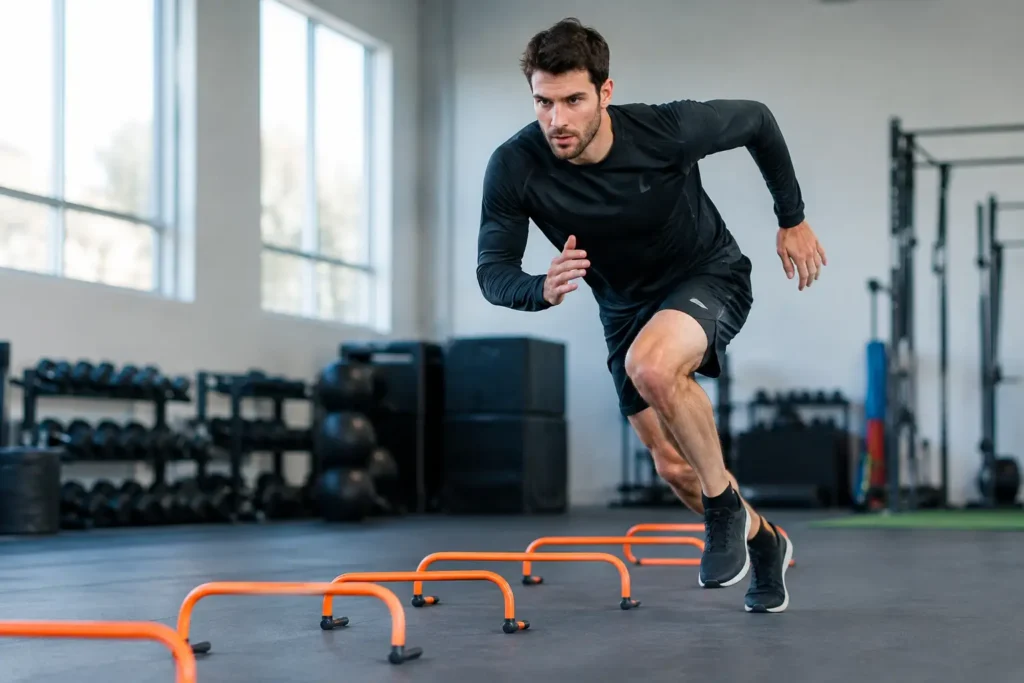
A search for adult hockey training near me usually starts after a familiar moment: your legs feel a half-step behind the play, your shot is not coming off cleanly, or you know exactly what you want to do but cannot execute it at game speed. More ice time can help, but unstructured ice time does not automatically correct a weak stride, inefficient edges, or a release that breaks down under pressure.
The right training environment gives adult players something most league games and pickup skates do not: deliberate repetitions, direct coaching, and a plan built around the skills that affect their game most. Whether you play competitive rec hockey, return to the sport after years away, or simply want to feel more confident every time you step on the ice, the goal is not to train like someone else. It is to build a more efficient version of your own game.
What Adult Hockey Training Should Actually Improve
Adult players arrive with different backgrounds, conditioning levels, and goals. Some are former competitive players who want their speed back. Others are newer players who want to stop feeling rushed with the puck. A quality program recognizes those differences while still addressing the technical foundations that make every player more effective.
Skating should be the first priority. A stronger stride is not just about moving your feet faster. It comes from body position, knee bend, edge control, full extension, recovery mechanics, and the ability to transfer force efficiently. When those pieces improve, players can generate more speed without wasting energy. That matters late in a shift, when poor mechanics are most likely to show up.
Shooting instruction should go beyond firing pucks at a target. Effective coaching breaks down puck position, hand separation, weight transfer, blade contact, and follow-through. A player with a hard shot that takes too long to release is still easy to defend. The best training develops both power and a repeatable release that works from different body positions.
Puck control, passing, and small-area movement also matter, especially for adult league players. You may not need a highlight-reel toe drag. You do need to protect the puck, scan before receiving it, make a clean first pass, and move your feet after the pass leaves your stick. Focused training turns those details into habits.
How to Evaluate Adult Hockey Training Near Me
Convenience matters. A nearby facility makes it easier to train consistently around work, family, and league schedules. But location alone should not make the decision. Before booking, look at how the program teaches, how many athletes share a coach, and whether the sessions are built around measurable improvement rather than generic drills.
Look for coaching that identifies the real issue
A drill can expose a problem, but it does not necessarily solve it. Good coaches watch closely enough to identify why a player is losing speed or missing a shot. Maybe the player is standing too tall through the stride. Maybe the upper hand collapses during the release. Maybe a lack of hip mobility is limiting the position needed to create power.
That level of correction is difficult in a large group. Smaller training groups give coaches time to demonstrate the movement, provide immediate feedback, and have the player repeat the correction before the old pattern returns. For adult athletes, that efficiency is valuable. Most players cannot spend hours each day training, so every repetition should have a purpose.
Ask how video feedback is used
Video can be one of the fastest ways to understand a technical issue. Players often feel that they are getting low in their stride or driving through the puck, only to see a very different movement on screen. Immediate video review creates a useful connection between what the athlete feels and what they are actually doing.
The technology is only as useful as the coaching behind it. A coach should not overwhelm players with ten corrections at once. One or two clear priorities, followed by targeted repetitions, gives the body a realistic chance to adapt. Film the movement again after the adjustment, and progress becomes visible rather than assumed.
Consider the value of off-ice skill work
Not every skill requires a full sheet of ice. Purpose-built off-ice training can give players high volumes of quality repetitions in less time. Synthetic-ice shooting lanes, skill areas, and skating treadmills allow coaches to slow down the teaching process, isolate a movement, and repeat it with intention.
A skating treadmill is especially useful for stride work because the athlete can maintain the movement while the coach observes closely. Video feedback can be reviewed immediately, then applied during the next repetition. This is not a replacement for on-ice decision-making or game awareness. It is a focused setting for improving the mechanics that support better on-ice performance.
Choose the Format That Matches Your Goal
Private instruction is usually the fastest route for a player with a specific technical need. If your crossover is weak, your shot lacks power, or you are returning from an injury and need patient guidance, individualized coaching makes sense. The coach can build the session around your starting point instead of asking you to fit into a preset group plan.
Small-group training can be an excellent fit when athletes share similar goals and want a competitive training environment. It can add passing, puck-protection, and reaction elements that are harder to create in a one-on-one format. The trade-off is attention: as group size grows, the number of personal corrections each athlete receives usually drops.
Team sessions have a different purpose. They can improve pace, skill habits, and shared offensive details, but they are not always the best place to rebuild an individual skating pattern. If a player has a technical issue that needs concentrated attention, pair team development with individual work whenever possible.
At Pro Stride Hockey, private sessions are structured around a 2:1 player-to-coach ratio with no more than four athletes, creating space for real-time correction instead of athletes simply cycling through a drill. That kind of environment is particularly valuable when the goal is to make every repetition count.
Build a Training Plan You Can Maintain
The best program is not necessarily the one with the most sessions on the calendar. It is the one you can attend consistently and apply to your hockey. Start by choosing one primary objective for the next four to eight weeks. It might be a deeper, more powerful stride, a quicker wrist shot, or better puck control under pressure.
Then make the work specific. If stride power is the goal, training should include posture, edge pressure, extension, and recovery, not just conditioning circuits. If shooting is the priority, spend enough repetitions on mechanics before layering in movement and deception. Progression matters because speed without control reinforces poor habits.
Recovery deserves attention as well. Adult players balance training with jobs, travel, family responsibilities, and games. Soreness is normal when learning a new movement pattern, but constant fatigue is not a sign of productive training. A smart coach adjusts volume, intensity, and exercise selection based on the athlete in front of them.
Measure More Than a Harder Shot
A good training program gives you ways to recognize progress. Some improvements are easy to see, such as a faster treadmill stride, more accurate shot placement, or a quicker release. Others appear in games: you win a race to a loose puck, receive a pass with more control, or have enough balance to make a play after contact.
Confidence is also a legitimate performance outcome. When players understand what they are working on and can feel the change through repetition, they stop hoping for improvement and start trusting their preparation. That confidence does not come from empty praise. It comes from doing difficult technical work, receiving clear feedback, and seeing proof that the work is carrying over.
The right coach will challenge you without treating adult players as an afterthought. Your training should be demanding, organized, and adapted to where you are now. Find a program that respects your time, teaches the details, and gives you a reason to notice every stronger stride and cleaner release the next time the puck finds your stick.