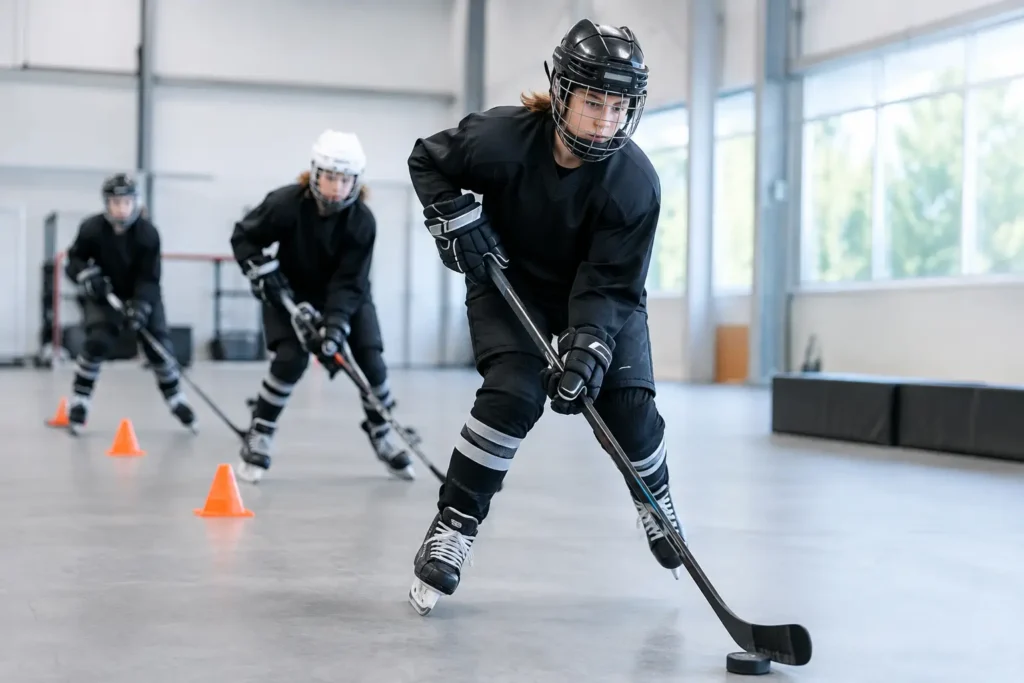
A youth hockey team skating session should never feel like players are simply racing cones. Game speed comes from a stride that holds up through starts, stops, puck battles, tight turns, and late shifts. The goal of youth hockey team skating is to help every player move more efficiently, then give the group a shared standard for how speed, posture, and effort show up in games.
For coaches and parents, the challenge is familiar. A team may practice several times a week, but individual skating corrections can get lost between systems work, drills, and scrimmages. Players who need help with knee bend, edge control, or stride recovery may repeat the same movement pattern for an entire season without anyone having time to stop and address it.
Focused off-ice team training creates room for that correction. It gives players high-quality repetitions without the interruptions of a full on-ice practice, while coaches can connect each technical detail to a real hockey situation. More power. Better stride mechanics. Maximum speed that carries into the game.
Why Youth Hockey Team Skating Needs a Clear Purpose
Speed is not one skill. A player can look quick in a straight line and still lose races because they cannot accelerate out of a crossover, recover their stride after contact, or stop efficiently before changing direction. Strong team skating development addresses the pieces that make speed usable: body position, edge pressure, force production, balance, and recovery.
For younger players, the work may start with athletic posture and confidence on one leg. They need to understand what it feels like to load the inside edge, drive through full extension, and return the skate under the body instead of letting it swing wide. For older or more competitive players, the focus may shift to explosive first steps, deeper knee and hip flexion, crossover efficiency, and maintaining power when fatigue sets in.
That is why a single generic skating drill does not serve every roster equally. A U9 player and a U15 player can train the same fundamental pattern, but the coaching language, resistance, tempo, and expected output should be different. The standard stays high. The path to reach it changes with the athlete.
The Mechanics Behind a Faster Team
A powerful skating stride begins with a stable athletic position. Players need a forward body angle, knees flexed over the toes, hips engaged, and chest positioned to support balance rather than pull them upright. When athletes skate too tall, their legs cannot apply force effectively. They often compensate by taking fast, shallow steps that create effort without much acceleration.
From there, the push must travel through the edge. Efficient skaters do not simply kick backward. They load the skate, apply pressure through the ice, extend through the leg, and recover the skate underneath their body to repeat the movement quickly. That recovery matters. A long stride can look impressive, but if the player takes too long to bring the skate back under their hips, they may lose their ability to apply the next powerful push.
Team sessions should also train the transitions that decide possession. First-step acceleration, forward-to-backward movement, crossover starts, tight turns, and stops are where small technical leaks become major gaps. A player who needs two extra steps to get moving may not arrive late by much, but in hockey, a half-second is often the difference between a clean breakout pass and a turnover.
Skating Treadmill Training Makes Movement Visible
A skating treadmill creates a valuable coaching environment because athletes can repeat a movement at a controlled speed while receiving immediate feedback. Instead of trying to identify a stride issue during a quick on-ice drill, a coach can isolate the pattern, demonstrate the correction, and have the player feel the difference on the next repetition.
Video analysis strengthens that process. Many young athletes think they are getting low or extending fully because they are working hard. Seeing their stride on a display gives them a clearer reference point. They can compare what they feel with what they are actually doing, then make a specific adjustment rather than guessing.
The treadmill is not a replacement for ice. It is a tool for building the movement quality that players need on ice. The strongest development plans use both: controlled off-ice repetitions to establish mechanics and on-ice practice to apply those mechanics in changing, competitive situations.
Building Team Sessions That Transfer to Games
The best team skating sessions have a simple progression. Players first learn the position and movement. Then they repeat it with enough quality to make the pattern more reliable. Finally, they are challenged to execute it under a game-like demand, whether that means a faster tempo, a directional change, puck handling, or a competitive finish.
Coaches should avoid filling a session with too many unrelated drills. If the objective is acceleration, players need repeated exposure to acceleration mechanics. A session can include different exercises, but each should reinforce the same outcome: better forward lean, stronger pushes, quicker recovery, and more explosive first steps.
A useful team format may include a short movement assessment, technical treadmill repetitions in small groups, video review, and competitive application work. Players stay active, but they also receive enough coaching to understand why a correction matters. This is especially effective when a team is preparing for a faster level of competition or trying to correct a recurring issue such as slow starts, weak puck-race habits, or difficulty defending off the rush.
At Pro Stride Hockey, team development can be delivered in a purpose-built 3,600-square-foot training center where athletes rotate through skating, shooting, and skills work. The environment allows coaches to create more repetitions than a standard team practice while keeping instruction focused and energetic.
Why Small Groups Matter for Team Development
A full team can train together and still receive individualized coaching. The key is how the session is organized. When athletes work in small stations, coaches can observe details that disappear in a large line: a player collapsing at the ankle, failing to finish the push, crossing over with poor posture, or opening their shoulders too early in a turn.
Small-group coaching also helps athletes feel safe making adjustments. Young players can be hesitant when they believe a correction means they are behind their teammates. A patient coach reframes the process. Every athlete has a next step, and identifying it is a strength, not a weakness.
For parents, visible progress often starts with confidence. A player who understands how to create speed is more willing to pursue loose pucks, support the play through the middle, and recover after a mistake. Better mechanics can improve performance, but the willingness to use those skills under pressure is what changes a player’s game.
Measuring Progress Beyond a Faster Time
Timed sprints have value, particularly for older players working toward competitive benchmarks. But a team should not judge skating development by one number alone. Coaches should watch for cleaner starts, fewer wasted steps, stronger posture late in a shift, improved ability to stop and restart, and more successful puck races during games.
Video provides a useful baseline. Record a player’s stride early, identify one or two priorities, and review the same movement weeks later. The goal is not perfection in a single session. It is measurable improvement in a pattern that supports game performance.
There are trade-offs. Players who are rebuilding inefficient habits may initially feel slower because they are thinking about their body position and stride path. That is normal. Technical change takes repetition before it becomes automatic. Rushing through that stage can reinforce the very habits the athlete is trying to replace.
A Better Standard for Team Speed
The fastest-looking team is not always the team that skates best. Sustainable team speed comes from players who can move efficiently, repeat their mechanics under fatigue, and make quick skating decisions when the game becomes chaotic. It comes from defensemen who can escape pressure, forwards who can win the first three steps, and every player who can recover into the next play.
Give athletes the coaching, repetitions, and feedback to understand their stride. Then challenge them to bring that work to every race, every backcheck, and every shift when the game is on the line.