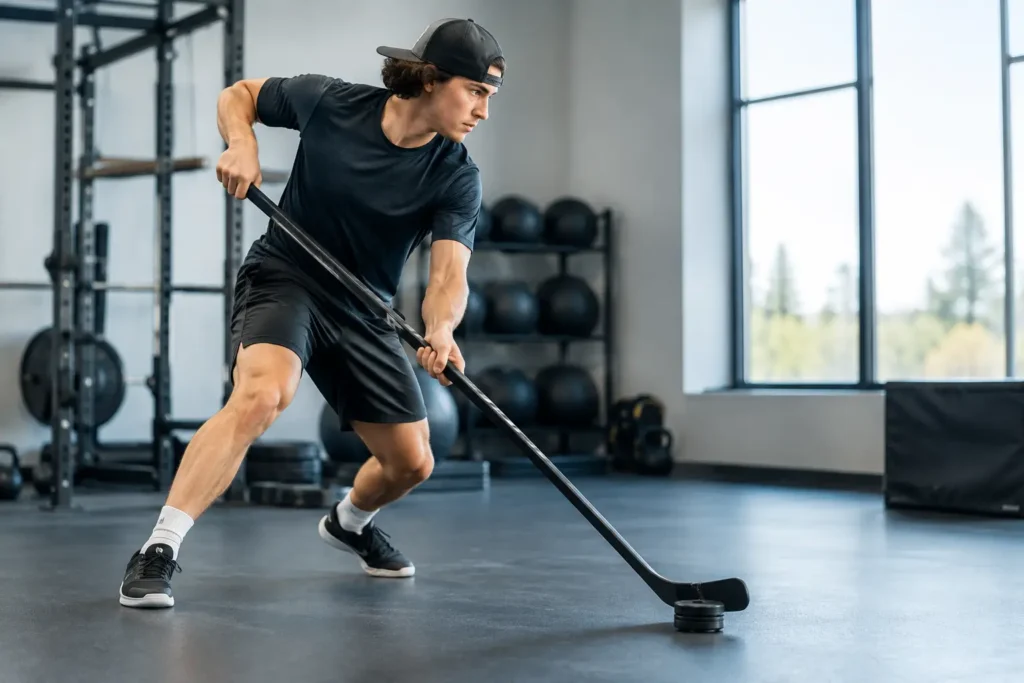
A harder shot is not created by telling a player to shoot harder. It is created when the blade, hands, hips, trunk, legs, and ice contact work in the right order. Hockey shot power training gives athletes a repeatable process for building force without sacrificing accuracy, deception, or the ability to release the puck under pressure.
For young players, this distinction matters. A big windup may look powerful in a shooting lane, but it will not help much if the puck takes too long to leave the blade in a game. The goal is not simply a higher radar number. The goal is a shot that gets through traffic, arrives quickly, and can be used from the player’s actual game position.
What Creates a Powerful Hockey Shot?
Shot power starts from the ground up. Whether an athlete is working on a wrist shot, snap shot, or slap shot, the lower body establishes a stable base and begins the transfer of energy. The hips and trunk then rotate or shift into the shot, while the hands create leverage on the stick. Finally, the blade loads, bends, and releases the puck toward the target.
When one link is late or missing, players often try to compensate with their arms. That usually produces a shot that looks busy but lacks pace. It can also create inconsistent accuracy, especially when the athlete is moving or shooting from an uncomfortable stance.
A stronger shot is not always a bigger motion. In fact, advanced players often create more power with less visible effort because their sequence is efficient. Their weight arrives at the right time, their bottom hand moves away from the body to create a lever, and their blade stays on the puck long enough to direct it.
Hockey Shot Power Training Starts With Assessment
Before adding more repetitions, identify what is limiting the shot. Two athletes may both want more velocity but need completely different corrections. One player may have strong hands but poor weight transfer. Another may create good lower-body force but pull the puck too far behind the body, costing them release speed and accuracy.
A quality assessment looks beyond whether the puck hits the net. Coaches should watch the player’s stance, puck position, hand separation, shoulder and hip alignment, blade contact, follow-through, and recovery after the shot. They should also watch shots from multiple positions: stationary, off a pass, in stride, and after a change of angle.
Immediate video feedback is especially valuable here. Young athletes often feel as though they are transferring weight or keeping their hands in front, only to see that their movement tells a different story. Reviewing a clip right after a repetition makes technical coaching specific. Instead of hearing “use your legs,” an athlete can see where their hips stopped, where the puck drifted, or why their blade opened early.
Build the Base Before Chasing Velocity
Power needs a stable platform. If a player cannot control their posture or balance while loading into a shot, adding resistance or asking for maximum effort can reinforce poor habits. This is why off-ice shooting training should include athletic positions, not just hundreds of pucks fired at a target.
Start with a balanced stance that matches the shot. For a wrist or snap shot, the athlete needs enough knee and hip flexion to move into the puck while keeping the chest controlled. The feet should allow a clear transfer toward the target, rather than locking the player into a narrow, upright position. For a slap shot, athletes need room to shift, load the stick, and strike the ice just before the puck.
Core strength matters, but hockey players do not need to become bodybuilders to shoot harder. They need the ability to resist unwanted rotation, transfer force from the lower body through the trunk, and stay connected during an explosive movement. Controlled split-stance holds, rotational work, and single-leg balance can support shooting mechanics when they are coached for the player’s age and stage of development.
The trade-off is simple: strength work can improve force potential, but it cannot replace skill. A player who becomes stronger without improving their sequence may simply become better at repeating the same inefficient shot.
Train the Hands and Stick as a Lever
The stick is not just an object the player holds. It is a lever that stores and releases energy. Hand position determines whether an athlete can load that lever effectively.
The top hand guides the puck and helps pull the stick through the shooting path. The bottom hand creates separation from the body, giving the shaft room to flex. When both hands stay tight to the hips, the player loses leverage. When the bottom hand reaches too far or too early, the player can lose control and pull the puck off line.
A productive drill does not merely ask for more shots. It gives the athlete one technical intention. For example, a player may shoot ten pucks with a focus on moving the bottom hand forward while keeping the puck just ahead of the body. The next set may focus on maintaining blade contact through the release. Small, deliberate sets make it easier to recognize improvement and avoid mindless repetition.
Stick flex also deserves attention. A stick that is too stiff may prevent a smaller or younger athlete from loading the shaft. A stick that is too whippy can make puck control and accuracy harder for a stronger player. Equipment should support the athlete’s mechanics, not force the athlete to adapt to equipment that does not fit.
Turn Mechanics Into a Faster Release
Game power depends on release speed. Players rarely have unlimited time to pull the puck back, load their feet, and take a full shot. They need to create pace from a compact motion.
Once foundational mechanics are consistent, athletes should practice shots from realistic puck locations. Work from the forehand side, off the back foot, after a lateral pull, and after receiving a pass. These variations teach the player to keep their hands available and their blade prepared rather than resetting before every rep.
Accuracy still matters. A shot with more velocity but no target control is not a scoring weapon. Use small targets, corners, and shooting lanes that require the puck to stay low or travel through a simulated screen. Athletes should learn when to choose maximum power and when a quick, accurate release is the better option.
This is where training should become progressively demanding. Begin with clean technical reps. Add a target. Then add movement, a time constraint, or a decision. If mechanics collapse, reduce the challenge briefly and rebuild. Development is not linear, and a player who is growing quickly may need to revisit positions that felt automatic a few months earlier.
Make Repetition Measurable
Purposeful repetition is one of the biggest differences between casual shooting and performance training. A player can shoot 200 pucks with no feedback and repeat the same error 200 times. A better session defines the shot, the target, the technical focus, and the outcome that will be tracked.
For example, an athlete might complete sets of snap shots from three locations, recording target hits and noting whether their release stayed compact. Another player may use video to compare their first and final repetitions, checking puck position and hand separation. The best measurement depends on the athlete. Velocity can be useful, but accuracy percentage, release consistency, and shot execution while moving often tell a more complete story.
At Pro Stride Hockey, small-group and private instruction allow coaches to correct details in real time rather than waiting until a poor pattern becomes permanent. With a maximum of four athletes and a 2:1 player-to-coach ratio in private sessions, players can receive the repetitions they need while still getting individual technical direction.
A Smart Weekly Approach
For most youth players, two or three focused shooting sessions each week are more productive than one long session performed with poor mechanics. A session can be short and still create progress when the player arrives with a clear objective.
One day may emphasize mechanics and blade contact. A second day can focus on quick-release shooting from different puck positions. A third, if appropriate, can challenge the player to shoot after movement or fatigue. Off-ice strength and mobility work should support these sessions, especially hip mobility, trunk control, and lower-body stability.
Players should also leave room for recovery. Sore wrists, elbows, shoulders, or lower backs are not badges of honor. Pain that persists should be addressed early, and young athletes should not be pushed into high-volume shooting simply because older players are doing more. Quality reps, proper stick fit, and patient progression protect both confidence and long-term development.
The most valuable shot is the one a player trusts when the puck arrives in a tight game. Build that trust one well-coached repetition at a time: stable base, connected hands, efficient release, clear target, then repeat it until power becomes part of the player’s natural game.