Table of Contents
- What Hockey Development for Competitive Players Means
- Hockey Skating Development: Building Speed and Stride Efficiency
- Hockey Shooting Training: Developing Accuracy and Confidence
- Off-Ice Hockey Training: Translating Skills to Game Performance
- Building a Hockey Development Program That Works
- Measuring Progress and Adjusting Your Development Plan
- Common Mistakes in Hockey Development
- Your Path to Competitive Excellence
- Frequently Asked Questions
Last Updated: October 11, 2026
What Hockey Development for Competitive Players Means
Hockey development for competitive players is a structured approach to building elite-level skating speed, shooting accuracy, and game awareness through personalized coaching and specialized training methods.
Competitive hockey demands deliberate practice designed to push athletes beyond their comfort zones. The difference between a player who makes the provincial team and one who doesn’t often comes down to how effectively they’ve trained their fundamentals during the off-season.
The most competitive players treat their off-season training with the same intensity as their in-season games. They understand that small improvements in stride efficiency or shot accuracy compound into significant advantages when the season starts.
Hockey Skating Development: Building Speed and Stride Efficiency
Skating is the foundation of every skill in hockey. A player with superior stride mechanics will always outpace someone relying on raw leg strength alone. Hockey development for competitive players must prioritize stride efficiency because it directly translates to speed, agility, and endurance on the ice.
Stride Mechanics and Power Transfer
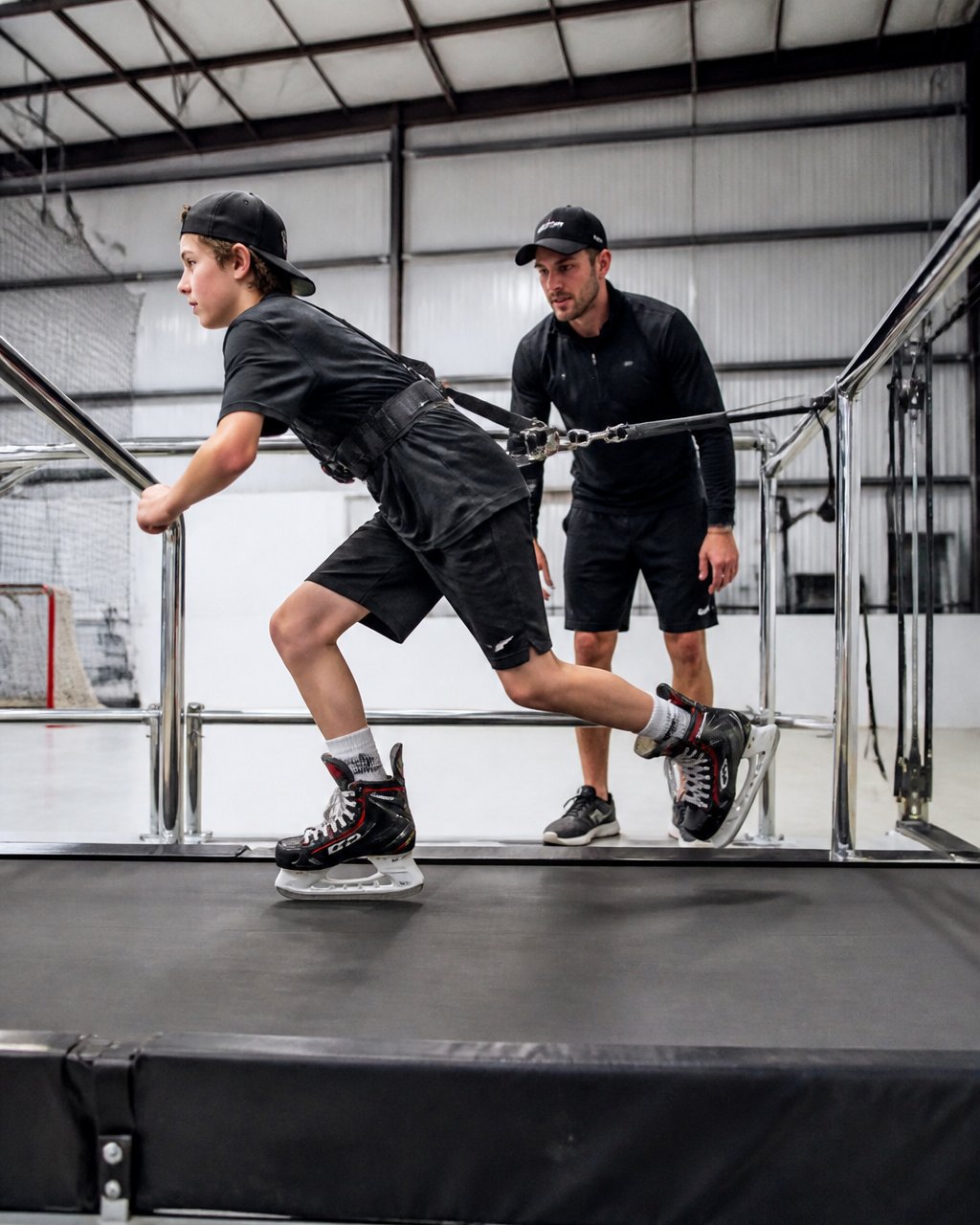
Proper stride mechanics involve coordinated movement of your hips, knees, and ankles to generate forward propulsion with minimal energy waste.
Power comes from hip extension, which engages your glutes and core, the largest muscle groups in your body.
Acceleration and Edge Control
Acceleration separates elite players from good ones. Edge control, using the inside and outside edges of your blade to change direction, allows you to maintain speed while shifting laterally.
Edge control drills isolate weight transfer and blade positioning, teaching your body to feel the difference between inside and outside edges. The progression moves from static balance work to dynamic movement patterns that mimic game situations.
Hockey Shooting Training: Developing Accuracy and Confidence
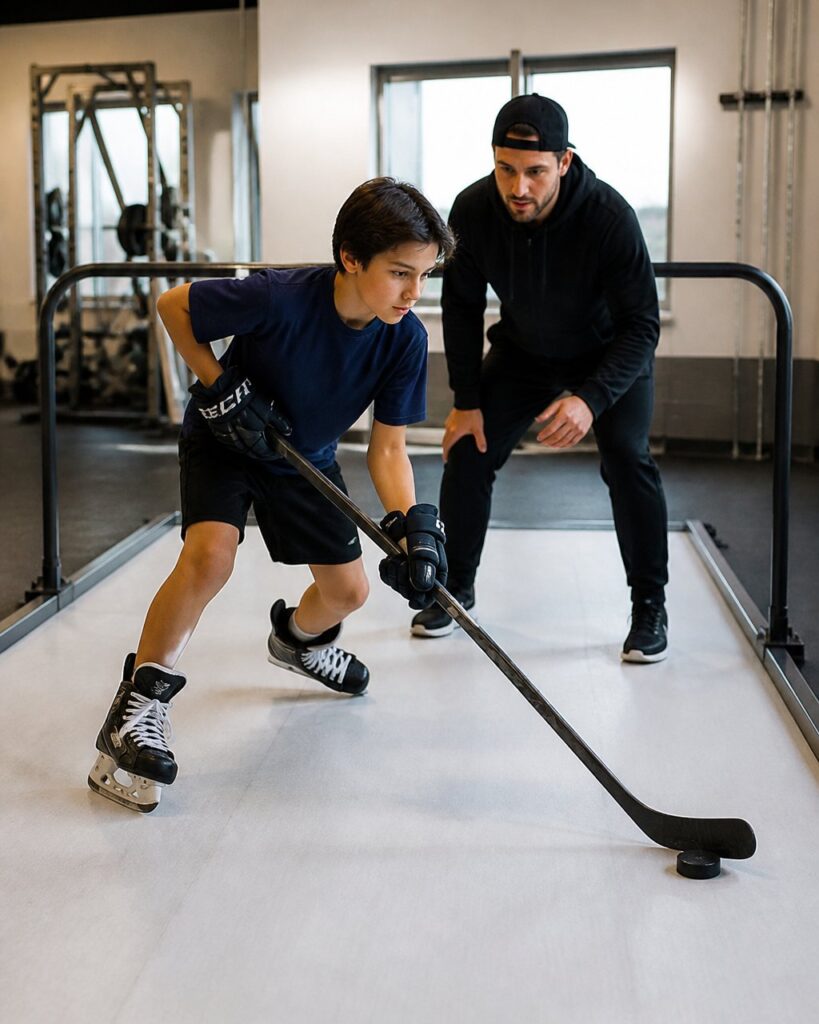
In competitive hockey development, shooting accuracy and shot speed are trained separately and deliberately, not as an afterthought at the end of practice.
Shot Mechanics and Release
A consistent shot starts with consistent mechanics: stance, weight distribution, stick position, and follow-through. The release is where many competitive players lose accuracy.
Pro Stride Hockey’s specialized shooting lane facility allows players to shoot. The progression moves from stationary shots to shots off the pass, then to game-speed scenarios.
Game-Situation Shooting Drills
Hockey development for competitive players must include shooting drills that replicate game conditions: limited time, defensive pressure, and shooting from various positions.
Effective game-situation drills include one-timers off passes, snap shots in tight spaces, and backhand shots under fatigue. Confidence in your shot comes from thousands of repetitions where you’ve succeeded.
The players who score consistently in games are those who’ve taken thousands of shots in practice. They trust their mechanics because they’ve proven them repeatedly. This trust is what separates competitive shooters from inconsistent ones.
Off-Ice Hockey Training: Translating Skills to Game Performance
Off-ice training in hockey development for competitive players isolates and refines one skill element in a controlled setting, then systematically adds complexity until the skill transfers to game speed and game pressure.
The Off-Ice Training Progression Model
Structured off-ice training follows a four-stage progression:
Stage 1: Mechanics Isolation. Using a skating treadmill, you focus entirely on one mechanical element, hip extension, knee drive, blade positioning, or weight transfer, without managing ice surface variables, opponent pressure, or game speed. This stage builds neuromuscular awareness and muscle memory for the correct movement pattern.
Stage 2: Skill Combination. Once the isolated mechanic is solid, you combine it with related skills. For example, after mastering hip extension in a straight-line stride, you add crossover mechanics, then edge transitions.
Stage 3: Environmental Complexity. You introduce variables that mimic game conditions: fatigue, time pressure, or decision-making. This stage bridges the gap between practice and game.
Video Analysis and Objective Feedback
Video analysis identifies specific, measurable deviations from the intended movement pattern. Effective video feedback follows a structured process:
Baseline Recording. Record your skating stride and shot form from multiple angles (front, side, rear). Note stride frequency, stride length, hip height, knee bend angle, and weight distribution. For shooting, record stance width, stick angle, weight transfer, and follow-through position.
Comparison Analysis. Every 2-3 weeks, record the same movements from the same angles and compare to your baseline.
Coaching Annotation. A coach reviews the footage and marks specific frames where deviations occur, allowing you to target the exact problem.
Athlete Self-Review. Watching your own footage builds proprioceptive awareness and reveals gaps between how your movement feels and how it actually looks.
Measuring Transfer to Game Performance
The ultimate test of off-ice training is whether it improves on-ice performance. Track these metrics:
- Skating speed: Time yourself over 10, 20, and 30 meters on-ice.
- Shot accuracy: Record your shot accuracy percentage from the slot, point, and off-wing positions.
- Agility and edge control: Measure time to complete a figure-eight.
- Fatigue resilience: Compare your skating speed and shot accuracy in the first period versus the third period.
If on-ice metrics are not improving after 6-8 weeks of consistent off-ice training, the program needs adjustment. Video analysis and coaching feedback help identify the bottleneck.
Off-ice training is only valuable if it transfers to on-ice performance. Use video analysis to confirm that mechanics are actually changing, and use on-ice metrics to confirm that the mechanical changes are producing competitive results. If either link breaks, adjust the program.
Building a Hockey Development Program That Works
A structured hockey development program for competitive players combines multiple training modalities: on-ice skill work, off-ice conditioning, video analysis, and personalized coaching feedback. The program must be progressive, starting with foundational mechanics and advancing toward game-speed execution.
Personalized Coaching and Small-Group Training
Each player has unique strengths, weaknesses, and learning styles. Personalized coaching adjusts the program to address your specific needs.
Small-group training creates accountability while maintaining personalization. Pro Stride Hockey’s 2:1 player-to-coach ratio in sessions ensures every athlete receives meaningful instruction and correction.
Video Analysis and Performance Tracking
Tracking progress is essential for maintaining motivation and identifying areas for improvement. Video analysis provides objective feedback on whether your stride mechanics have actually improved.
Measuring Progress and Adjusting Your Development Plan
Hockey development for competitive players requires measurable progress. Without clear metrics, you can’t distinguish between genuine improvement and the feeling of working hard.
Establishing Baseline Measurements
Skating Baselines:
- Acceleration time: Time yourself from a standstill to 10 meters and 20 meters. Perform three trials and record the average.
- Stride frequency: Count strides over 20 meters at game speed. Higher frequency correlates with better acceleration and agility.
- Edge control: Time how long it takes to complete five figure-eights at game speed.
- Stride consistency: Video-record your stride from the side and measure stride length. Asymmetry indicates a mechanical imbalance.
Shooting Baselines:
- Shot accuracy from the slot: Take 20 shots from the slot and record how many hit the target area.
- Shot accuracy off the pass: Take 20 one-timer shots from the slot and record accuracy.
- Shot speed: Record your shot speed from a stationary position and off a pass. Track wrist shots and snap shots separately.
- Shot release time: Measure the time from when you receive the puck to when it leaves your stick.
Game Performance Baselines:
- Points per game: Track your goals and assists over a 10-game sample.
- Shots on goal per game: Record how many shots you take per game.
- Plus-minus rating: Track your plus-minus over a season.
- Shift efficiency: Record your average shift length and points per shift.
Testing and Retesting Protocol
Retest every 4 weeks using the same protocol each time so results are comparable.
Retest Process:
- Perform a full warm-up.
- Perform three trials of each metric and average the results.
- Compare the average to your previous test result. A 2-3% improvement is meaningful; 5%+ indicates significant progress.
- Record results in a spreadsheet or notebook to track trends.
Interpreting Results and Adjusting Your Program
Progress is not always linear. The key is tracking the overall trend over 8-12 weeks.
Positive Trend (Improvement Every 4 Weeks): If your metrics are improving consistently, continue with the current approach for another 4-8 weeks before making major changes.
Plateau (No Change Over 8 Weeks): If your metrics are flat despite consistent training, the program needs adjustment.
Regression (Performance Declining): If your metrics are getting worse, take 3-5 days of reduced training or active recovery.
Adjusting Based on Data
When you identify a specific weakness, adjust your program to address it:
- Increase drill frequency: Add a second session per week focused on your weak spots.
- Change drill type: Try a different approach if a drill isn’t producing results.
- Address prerequisites: Drill foundational skills before returning to advanced work.
- Reduce volume elsewhere: If recovery is inadequate, reduce volume in lower-priority areas.
Commit to a program for at least 8-12 weeks and retest at the 4-week and 8-week marks before deciding whether to adjust. Patience and consistency are more important than constant variation.
Seasonal Adjustment
Your development plan should change across the season. During the off-season, focus on building foundational skills and strength. During the pre-season, emphasize game-speed execution and conditioning. During the regular season, prioritize maintenance and refinement. During the post-season, focus on recovery and addressing weaknesses.
Common Mistakes in Hockey Development
Neglecting the fundamentals. Players often chase advanced techniques before mastering basic stride mechanics or shot form.
Training in isolation. Practicing skating separately from shooting creates a disconnect.
Ignoring recovery. Improvements happen during recovery, not during the session itself.
Comparing yourself to others. Focus on your own metrics and your own improvement trajectory.
Your Path to Competitive Excellence
Hockey development for competitive players is a deliberate, structured process. It requires personalized coaching, specialized training methods, and a commitment to measurable progress.
Pro Stride Hockey provides the framework and coaching expertise to accelerate your development.
The difference between a competitive player and an elite one is often measured in hours of deliberate practice and access to expert coaching.
Frequently Asked Questions
How can competitive hockey players improve their skating?
Competitive players improve skating through focused work on stride mechanics, edge control, and explosive acceleration. Off-ice training on specialized equipment allows you to isolate technique without game pressure. Combine treadmill work with video analysis to identify inefficiencies in your stride. Most players see measurable improvements in speed and agility within 4-6 weeks of consistent, structured training focused on proper mechanics.
What is the best hockey development program for competitive players?
The best hockey development program combines personalized coaching, small-group training (ideally 2:1 player-to-coach ratios), and objective performance tracking. Look for programs that teach game-applicable skills, use video analysis to show you exactly what to improve, and adapt drills to your specific weaknesses. A strong program pushes you out of your comfort zone while building confidence and emotional maturity alongside technical skills.
Can off-ice hockey training improve my skating and shooting?
Yes. Off-ice training isolates specific skills in a controlled environment where you can focus entirely on technique without the chaos of game speed. Skating treadmills let you work on stride efficiency. Specialized shooting facilities allow you to build skills. These skills transfer directly to on-ice performance when trained with purpose and proper coaching.
How often should a hockey player train to improve?
Competitive players typically benefit from 2-3 focused development sessions per week alongside their regular team practice. The frequency depends on your current level and goals. Consistency matters more than volume; regular, purposeful training with qualified coaching produces better results than sporadic intense sessions. Recovery between sessions is equally important, overtraining without proper rest can lead to plateaus or injury.
How do you measure progress in hockey development?
Measure progress objectively: track skating speed, acceleration times, and stride efficiency through video analysis and treadmill data. Monitor shot accuracy by counting successful shots in drills. Assess game performance by tracking goals, assists, and decision-making in competitive play. Regular testing and video review show exactly what’s improving and where to focus next. This removes guesswork and keeps your development plan aligned with measurable results.
Is individualized hockey coaching worth it for competitive players?
Yes, especially for competitive players with specific goals. Individualized coaching identifies your unique strengths and weaknesses, then tailors drills to address them directly. A coach can correct technique in real time, push you appropriately, and design a progression plan that builds on your improvements. The 2:1 player-to-coach ratio ensures attention while maintaining affordability compared to pure 1-on-1 lessons, making personalized development accessible without excessive cost.
Ready to take your hockey development to the next level? Book a session with Pro Stride Hockey and experience personalized coaching designed to push you out of your comfort zone and unlock your full potential on the ice.