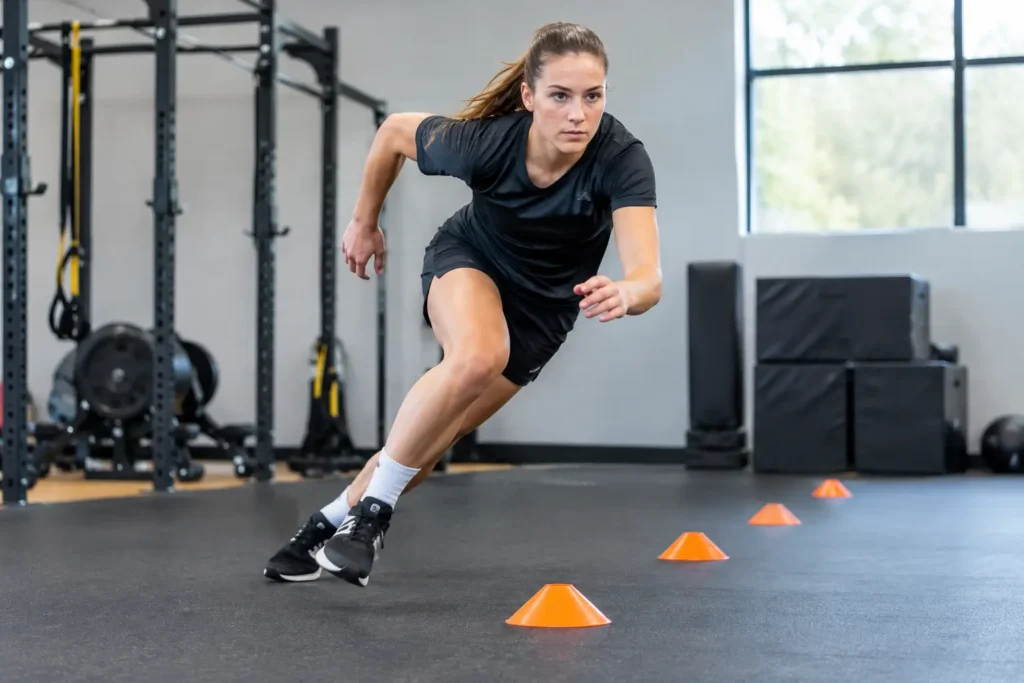
The first three strides often decide the play. A loose puck, a race through the neutral zone, a quick recovery after a turnover – each demands force, balance, and efficient movement before a player reaches top speed. Effective hockey speed training is not simply about telling athletes to work harder. It is about teaching them how to create more power in every stride and apply it when the game speeds up.
For young players, speed can feel like a talent they either have or do not have. In reality, skating speed is a skill. Players can improve it through technical coaching, purposeful repetition, and training that connects off-ice work to the positions and movements they use on the ice.
What Actually Creates Hockey Speed?
Straight-line speed matters, but hockey players rarely skate in a straight line for long. They start, stop, accelerate out of turns, change direction, and recover their edges under pressure. A faster player is usually not the one taking the most strides. They are the player creating more force in the right direction with each stride.
A powerful skating stride begins with posture. The athlete needs a stable, athletic base with knees and hips bent, chest controlled, and weight balanced over the skating surface. From there, the stride should drive out to the side and slightly back, using a full extension through the hip, knee, and ankle. When a player stands too tall, pushes straight behind them, or returns the skate slowly under their body, valuable power disappears.
Acceleration also requires a different approach than top-end speed. Early strides need to be compact, aggressive, and angled to move the body forward quickly. Once the player has built momentum, the stride can lengthen without losing edge pressure or body position. Training both phases matters. A player who looks smooth at full speed but cannot win the first five feet will still lose races in games.
Hockey Speed Training Starts With Mechanics
Speed work without technical correction can reinforce the exact habits holding a player back. More repetitions only help when the movement pattern is worth repeating.
Common issues are easy to miss during a busy team practice. A player may drop their chest, allow their knees to collapse inward, cut their stride short, or fail to recover the skate underneath their body. Each problem reduces power and can make skating more tiring. Younger athletes may simply lack the awareness to feel what is wrong, while older players sometimes rely on effort to compensate for an inefficient stride.
This is where small coaching groups make a real difference. At Pro Stride Hockey, private sessions are limited to a 2:1 player-to-coach ratio, with no more than four athletes. That gives coaches time to identify the specific movement limiting a player, demonstrate the correction, and have the athlete repeat it while the feedback is still fresh.
A good speed session does not overload a player with ten changes at once. It may focus on one priority, such as deeper knee flexion through the first three strides or a cleaner recovery under the hips. Once that movement becomes more consistent, the next layer can be added. Progress is built through clear, repeatable details.
Why Video Feedback Changes the Learning Process
Players often understand a correction only after they see it. Immediate video analysis can show the difference between what an athlete feels they are doing and what their body is actually doing.
For example, a player may believe they are getting low in their skating stance, but video may reveal that their hips rise as soon as they begin accelerating. Another athlete may think they are taking a long, powerful stride, yet their skate may be leaving the surface before full extension. Seeing those moments on a screen creates a stronger connection between coaching language and movement.
The goal is not to make athletes overly analytical. It is to give them a clear picture, a simple adjustment, and another quality repetition. Over time, better mechanics become more automatic.
Train Acceleration, Not Just End-to-End Speed
A full-ice sprint is useful, but it does not represent every speed demand in hockey. Many game-changing races happen over short distances: the first few steps to a loose puck, a quick escape from pressure, or a burst to close on an opponent in the defensive zone.
Acceleration training should include powerful starts from multiple positions. Players need to learn how to create force from a still stance, after a stop, while transitioning from backward to forward skating, and after receiving a pass. The body position changes slightly in each situation, but the same principles remain: low hips, strong edge pressure, efficient arm action, and a direct line of force.
Skating treadmill training is especially valuable for this type of work because it allows athletes to repeat a specific movement pattern without waiting for a line change or resetting across the ice. Coaches can adjust the pace, observe each stride closely, and make corrections in real time. The player receives more meaningful repetitions in an hour than they would get from simply skating laps.
There is a trade-off, however. Treadmill work should support on-ice skating, not replace it. Players still need ice time to learn puck management, timing, awareness, and speed under game pressure. The strongest development plan uses focused off-ice instruction to improve the mechanics, then gives the athlete opportunities to apply those improvements on the ice.
Build Strength That Supports the Stride
Speed is not only a technical issue. Players also need the physical capacity to hold a strong position and generate force repeatedly.
For youth athletes, that does not mean chasing heavy weight or training like a fully developed professional. It means learning to control their body. Squat patterns, lunges, single-leg balance, jumps, core stability, and lateral movement can all support skating when they are coached appropriately. The purpose is to improve force production, coordination, and resilience – not to exhaust the athlete for the sake of a hard workout.
Single-leg control deserves special attention. Hockey is built on alternating pushes from one leg to the other. If a player cannot stabilize over one hip, they may lose balance during their stride, leak power through the knee, or struggle to maintain clean edges through turns. Better balance creates a stronger platform for speed.
Mobility matters as well. Limited ankle, hip, or thoracic mobility can restrict skating depth and extension. The right solution depends on the athlete. Some players need more strength to stay low; others need better movement range or a cleaner technical pattern. Individual assessment prevents a one-size-fits-all program from wasting valuable training time.
Make Speed Transfer to Real Hockey
A player can look fast in a drill and still struggle to use that speed in a game. Transfer happens when training includes decision-making, puck control, and realistic movement demands.
Once an athlete has improved their stride mechanics, add a puck. Can they accelerate while protecting it? Can they carry speed through a change of direction? Can they get into shooting position without losing their skating posture? These are the details that turn faster skating into more offensive opportunities.
Team sessions can also target speed within game situations. Short-area races, transition patterns, forechecking routes, and offensive-zone entries give players a reason to use their acceleration. Coaches can reinforce that speed is not just about moving quickly. It is about arriving on time, under control, and ready to make the next play.
Parents should also expect progress to look different from player to player. A younger athlete may show improvement through better balance and confidence before their speed becomes obvious. A competitive player may gain separation through more efficient starts rather than a dramatic change in top speed. The goal is measurable progress that fits the athlete’s age, development stage, and current skating needs.
A Better Standard for Speed Development
The best hockey speed training creates athletes who can trust their stride. They know how to get low, drive power through the ice, recover efficiently, and keep moving when the play becomes chaotic. That confidence changes how a player attacks a puck battle, joins a rush, or recovers defensively.
More power. Better movement. Maximum speed begins with the next quality repetition.