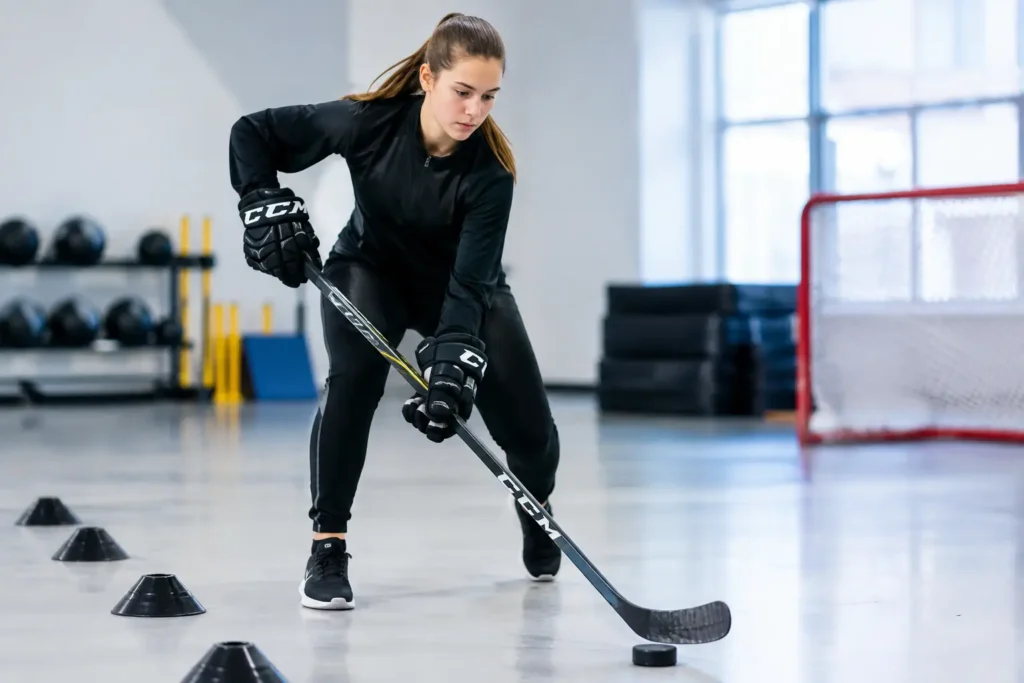
A hockey skills academy should do more than keep a player busy between team practices. It should identify the small technical details holding them back, give them enough quality repetitions to change the movement, and build confidence that carries into the next game. For young players, that might mean a stronger first three strides. For a competitive athlete, it may mean getting a release off before a defender closes space.
Team practices are essential, but they are built around the needs of a full roster. Coaches must install systems, run drills, manage lines, and prepare for games. Individual feedback can be limited, especially when players are moving quickly through a drill. A dedicated development setting creates time for a coach to watch, demonstrate, correct, and repeat until a skill becomes more natural.
What a Hockey Skills Academy Is Meant to Solve
Most players do not need more random drills. They need clear coaching on the parts of their game that are limiting performance. A player may work hard every practice yet lose races because their stride recovery is too wide. Another may have a hard shot but lose scoring chances because their hands, feet, and puck position are not connected during the release.
A strong academy begins with observation. Coaches look at how an athlete moves, not simply whether they finish the drill. They assess posture, edge use, knee drive, arm action, weight transfer, puck placement, shooting sequence, and balance under pressure. From there, training has a purpose. The athlete understands what to change, why it matters, and how to practice it correctly.
That individual focus is especially valuable during key development years. Young players are building movement patterns that can stay with them for years. Patient correction early can prevent inefficient habits from becoming difficult to break later. For older athletes, focused training helps refine the details that separate a good player from a faster, more reliable, more dangerous one.
Why Small Coaching Ratios Change Development
The number of athletes in a session matters. In a large group, players can get plenty of activity but limited correction. They may repeat the same mistake 30 times before a coach has a chance to address it. Repetition only creates improvement when the movement being repeated is technically sound.
Private and small-group instruction gives coaches the capacity to respond in real time. At Pro Stride Hockey, private sessions maintain a 2:1 player-to-coach ratio with a maximum of four athletes. That format keeps players moving while allowing coaches to slow down, demonstrate a correction, and immediately check whether the athlete can apply it.
This is not about making training easy. Effective development asks players to be accountable for details. It is about making hard work productive. When an athlete receives a specific cue, such as driving through the full skating extension or keeping the puck loaded in the shooting pocket, they have something concrete to work on during every repetition.
Small groups can also be an excellent fit for teammates or friends with similar goals. The right group adds energy and competition without allowing anyone to disappear into the back of the line. The best format depends on the athlete. A player rebuilding mechanics after an injury or addressing a major stride issue may benefit most from private instruction. A player sharpening skills alongside peers may thrive in a small group.
Train the Stride, Not Just the Speed
Speed is often discussed as if it is a simple physical trait. In hockey, speed is a technical skill. It comes from how efficiently a player applies force into the ice, recovers each leg, controls body position, and accelerates through the first few steps.
A skating treadmill is valuable because it gives athletes a controlled environment to work on the stride itself. Instead of chasing a puck or reacting to traffic, the player can focus on body position and movement quality. Coaches can isolate parts of the stride, build proper habits, and progress the work as the athlete improves.
Immediate video analysis makes those lessons clearer. A player may feel like they are getting low in their stride, but video can show whether their chest is actually rising or whether their recovery leg is swinging too far behind the body. Seeing the movement on a 55-inch display turns a vague coaching point into a visible adjustment.
The goal is not to create one identical stride for every athlete. Players have different body types, growth stages, strengths, and experience levels. Good coaching respects those differences while still developing the core mechanics that produce more power, better balance, and maximum speed.
Progress Needs to Match the Athlete
An introductory player may need to develop comfort, coordination, and a strong athletic stance before working at higher speeds. An advanced player may need more detailed work on crossover efficiency, acceleration angles, or maintaining mechanics when fatigue sets in. The standard should be high for both athletes, but the path should be appropriate for where they are today.
That approach also protects confidence. Players improve faster when they are challenged without being overwhelmed. A coach who can adjust a drill, explain the purpose, and recognize progress helps athletes stay engaged through the uncomfortable part of learning a new movement.
Better Shooting Starts With Better Mechanics
Goal scoring is not just about shooting hard. A quick, accurate shot depends on efficient mechanics, timing, puck position, lower-body connection, and the ability to make decisions under pressure. A player who can release the puck from multiple positions becomes much harder for goaltenders and defenders to read.
A synthetic-ice shooting lane gives players the repetitions needed to develop those skills. Rather than taking a few shots at the end of a team practice, athletes can focus on the exact elements of the release: hand placement, weight transfer, blade contact, follow-through, and recovery after the shot.
Specialized shooting instruction can be particularly useful for athletes who have reached a plateau. They may be strong enough to shoot harder but still struggle to get pucks off quickly. They may hit the net in practice but miss in games because their feet stop moving before the release. Targeted sessions, including Tim Turk Shooting Only training, can break down those issues and build game-applicable habits.
A shooting session should not turn a player into a stationary shooter. The strongest work connects hands and feet. It asks the athlete to load the puck while moving, change the angle, release from pressure, and stay ready for the next play. The shot matters, but the ability to create it matters just as much.
The Facility Should Serve the Coaching
Equipment alone does not develop a player. A treadmill, video system, shooting lane, and synthetic-ice skills area are tools. Their value comes from how knowledgeable coaches use them to create deliberate practice.
In a purpose-built 3,600-square-foot facility, athletes can move from skating mechanics to puck skills and shooting work without losing the focus of the session. That allows training to connect. A player can work on acceleration, then practice handling the puck while maintaining a more athletic body position, then finish with a release that uses the same lower-body control.
The advantage is measurable repetition with immediate feedback. Instead of waiting until the next week to remember what a coach said, athletes can make an adjustment, see it, feel it, and repeat it. Over time, those small corrections become more automatic.
How Parents Can Choose the Right Program
Parents should look beyond promises of faster skating or harder shots. Ask how the academy assesses athletes, how many players share a coach, and how feedback is delivered. Find out whether sessions are designed around the player’s needs or whether every athlete follows the same routine.
The right program should also communicate clearly. Parents deserve to understand what their athlete is working on and where improvement is being made. That does not mean every session needs a dramatic breakthrough. Real development is often gradual: cleaner edges, stronger posture, more consistent puck contact, a quicker release, or greater willingness to try a skill in a game.
Consistency matters more than occasional bursts of training. A player who returns to the same technical focus, receives quality correction, and practices with intent will make more durable gains than a player who constantly jumps between unrelated drills. Training should complement team hockey, school, rest, and family schedules, not create burnout.
The best next step is simple: choose a training environment where your player is seen, coached, and challenged as an individual. When effort is paired with skilled instruction and purposeful repetition, confidence stops being something a player hopes to find and becomes something they earn one stride, one touch, and one shot at a time.