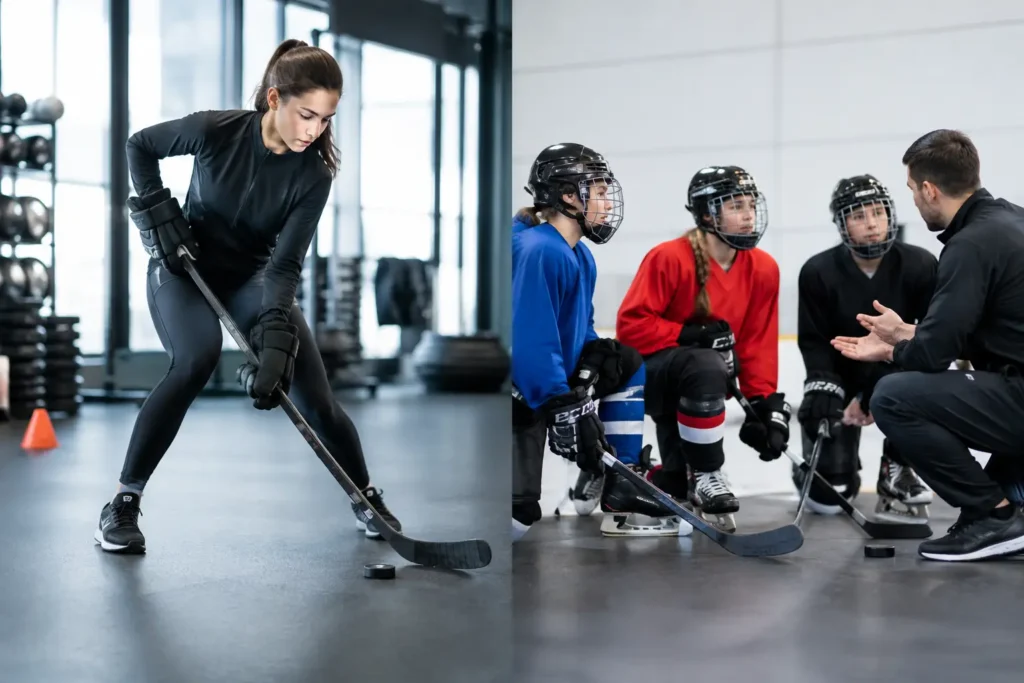
A player can work hard through every team practice and still carry the same stride inefficiency or shooting flaw into the next game. That is where private versus team hockey training becomes a practical decision for families. Both formats can move an athlete forward, but they solve different development problems. The right choice depends on what the player needs most right now: individual correction, game-connected group habits, or a deliberate mix of both.
Private Versus Team Hockey Training Starts With the Goal
Team practices are built around the group. A coach needs to organize drills, teach systems, manage pace, and make sure every player stays engaged. Players gain valuable reps, compete with teammates, and learn how their decisions affect the game. But in a full team environment, there is limited time to stop one player, identify the cause of a technical issue, demonstrate the correction, and repeat it until it holds.
Private training is built around the athlete. The session can slow down a stride, isolate a shot release, adjust body position, or address the confidence gap that appears when a player avoids a difficult skill. Instead of simply completing a drill, the player learns why a movement is working or breaking down.
Neither format replaces the other. Team sessions sharpen the ability to apply skills around other players. Private instruction gives athletes the technical foundation to make those skills more reliable when the game speeds up.
When Private Training Creates the Biggest Change
Private hockey training is especially valuable when a player has a clear bottleneck. Maybe they generate effort but not speed. Maybe their shot is accurate in the driveway but slow under pressure. Maybe they have grown quickly and their skating mechanics no longer feel natural. Broad instruction rarely fixes a specific issue as efficiently as focused coaching does.
At Pro Stride Hockey, private sessions keep a 2:1 player-to-coach ratio and no more than four athletes in a one-hour session. That structure gives coaches time to observe, demonstrate, correct, and immediately check whether the athlete can repeat the movement correctly. For a developing player, that attention can turn a vague instruction such as “get lower” into a specific, usable correction involving knee bend, hip position, edge pressure, and recovery.
Immediate feedback prevents bad repetition
Repetition matters only when the player is rehearsing the right movement. A young athlete who repeatedly pushes straight back instead of using a full lateral skating stride may become fitter without becoming faster. A player who loads a shot with poor hand separation may take hundreds of pucks without adding release speed.
Immediate video feedback makes the lesson more concrete. Seeing a stride or release on a large display helps players connect what they feel with what they are actually doing. The coach can compare one rep to the next, point out a small adjustment, and give the athlete another chance before the old pattern returns. This is particularly useful for players who learn visually or struggle to understand a correction through words alone.
Private sessions support confidence as well as mechanics
Skill development can feel personal, especially for athletes who know something is not clicking. In a private or very small-group setting, players can ask questions, make mistakes, and work through frustration without worrying about holding up a full line of teammates.
That does not mean every session should be easy. Good coaching sets a demanding standard while giving the player a path to meet it. When athletes see a stronger stride, a quicker release, or a cleaner puck touch after focused work, confidence becomes earned. That confidence carries into tryouts, games, and the next difficult drill.
What Team Training Does Better
Team hockey training is not simply private instruction with more players. Its value comes from the interaction between athletes. Players must read pressure, communicate, support the puck, transition quickly, and execute skills at the pace of a group. Those are game realities that cannot be fully recreated in an individual session.
A focused team development session can also expose shared needs. If an entire group lacks first-step quickness, struggles to create scoring chances, or needs better offensive-zone habits, a coach can build a progression that improves the team together. Players compete, observe different solutions, and learn to execute while dealing with space, timing, and teammates.
The trade-off is coaching attention. Even an excellent team coach cannot provide extended technical correction to every athlete in every drill. The player who needs a major skating adjustment may need additional individual work before that new movement can hold up in a team setting.
How to Choose Between Private and Team Hockey Training
Start with an honest look at the athlete’s current challenge, not just the calendar. If a player is being passed by in races, lacks power in their stride, has trouble handling passes, or cannot get shots away quickly, private training is often the more direct first step. It identifies the cause and gives the athlete targeted repetitions.
If the player already has a solid technical base but needs to make faster decisions, compete through traffic, or build chemistry with teammates, team training may deliver more value. This is common for groups preparing for a season, tournament, or tryout period where execution together matters as much as individual skill.
Age and experience matter, too. Younger players may benefit from small-group instruction that keeps training energetic while still allowing meaningful correction. Advanced players can use private work to refine details that separate a good skill from a dependable one at higher speed. A junior prospect may need to improve force production on the skating treadmill, while an introductory player may need a patient explanation of balance and edge control. The training format should meet the athlete where they are.
Parents should also consider the player’s response to coaching. Some athletes thrive with direct, concentrated attention. Others perform best when they can compete alongside peers. A strong development plan recognizes both personality and performance needs rather than forcing every player into the same model.
The Strongest Plan Often Uses Both Formats
For many players, the best answer is not private or team training. It is a purposeful progression between them. Private sessions can build the movement pattern. Small-group work can add pace and accountability. Team sessions can test whether the player can apply that skill when space disappears and decisions must happen quickly.
Consider a player working on shooting. In an individual setting, they can refine puck position, weight transfer, hand separation, and release mechanics on a synthetic-ice shooting lane. Once the mechanics are more consistent, group work can add passing, movement, and time pressure. On the ice, that improved release has a better chance of showing up in a real scoring opportunity.
The same progression applies to skating. A coach can use treadmill training to isolate stride length, recovery, knee drive, and power production. The athlete then needs competitive reps to use that stronger stride while accelerating, stopping, changing direction, and reacting to the play. Technical work creates the tool. Group and team environments teach the player when to use it.
Make Training Time Count
More sessions do not automatically mean more development. Families get the most from training when they choose a clear priority, track progress, and give athletes enough time to practice the correction between sessions. One player may need a block of private instruction before team training makes sense. Another may benefit from occasional private tune-ups while staying primarily in a team environment.
Ask a simple question after each training block: What changed in the player’s movement, execution, or confidence? The answer should be more specific than “they worked hard.” Look for a deeper knee bend through acceleration, a more controlled puck touch, a faster release, better balance, or a willingness to try the skill in a game. Visible progress helps athletes understand that disciplined effort has a purpose.
The next meaningful gain may not come from adding another general practice. It may come from giving your player the right coaching environment, the right correction, and enough quality repetitions to make improvement feel natural when the puck drops.