Last Updated: November 21, 2026
Quick Summary
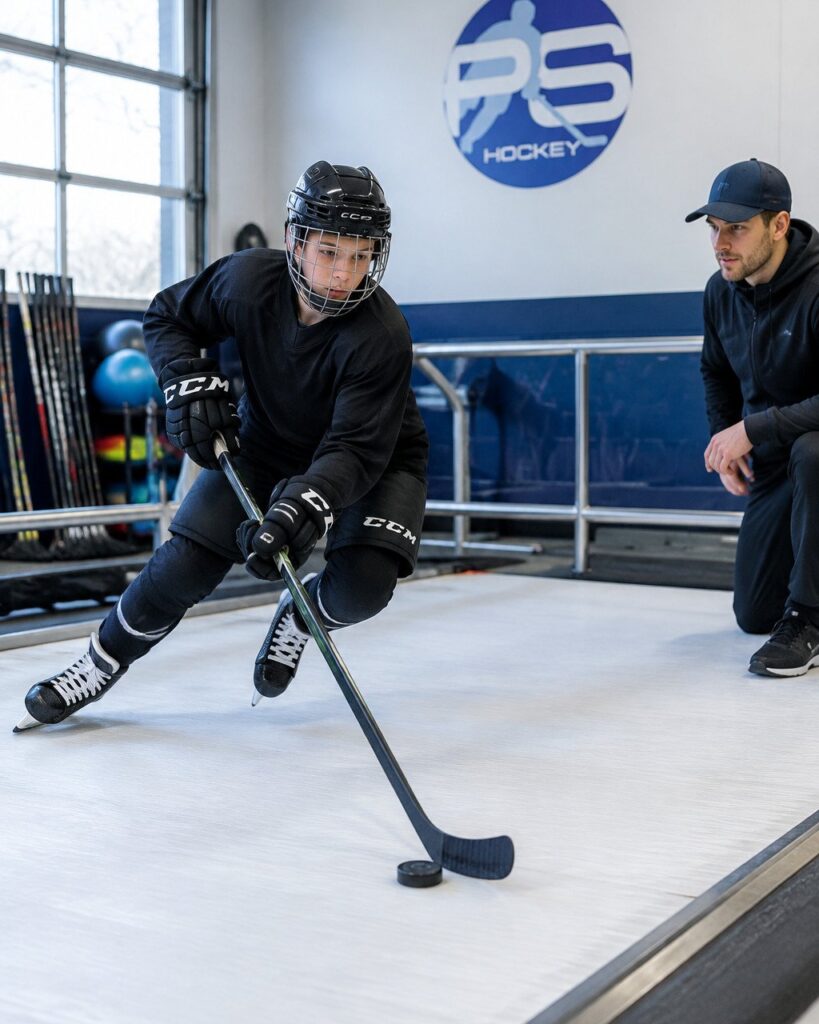
Prostride hockey training is an off-ice program at Pro Stride Hockey in Edmonton that develops skating stride and shooting mechanics for youth hockey and ringette players. It uses a skating treadmill for stride technique and structured instruction for shooting, with small sessions that let coaches correct form in real time.
- The program uses a skating treadmill so players can repeat stride mechanics at a controlled pace.
- One-on-one sessions use a 2:1 player-to-coach ratio, and group sessions are capped at four players.
- Off-ice work is meant to make on-ice practice more productive, not to replace it.
- Players learn wrist and snap shot mechanics, with video analysis used to review their motion.
- Coaches increase volume only once a player can hold the cue without being reminded.
Table of Contents
- What Prostride Hockey Training Covers
- How a Skating Treadmill Builds Stride Technique
- Hockey Shooting Training Off the Ice
- Ringette Shooting Training and Shared Mechanics
- Private Hockey Training Sessions Versus Group Training
- Age and Skill-Level Adaptations and Progress Checks
- Booking Your First Prostride Session
- Frequently Asked Questions
What Prostride Hockey Training Covers
Prostride hockey training is an off-ice program that develops skating stride and shooting mechanics without needing a full ice session. At Pro Stride Hockey in Edmonton, we work with youth hockey and ringette players who want to sharpen their skating ability and shooting accuracy between games and practices.
The program combines a skating treadmill for stride technique with structured instruction on proper shooting mechanics. Players also get guidance on how these two skills support each other on the ice.
We keep sessions small. Pro Stride Hockey uses a 2:1 player-to-coach ratio in one-on-one sessions and caps group sessions at four players. That structure lets coaches correct form in real time, which is hard to do in a crowded ice session.
Parents often ask whether off-ice work replaces time on the ice. It does not. Think of it as a way to build the mechanics that make on-ice practice more productive.
How a Skating Treadmill Builds Stride Technique
A skating treadmill lets a player repeat stride mechanics at a controlled pace. The belt moves beneath the skates, so the player works on push-off, glide and recovery without the drift that comes with learning on ice. Because the surface speed is set by the coach, a player cannot cheat the tempo, the belt keeps moving whether the stride is clean or not, which exposes wasted motion quickly.
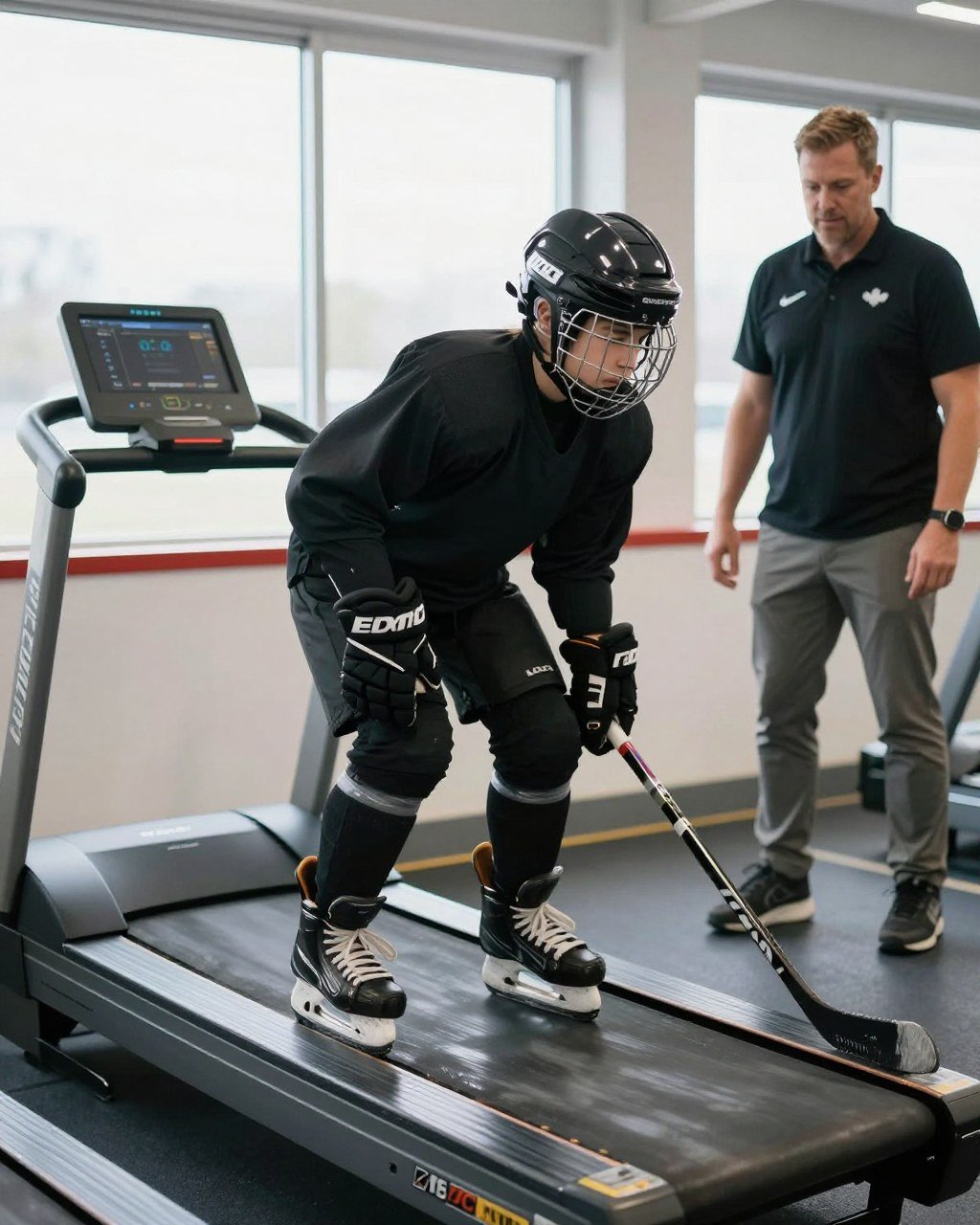
Repetition is the main benefit. A player can run the same stride pattern dozens of times in one session, with a coach adjusting knee bend, hip position and foot placement after each set. Players who want to compare this format with ice time can read our guide on skating treadmill versus ice skating.
Stride Mechanics Players Practise First
A simple early progression looks like this:
- Stance hold. Player sets feet hip-width, knees bent over the toes, chest up and hands in front. Hold for a short count while the belt runs slowly. Cue: “knees over toes, hips down.” Common mistake: standing tall and reaching with the chest instead of sitting into the legs.
- Single-leg push. Player pushes out to the side with one leg and recovers under the body, alternating sides at a slow belt speed. Cue: “push out, then pull the foot back under you.” Common mistake: pushing backward instead of out to the side, which shortens the stride.
- Full stride sets. Player links push-off, glide and recovery at a moderate belt speed for short sets, with a coach calling one cue per set. Common mistake: rushing the recovery so the foot lands outside the hip line.
Explosive acceleration depends on the first step. If you want to understand how body position and edge power drive quicker starts, see our guide to increasing skating acceleration. For more stride-specific drills, our article on improving hockey stride walks through the progression.
Balance, Edge Control and Stability
A practical edge sequence:
- Inside-edge hold. Player glides on one skate with the ankle stacked under the knee and holds the position for a short count. Cue: “ankle under knee, hip over the skate.” Common mistake: rolling the ankle outward to find balance.
- Outside-edge hold. Same idea on the outside edge, which most youth players find harder. Keep the count short at first and build as control improves.
- Weight-shift turns. Player shifts weight from one edge to the other in a controlled rhythm, keeping the hips level. Common mistake: bobbing the head and shoulders instead of moving from the hips.
How Much Volume and How Often
Short, frequent treadmill sets with rest between them are a sound approach for youth players. Coaches stop the belt to reset form rather than letting a tired player groove a bad habit, and volume should rise only when the player can hold the cue without reminding. For ringette players, the same stride work applies, the skating mechanics are shared even though the implement differs.
Hockey Shooting Training Off the Ice
Shooting is the other half of the program. Players learn the mechanics of a proper wrist and snap shot, including weight transfer, stick loading and follow-through. Repetition on a fixed setup lets the coach see exactly where the stick and body move. Consistent contact and follow-through also depend on protecting the blade between repetitions, making an off-ice hockey stick protector part of keeping shooting practice focused on technique.
Video analysis is a major part of this work. Video analysis is part of the Pro Stride Hockey approach, and it can help players see motion details they may not feel. Our piece on the benefits of hockey video analysis explains how this review process helps players correct those habits.
Ringette Shooting Training and Shared Mechanics
Ringette players use a different implement, but the core shooting mechanics overlap with hockey. Weight transfer, hip rotation and a controlled follow-through matter in both sports. Our program teaches the proper way to shoot a ringette ring.
Parents of ringette players often ask whether hockey and ringette training can happen together.
Private Hockey Training Sessions Versus Group Training
Private sessions and group sessions serve different goals. Sessions are offered one-on-one or in groups of up to four players. Players comparing formats can read how private coaching value gives targeted corrections and purposeful repetitions.
Age and Skill-Level Adaptations and Progress Checks
Training should match the player’s age and experience. The table below is a starting framework, not a fixed prescription, a coach adjusts it after the first assessment.
| Player stage | Stride focus | Shooting focus | Session rhythm |
|---|---|---|---|
| New to skating or ringette | Stance hold, single-leg push, inside-edge hold | Grip, stance, weight transfer with a light puck or ring | Short sets, frequent rest, one cue at a time |
| Youth house or recreational | Full stride sets, weight-shift turns | Wrist shot mechanics, follow-through | Moderate sets, video review of one skill |
| Competitive youth | Stride under speed, edge control at pace | Snap shot release, shot accuracy under fatigue | Longer sets, combined stride-and-shoot work |
| Advanced | Explosive first step, stride consistency | Quick release, shooting in motion | High volume with recovery built in |
Progress Checks You Can Actually Measure
Progress is easiest to track when a coach records the same drills at regular intervals. Rather than relying on feel, use a small set of repeatable checks:
- Stride consistency. Count how many strides a player completes before form breaks down at a set belt speed. More clean strides before the first correction is a sign of improvement.
- First-step quickness. Time a short acceleration burst from a standing start on the treadmill or in the shooting area, and compare across sessions.
- Edge-hold count. Record how long a player holds an inside or outside edge with a stable ankle. Build the count gradually.
- Shot accuracy. Set a target and count how many pucks or rings hit it out of a fixed number of attempts. Track the number, not the impression.
- Release consistency. Use video to compare the stick position and torso at release across sessions, looking for the same error repeating or disappearing.
Adapting Volume Safely
Watch out: adding volume faster than form can hold is the most common way youth players pick up bad habits. Increase sets only when the player can repeat the cue without a reminder, and keep rest between sets generous. Younger players and players new to off-ice work should start with shorter sessions and more frequent breaks, while advanced players can extend sets and add shooting volume once stride form is stable. Ringette players follow the same progression, with the ringette ring substituted for the puck in shooting checks.
Booking Your First Prostride Session
A first session is the best way to see whether the program fits your player. Pricing depends on session type and schedule, so contact Pro Stride Hockey directly or visit its website for current rates.
If you are ready to get started, book your first session or reach out to our team with questions about the program. We can tell you which format makes sense for your player’s age and goals.
Frequently Asked Questions
What is Prostride hockey training?
Prostride hockey training is an off-ice program for youth hockey and ringette players that focuses on skating stride technique and shooting mechanics. Sessions use a skating treadmill so players can repeat stride patterns many times in a controlled setting, with coaches correcting form in real time. Players can also work on shooting technique in a dedicated shooting lane. Programs are offered in private and small-group formats, and details on current session options are best confirmed directly with Pro Stride Hockey.
How does a skating treadmill help hockey players?
A skating treadmill lets a player repeat stride mechanics, balance and edge control without the time limits of ice sessions. Because the belt moves under the skate, players can focus on pushing out to the side and recovering the leg with a consistent, efficient motion. Coaches can see the stride clearly and give immediate feedback.
Can ringette players train at Pro Stride Hockey?
Yes. Pro Stride Hockey works with ringette players as well as hockey players, focusing on shooting technique for the ringette ring and the stride mechanics that support it. Many shooting fundamentals, including body positioning, weight transfer and follow-through, apply across both sports, Parents and players interested in ringette sessions should contact the academy to confirm available options.
What should players expect during a private hockey training session?
In a private session, a player works one-on-one with a coach, using a 2:1 player-to-coach ratio. Sessions can also include up to four players per group. Video analysis is part of the program. Session length and frequency depend on the player’s goals, so the academy can recommend a schedule after an initial conversation.
