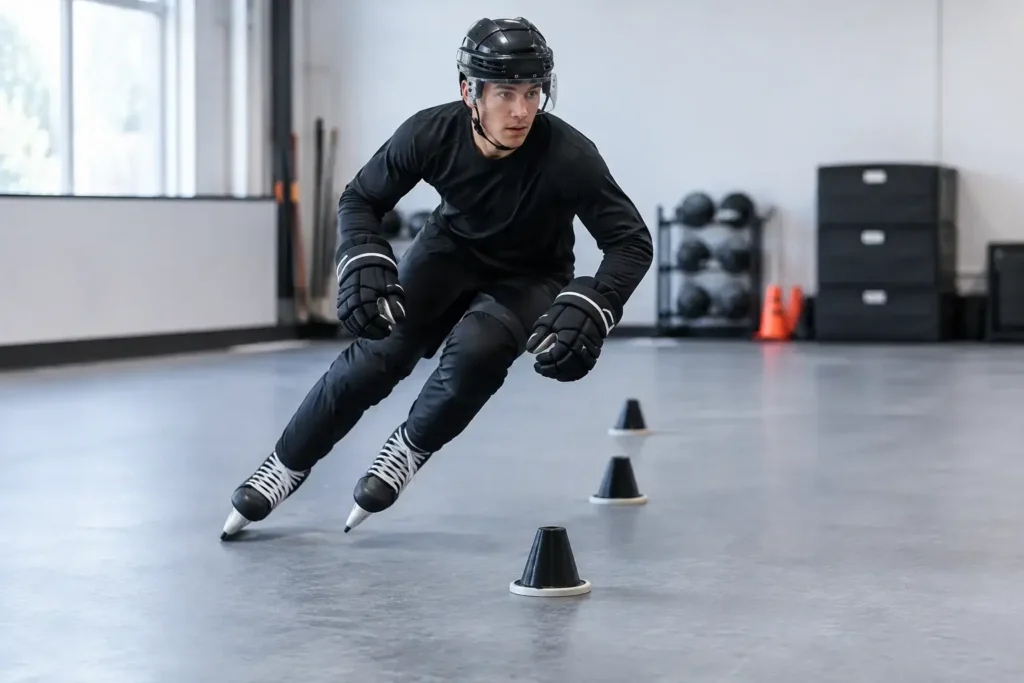
A player can have a powerful stride and still lose races, separation, and puck battles if they cannot control their edges. The best skaters do not simply push harder. They use inside and outside edges to stay balanced through turns, change direction without standing up, and create speed from positions that look uncomfortable to an untrained athlete. This hockey edgework progression guide gives players and parents a clear path from basic edge awareness to game-speed agility.
Edgework is not a collection of flashy drills. It is the foundation that allows a player to accelerate out of a tight turn, protect the puck along the wall, close space on a defender, or recover after a missed step. Progress takes focused repetitions, honest technical feedback, and the patience to build control before adding speed.
Start With Edge Awareness and Body Position
Every progression begins with posture. Players need a stable athletic stance before they can load an edge effectively: knees bent, chest tall, hips under the body, and hands active in front. When an athlete skates too upright, pressure shifts toward the heels, the edges wash out, and direction changes become slow and wide.
Inside edges sit toward the center of the body. They are commonly used for crossovers, tight turns, and acceleration patterns. Outside edges sit away from the center of the body and are essential for balance, deception, one-foot turns, and efficient transitions. Strong skaters trust both edges. Developing players often rely too heavily on their inside edges because they feel safer.
At the earliest stage, slow is productive. Have the athlete glide on two feet and gently shift pressure from the inside to the outside of each skate. The objective is not a deep lean. It is recognizing where the blade contacts the ice and maintaining a quiet upper body while the feet move underneath.
A player should be able to hold a controlled hockey stance through these basic movements before advancing. If the knees straighten, the shoulders tip, or the feet separate too far, adding speed only rehearses poor mechanics.
Hockey Edgework Progression Guide: Build Control First
The most effective progression moves from supported balance to single-leg control, then to directional changes and competitive speed. Each layer asks more of the athlete, but the technical standard stays the same: pressure through the blade, hips and knees engaged, and eyes up.
Stage 1: Two-Foot Edge Patterns
Begin with wide C-cuts, shallow slaloms, and two-foot turns in both directions. These drills teach an athlete to roll from one edge to the other without panic or stiffness. The player should feel pressure move through the full blade rather than scraping with the toe or heel.
A useful coaching cue is to keep the head level while the hips travel. If the head swings side to side or drops toward the ice, the player is likely leaning from the shoulders instead of creating the angle through the ankles, knees, and hips.
At this stage, quality matters more than distance. Ten deliberate repetitions with clean body position are more valuable than forty rushed reps that teach the player to stand tall.
Stage 2: One-Foot Balance and Edge Holds
Once two-foot control is reliable, athletes need to own each skate independently. One-foot inside-edge and outside-edge glides expose weaknesses quickly. Many players can turn well on their dominant side but struggle to hold an outside edge on the opposite foot.
Start with short glides, using a stick for balance only if needed. Progress to gentle curves, then longer arcs. The free leg should stay relaxed and controlled rather than swinging wildly for balance. A player who cannot maintain a one-foot edge at low speed will have difficulty making a sharp cut while carrying the puck or defending in open ice.
This is also where equipment matters. Skates that are too large, poorly sharpened, or lacking ankle support can make proper edge pressure harder to feel. Equipment should support development, but it cannot replace sound movement patterns.
Stage 3: Turns, Crossovers, and Transitions
The next layer connects edge control to movements players use every shift. Tight turns teach athletes to enter on an outside edge, load the turn, and exit with a strong crossover or push. Crossovers should create speed, not become a series of steps where the player rises out of position.
Forward-to-backward and backward-to-forward transitions demand even more control. Players should first learn to open their hips and transfer pressure at a manageable pace. When they rush the movement, they often spin their shoulders, lose knee bend, and slide across the ice instead of driving out of the transition.
For young players, simple circle work can be highly effective. Ask them to complete controlled laps using crossovers in both directions, then vary the radius of the circle. Smaller circles require greater edge angle and balance. Larger circles allow the player to feel rhythm and generate speed. Neither is automatically better. The right choice depends on the athlete’s current control.
Stage 4: Reactive, Game-Speed Edgework
Game skating is not performed around cones in a predictable pattern. Players react to opponents, pucks, passes, and changing lanes. Once technical control is established, edgework must become reactive.
Use visual or verbal cues that force a player to change direction at the last moment. Add puck handling once the feet remain stable. Include short races, corner escapes, stop-start patterns, and transition drills that finish with a pass or shot. The goal is not to make drills complicated. It is to make edge decisions happen under realistic time pressure.
A player who looks polished in a controlled drill but loses posture when reacting needs more time in the transition between Stages 3 and 4. That is not failure. It is useful information for the next session.
Common Edgework Mistakes That Limit Speed
Most edgework issues are visible before the player falls. Watch for these patterns during practice or skill sessions:
- Standing tall through turns instead of maintaining knee and hip flexion.
- Reaching with the upper body to create a lean rather than angling the skate beneath the body.
- Using only the dominant edge or direction because it feels comfortable.
- Looking down at the feet, which disrupts posture and delays reaction time.
- Adding pucks and speed before the athlete can repeat the movement cleanly.
The correction should be specific. “Bend your knees” can help, but it is often too broad. A more useful cue may be “keep your chest over your knees through the exit” or “finish the turn by pushing from the outside edge.” Clear language gives athletes something they can feel and repeat.
Use Video to Make Technical Changes Stick
Edgework can feel different from how it looks. A player may believe they are low in their stance while video shows that their hips rise every time they change direction. Another athlete may feel like they are leaning aggressively, but the footage reveals that their shoulders are tipping while their skates remain flat.
Immediate video feedback shortens the learning cycle. Instead of waiting until the end of practice to discuss a pattern, the coach can show the movement, identify one priority, and let the athlete apply the correction on the next repetition. At Pro Stride Hockey, this kind of feedback can be paired with focused skating treadmill work, allowing athletes to slow down a movement, understand the mechanics, and then build toward stronger, more confident execution.
The best video sessions do not overload players with five corrections at once. Choose the issue that will create the biggest improvement, whether that is posture, edge pressure, hip position, or timing. Once that change becomes more consistent, move to the next detail.
How Often Should Players Train Edgework?
For most youth players, two or three intentional edgework exposures per week can produce meaningful improvement when the training is technically focused. That may include a dedicated skating session, a short pre-practice block, and a few minutes of deliberate work during open ice. More volume can help, but only if the player maintains quality.
Younger athletes may need shorter, more engaging blocks with frequent coaching and a clear objective. Advanced players can handle longer sequences, tighter turns, added puck pressure, and more demanding transition work. Both groups benefit from individualized progressions rather than being pushed through the same drill at the same speed.
Parents should look for visible markers of progress: deeper knee bend that holds under fatigue, more confidence turning both directions, quicker exits from stops, and fewer wasted steps before acceleration. Those changes translate directly to better skating in games.
Edgework earns its value when it shows up in the moments that matter: a cleaner turn to win a loose puck, a sharper cut to create a passing lane, or a controlled recovery when the play changes direction. Build the foundation patiently, demand quality on every edge, and let speed become the result of better control.