Last Updated: October 28, 2026
Quick Summary
Mental preparation routines are worth it for hockey goalies because they give you a repeatable process that steadies nerves before a game and helps you reset after a goal. A timed routine can run from arrival at the rink to puck drop, combining breathing, visualization and a short focus cue.
- Start a timed routine about 90 minutes before puck drop, beginning with a slow walk of the room.
- Use a 4-2-6 breathing pattern: breathe in for four counts, hold for two, breathe out for six.
- Visualize three expected saves for about 30 seconds each, ending every rep on a clean stop.
- Choose one short focus cue, such as “see it, set it, stop it,” to anchor your first period.
- Tape your routine card inside your gear bag so it runs automatically under pressure.
Table of Contents
- Why Mental Preparation Routines Matter for Hockey Goalies
- Building a Timed Pre-Game Routine for Goalies
- Breathing Exercises for Hockey Goalies to Calm Pre-Game Nerves
- Goalie Visualization Exercises for Game Situations
- Goalie Reset Routine After a Goal
- Personalizing Your Routine by Age and Experience
- Booking Your First Session to Build Your Routine
- Frequently Asked Questions
A mental preparation routine is a repeatable process before a game. This guide explains whether these routines are worth the effort, what they look like in practice, and how to build one that fits your game. Consistency in these pre-game rituals serves as a vital foundation for overcoming performance anxiety when the pressure of the crease begins to mount.
A routine doesn’t remove nerves or guarantee a clean sheet.
Why Mental Preparation Routines Matter for Hockey Goalies
Goalies face pressure. You can play a strong game and still be pulled after a single goal.
Here is what a good routine typically does for a goalie:
A routine can be treated as a repeatable sequence.
Building a Timed Pre-Game Routine for Goalies
A timed routine can provide a schedule from arrival at the rink to taking the crease. For younger players, beginner hockey development focuses on confident skating through smart repetition and habits that carry onto the ice. The schedule below is a template, adjust the minutes to your rink’s schedule.
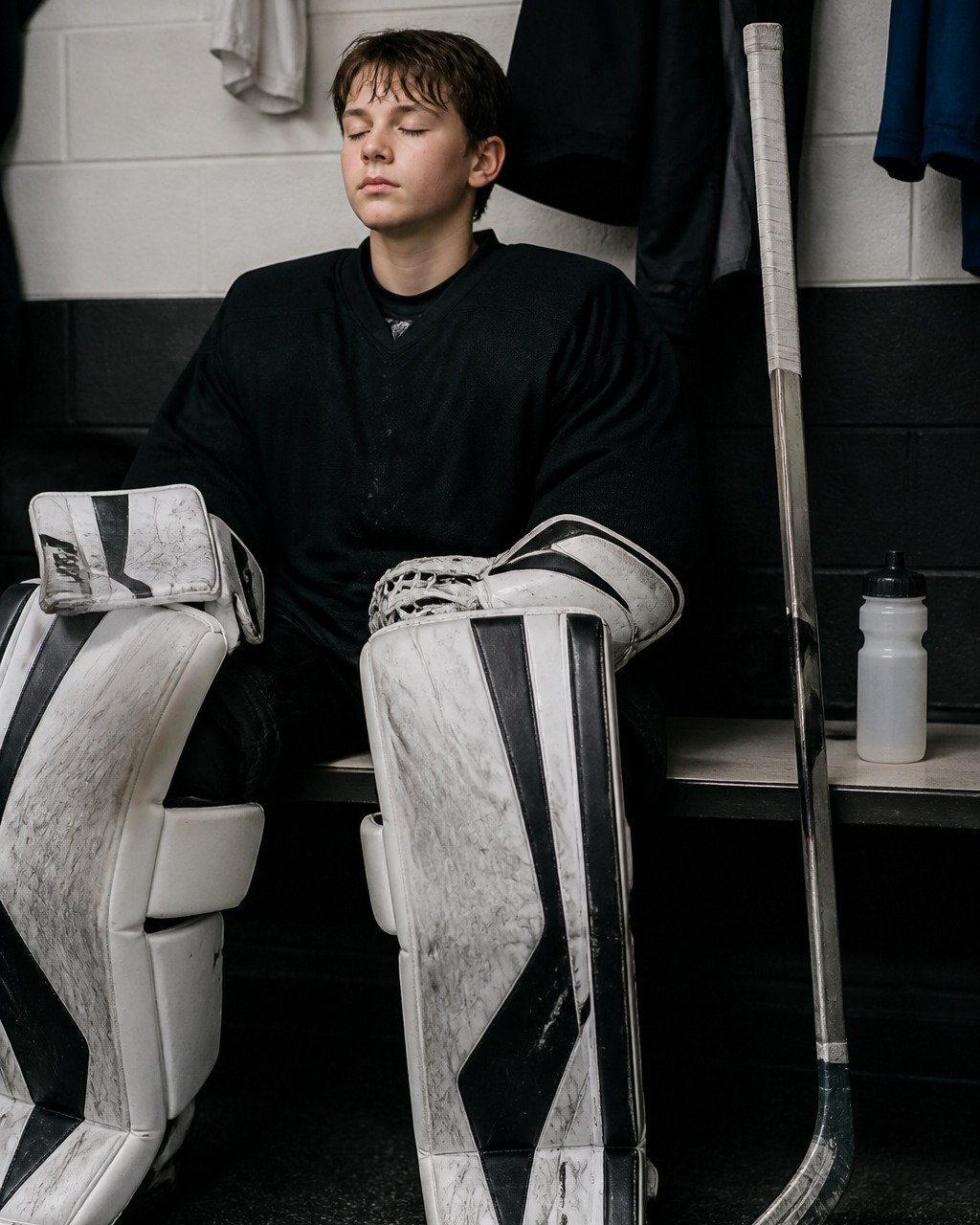
!A young hockey goalie in full gear sitting quietly in a dressing room before a game, eyes closed, taking a slow breath with a water bottle and taped stick beside them
Arrival to 60 Minutes Out: Settle and Scan
- Arrival (T-90): Put your gear down, drink water, and do a slow walk of the room. No phone, no game footage. This is your signal that the day has shifted into game mode.
- T-75: Light mobility, hip openers, ankle circles, and a few slow squats. Keep it easy; this is not a workout.
- T-60: One short review. Look at one or two notes from your last game (a positioning reminder, a rebound-control cue). Do not build a long list of faults.
60 to 20 Minutes Out: Warm the Body, Quiet the Mind
- T-45: Off-ice warm-up, dynamic movement, a few lateral shuffles, and light hand-eye work with a ball or reaction ball.
- T-30: Gear on, slowly and in the same order every time. The repetition itself is calming.
- T-20: One to two minutes of the breathing pattern below, seated with feet flat.
The Final 20 Minutes: The Mental Block
This is the part most goalies skip. Run these three steps in the same order every game:
- Breathe (2 minutes): Use the 4-2-6 pattern in the next section. Slow exhale, quiet shoulders.
- Visualize (3 reps, ~30 seconds each): One save you expect to face, a screen shot, a rebound, a breakaway. See the puck, your set position, and a clean stop. End each rep on the save.
- Set one cue (30 seconds): Pick a single short phrase, “see it, set it, stop it” or “square and quiet.” This is your anchor for the first period.
T-5 to Puck Drop: Activate
- T-5: Stand, shake out your legs, and take three slow breaths.
- T-2: Step on the ice and do two or three easy crease movements, side-to-side pushes, a few butterfly drops and recoveries. This wakes up your edges and tells your body the game is here.
- Puck drop: Repeat your cue once, then track the first shot. Your routine is done; now you play.
Write your routine on a card and tape it inside your gear bag. A routine you have to remember under pressure is a routine you will skip. The card makes it automatic.
Keep the steps short enough that you can run them even on a tired night, and never add a step you cannot repeat.
Breathing Exercises for Hockey Goalies to Calm Pre-Game Nerves
Breathing is one tool you can try. When nerves rise, you may notice changes in your breathing.
Try this simple pattern:
- Breathe in through your nose for four counts.
- Hold for two counts.
- Breathe out slowly through your mouth for six counts.
- Repeat for one to two minutes.
Do this sitting with your feet flat, or while standing and shifting your weight gently.
Goalie Visualization Exercises for Game Situations
Visualization is a way to picture game situations before they happen.
Use these steps during your routine:
- Pick a realistic situation: A breakaway, a screen in front, or a tight rebound.
- Picture the details: Where the shooter is, how the puck moves, and where your body goes.
- Add the feeling: See yourself staying square, quiet, and in control.
- Finish with a clean stop: End each rep with the save you want to make.
Goalie Reset Routine After a Goal
A reset routine can be a short, repeatable process after a goal.
When a goal goes in:
- Breathe out once: Take a slow exhale.
- Reset your stance: Get back into your crease and square up to the play.
- Use your focus cue: Repeat the short phrase you chose before the game.
- Look for the next shot: Shift your attention to the next play, not the last one. To sharpen your skating after a goal, see this skating improvement guide for more depth on stride and speed.
Personalizing Your Routine by Age and Experience
A routine can be adjusted for age, experience, and temperament, and tracked over time.
By Age and Stage
- Younger goalies (roughly 8-11): Two steps only, one breathing round and one picture of a save. Keep the whole block under three minutes. Parents and coaches should keep feedback calm and specific (“you stayed square on that one”) rather than results-focused.
- Competitive youth goalies (roughly 12-15): Add visualization of two specific situations (a screen and a rebound) and a short reset cue for after goals. The pre-game block can run five to seven minutes.
- Older and experienced goalies: Build the routine around game-specific scenarios, odd-man rushes, deflections, and post-to-post movement, and extend the reset process to include a quick read of what went wrong before the next faceoff.
By Temperament
- Goalies who get nervous easily: Start the breathing earlier (T-30 instead of T-20) and lean on the focus cue more often during play. A longer exhale is your fastest tool.
- Goalies who get flat or over-relaxed: Add movement to the final minutes, a few quick shuffles and reaction-ball reps, so you arrive at puck drop alert rather than sleepy.
- Goalies who over-analyze: Cap the pre-game review at one note. Save the detailed breakdown for after the game, when you can review it calmly.
Measuring Whether the Routine Works
Personalize by age, experience, and temperament, then track focus, nerves, and reset speed for five to ten games. The numbers tell you which step to keep and which to cut.
Test any change in practice before you rely on it in a game. If you want individualized guidance on your routine, small group hockey training in Edmonton gives you coaching attention alongside other players at your stage.
Booking Your First Session to Build Your Routine
You can book your first session.
Pricing depends on the session type and schedule, so check our website for current rates or request a quote before you book. You can compare the available session options to find the format that fits your schedule.
Frequently Asked Questions
How should a hockey goalie mentally prepare for a game?
Start with a fixed routine that runs the same way before every game. Set one or two specific goals, such as tracking the first five shots or staying patient on rebounds. Then use a short breathing exercise and a brief visualization of a save you want to make.
What should a goalie visualize before a game?
Visualize the situations you expect to face: a fast shot from the top of the circle, a rebound off the post, or a two-on-one rush. Picture your body position, your movement, and your rebound control. Keep each rep short and specific, and focus on the feel of the save as well as the sight of it.
How do goalies reset mentally after letting in a goal?
Use a repeatable sequence: take one slow breath, reset your stance, and say a short cue to yourself, such as ‘next shot.’ Then look at the next play, not the goal that went in. Between whistles, check your equipment and your position briefly to shift attention to the present.
