Table of Contents
- Why Confidence Is a Skill You Can Train
- Improving Mental Toughness in Hockey Through Consistent Preparation
- Hockey Visualization Techniques for Game-Day Readiness
- Positive Self-Talk for Athletes: Rewiring Your Internal Dialogue
- Building Resilience After a Bad Shift
- How to Build Confidence in Hockey Through Small Wins and Controllable Factors
- Tracking Progress: Data-Driven Confidence Building
- Conclusion
- Frequently Asked Questions
Last Updated: September 30, 2026
Why Confidence Is a Skill You Can Train
Confidence in hockey isn’t a personality trait you’re born with, it’s a skill you build with practice. That’s the first thing to understand about how to build confidence in hockey: it responds to repetition, feedback, and the right kind of pressure.
- Confidence grows from evidence. Every rep, every drill, every small win is proof you can do it.
- Pressure is a tool, not a threat. Learning to stay calm under pressure is a skill you can practice.
- Self-belief is built, not found. You don’t “find” confidence one day. You build it in small pieces.
Improving Mental Toughness in Hockey Through Consistent Preparation
Mental toughness in hockey means staying calm, focused, and ready when the game gets hard. The fastest way to improve it is through consistent preparation. When you know you’ve done the work, your brain stops panicking.
- Show up to practice on time and ready to work
- Warm up the same way every game day
- Review your last game before the next one
- Get enough sleep the night before a game
- Eat a real meal two to three hours before puck drop
Building a Pre-Game Routine That Works for You
Your pre-game routine should take 30 to 60 minutes and stay the same every time. The routine itself matters less than doing it the same way.
Here’s a simple template you can copy:
- Arrive 75 minutes early. Gives you time to settle in.
- Stretch and move for 15 minutes. Loosen the hips, ankles, and shoulders.
- Visualize for 5 minutes. Picture your first shift going well.
- Listen to the same playlist. Music cues your brain that it’s game time.
- Tape your stick the same way. Small rituals calm the nervous system.
Hockey Visualization Techniques for Game-Day Readiness
Hockey visualization means mentally rehearsing plays, shifts, and skills before they happen. Done well, it primes your brain and body to perform, and many sports psychologists treat it as one of the most useful tools for game-day readiness.
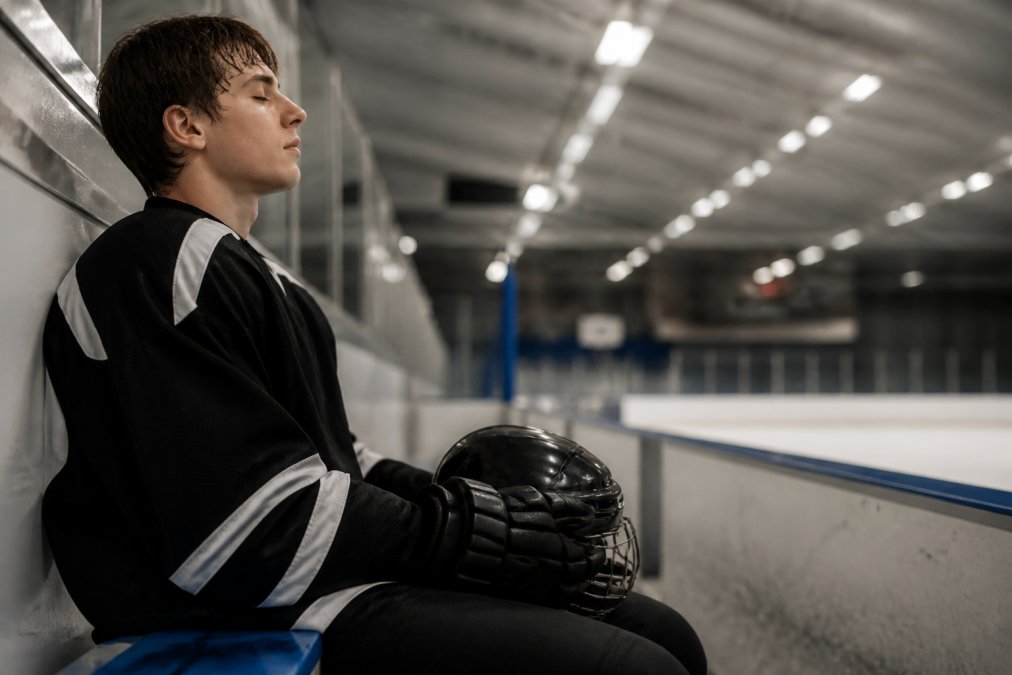
Here’s how to use it:
- See the play in real time. Don’t slow it down. Picture it at game speed.
- Use all your senses. Feel the ice, hear the crowd, smell the rink.
- Focus on your role. Picture yourself making the right read, not just the highlight.
- Repeat the same scene. Repetition builds the mental pathway.
How to Practice Visualization in 10 Minutes a Day
Ten minutes a day is enough. Here’s a simple daily plan:
- Minute 1-2: Sit or lie down. Close your eyes. Breathe slowly.
- Minute 3-5: Picture your warm-up. Feel your skates on the ice.
- Minute 6-8: Run through one specific play you want to improve.
- Minute 9-10: Picture yourself succeeding. Hold that image.
Positive Self-Talk for Athletes: Rewiring Your Internal Dialogue
Positive self-talk for athletes is the habit of replacing harsh inner criticism with useful, encouraging language. It’s not lying to yourself, it’s talking to yourself like a coach you respect.
Try these swaps:
- Instead of “I always mess up,” say “Next shift, I’ll keep it simple.”
- Instead of “I’m not fast enough,” say “I’ll work on my first three strides.”
- Instead of “Don’t mess up,” say “Move your feet and make the easy play.”
Building Resilience After a Bad Shift
Resilience after a bad shift is the ability to reset fast and play the next shift like nothing happened. Every player gives the puck away and gets beaten; the difference between good and great is how quickly they move on.
The fix is a reset routine. Short, simple, repeatable.
The Reset Routine: What to Do in the 30 Seconds After a Mistake
You have about 30 seconds on the bench after a bad shift. Use them like this:
- Take one slow breath in through your nose. Count to four.
- Breathe out through your mouth. Count to six.
- Say one short cue. “Next shift” or “Move my feet.”
- Look at the next play. Watch the puck. Get your eyes off your mistake.
- Stand up when your line is called. Walk to the bench edge with your chest up.
That’s it. Thirty seconds. Then it’s gone.
Players who reset fastest tend to be the ones coaches trust in big moments. It’s not because they make fewer mistakes. It’s because they don’t let one mistake turn into three.
Post-Game Confidence Recovery: The 24-Hour Rule
Most advice stops at the rink door, but what happens after a bad game matters just as much. A poor performance can linger for days, eroding confidence before the next practice, a gap most players and parents miss.
Immediately after the game (first 30 minutes):
- Do not rewatch the game or scroll through messages about it.
- Eat something. Low blood sugar amplifies negative emotions.
- Do one small physical task: stretch, foam roll, or walk. Movement helps metabolize stress hormones.
That evening (within 24 hours):
- Write down three things you did well, no matter how small. “I won one battle in the corner” counts.
- Write down one lesson. Not a flaw, a lesson. “I need to keep my stick on the ice in front of the net” is a lesson. “I’m terrible” is not.
- Close the notebook. The game is now data, not identity.
The next day:
- Do a 10-minute visualization session of yourself playing well in the next game. See the first shift going right.
- Return to your pre-game routine for the next practice as if it were a game. Familiarity rebuilds safety.
For Parents: How to Support Without Adding Pressure
Parents play a huge role in how a player processes a bad game. The car ride home can either reinforce resilience or undo it.
Resilience isn’t about never having a bad game. It’s about having a system that prevents one bad game from becoming a bad week.
How to Build Confidence in Hockey Through Small Wins and Controllable Factors
The fastest way to build confidence in hockey is to stack small wins and focus only on what you control: your effort, preparation, and attitude, not the refs, the ice, or the other team.
Here’s what to track:
- First three strides. Did you explode off the line?
- Compete level. Did you win your battles?
- Communication. Did you talk on the ice?
- Body language. Did you stay positive after a mistake?
- Effort on the backcheck. Did you skate hard both ways?
Tracking Progress: Data-Driven Confidence Building
Data-driven confidence building means keeping a simple record of your wins so you can see progress when your feelings say otherwise. Confidence dips when you can’t see growth. A log fixes that.
The Small Wins Journal: A Template You Can Copy
Here’s a simple template you can use after every practice and game. It takes two minutes.
| Date | Type | Win 1 (Effort) | Win 2 (Skill) | Win 3 (Mental) | One Lesson |
|---|---|---|---|---|---|
| Oct 5 | Practice | Won 3 of 4 battle drills | Completed 8/10 saucer passes | Stayed positive after a bad rep | Keep my head up on breakouts |
| Oct 7 | Game | Backchecked hard all 3 periods | Had 2 clean zone entries | Reset after a turnover in 10 seconds | Communicate earlier on the breakout |
Why This Works: The Mechanism
Confidence is built on evidence. Writing down a win creates a physical record your brain can’t argue with: feelings are temporary and often misleading, but a journal is permanent and objective.
Beyond the Journal: Simple Metrics to Track
If you want to go further, track a few specific metrics over a season. These are all controllable and easy to count:
- First three strides: Rate your explosion off the line after each game (1-5).
- Compete level: Count how many 1-on-1 battles you win per game.
- Communication: Tally how many times you call for the puck or direct a teammate.
- Reset success: After a mistake, note how many seconds it took to refocus.
- Sleep hours: Log your sleep the night before each game. You’ll likely see a correlation with your energy.
The players who improve fastest aren’t the ones with the most talent. They’re the ones who track their progress and adjust. Confidence follows evidence.
Conclusion
Building real confidence in hockey takes time, and it’s easy to feel stuck when progress feels slow. At Pro Stride Hockey, we build confidence into every session through a 2:1 player-to-coach ratio, video analysis that shows players exactly what they’re doing well, and a training approach that pushes athletes just past their comfort zone. Our partnership with the Tim Turk training program and specialized shooting lane facility give players concrete proof of their growth, week after week.
Frequently Asked Questions
How do you overcome fear of making mistakes during a hockey game?
Focus on what you can control: your effort, your positioning, and your next action. Try a reset routine after mistakes, like tapping your stick twice or taking a deep breath. Remind yourself that every elite player makes errors. The goal is not perfection but quick recovery. Pro Stride Hockey coaches build this into sessions by creating low-pressure repetitions that mimic game speed.
What are the best mental visualization techniques for hockey players?
Start with 5 to 10 minutes daily. Close your eyes and picture specific game scenarios: receiving a pass, skating through traffic, or taking a shot. Engage all senses. Feel the ice under your skates and hear the crowd. Focus on process, not outcome. Visualization before sleep or after practice works best. Pair it with physical rehearsal for stronger results.
How can young athletes build self-belief after a tough loss?
Separate the result from your identity. A loss does not mean you are a bad player. Review one or two things you did well, then identify one controllable area to improve. Write it down. Share it with a coach or parent. Then get back on the ice. Small, consistent actions rebuild belief faster than waiting to feel confident again.
What role does physical conditioning play in hockey confidence?
Physical preparation directly supports mental readiness. When you know your legs can handle a long shift, you skate with less hesitation. Improved stride efficiency and endurance reduce late-game fatigue, which often triggers mental errors. Pro Stride Hockey uses video analysis and specialized training to build that physical foundation, helping players trust their bodies under pressure.