A stronger player is not built by doing more random workouts. It is built by repeating the right movements with purpose, then carrying those gains onto the ice. This hockey dryland training guide gives young players and families a practical framework for developing speed, skating power, shooting strength, and confidence between practices.
Dryland training should support hockey, not compete with it. A player who adds ten pounds of muscle but loses mobility, struggles to recover, or practices poor movement patterns has not gained an advantage. The goal is simple: build an athlete who can create force, control their body, and execute skills late in a shift when the game gets fast.
What Hockey Dryland Training Should Improve
The best off-ice programs target the movements players use every shift. Skating is a repeated cycle of single-leg force, hip extension, balance, edge control, and efficient recovery. Shooting requires lower-body stability, sequencing through the hips and trunk, and hands that can direct the puck with speed and accuracy. A complete plan also develops coordination, conditioning, and the ability to stop and change direction safely.
For younger players, the priority is learning how to move well. They need to squat, hinge, land, sprint, brace, and balance with control before loading those movements heavily. For older players and junior prospects, training can become more specific and demanding, with greater emphasis on force production, repeated sprint ability, and power.
Age matters, but quality matters more. A U9 player does not need a complicated lifting program. They need a coach who can teach athletic positions, keep sessions engaging, and build confidence through success. A U15 player may benefit from more structured strength work, but only when technique remains the standard.
Start With Movement Quality, Not Heavy Weight
Hockey players spend much of the game in a forward body position with knees bent, hips loaded, and their chest strong enough to maintain posture through contact. That makes foundational strength patterns essential.
A squat pattern teaches players to absorb force and create power from the legs. A hinge pattern, such as a controlled hip hinge or deadlift variation, strengthens the glutes and hamstrings that help drive a powerful stride. Split squats and lunges matter because hockey is a single-leg sport. One leg pushes while the other recovers, stabilizes, and prepares for the next stride.
Players should also learn to control their trunk. This does not mean chasing endless crunches. Strong hockey posture comes from resisting unwanted movement while the legs and arms create force. Planks, dead bugs, carries, and controlled rotational exercises teach the torso to transfer energy instead of leaking it.
Start with body weight, light resistance, and deliberate tempo. If an athlete cannot keep their knee aligned over the foot during a split squat, adding more weight only makes the problem harder to correct. A coach, mirror, or video review can make technical errors visible before they become habits.
Build Speed From the Ground Up
Speed is not just fast feet. It starts with how efficiently a player applies force into the ground. The strongest first steps come from a stable athletic position, a powerful push, and clean body angles.
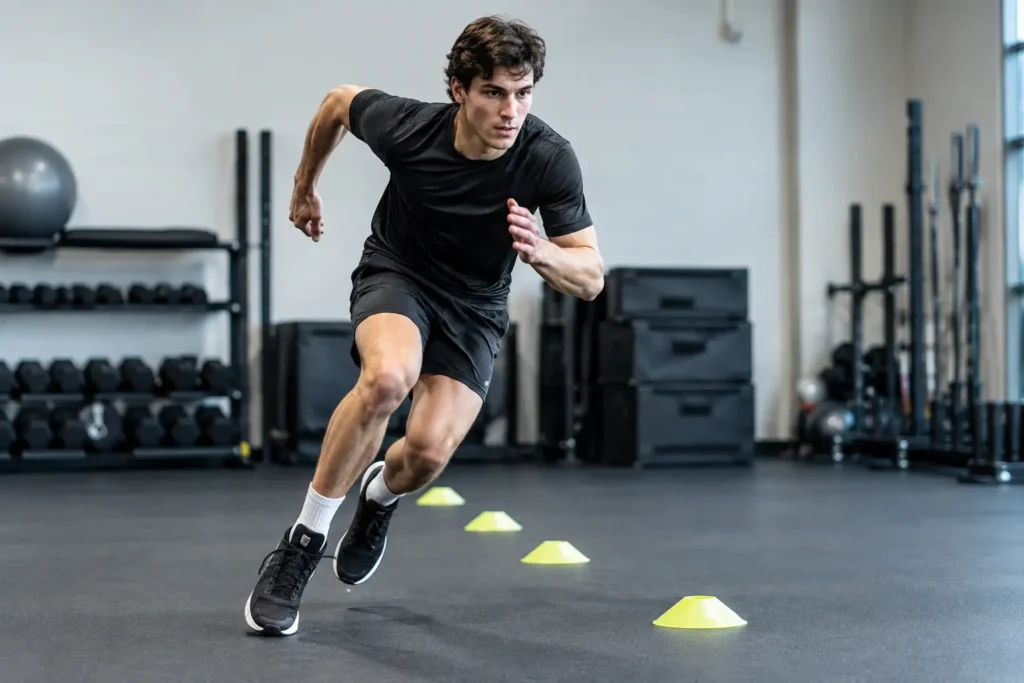
Short acceleration drills are more useful for hockey than long, exhausting runs. A player might work on five- to 15-yard starts from an athletic stance, focusing on driving the ground away rather than popping upright immediately. Full recovery between repetitions is essential. When every sprint is performed tired, players often rehearse slower mechanics.
Lateral movement deserves equal attention. Skaters must push sideways, control their hips, and redirect quickly. Lateral bounds, shuffle-to-sprint drills, and deceleration exercises can help players develop that ability. The landing is as valuable as the jump. A quiet, balanced landing with knees tracking well shows that the player can absorb force before asking their body to produce more of it.
Agility drills should have a purpose. Cones can be useful, but a player who memorizes a cone pattern is not automatically becoming more game-ready. Add reactions when possible: a coach calls a direction, points to a target, or gives a visual cue. This asks the athlete to process information and move, much like a game.
Train Power Without Losing Control
Power is strength expressed quickly. For hockey players, it shows up in the first three strides, a hard stop, a puck battle, and a shot that gets through traffic.
Jump training can be valuable when it is introduced progressively. Begin with snap-downs, controlled squat jumps, and low-level hops. Athletes should land with control before progressing to broad jumps, lateral bounds, or repeated jump sequences. More jumps are not always better. High-quality repetitions with enough rest develop power more effectively than sloppy volume.
Medicine ball work is another strong option for hockey because it can train rotation without turning every drill into a swing as hard as possible. Rotational throws, scoop tosses, and chest passes teach athletes to use their legs and hips before their upper body. That sequence closely supports shooting mechanics.
For players using weights, the best exercise is the one they can perform well. Goblet squats, split squats, Romanian deadlifts, rows, push-ups, and loaded carries are productive options. Advanced Olympic-style lifts may have a place with qualified instruction, but they are not required for a player to become faster or stronger.
Add Shooting Repetitions With a Technical Goal
Off-ice shooting is one of the most direct ways to improve a player’s puck skills, but only when the repetitions are intentional. Firing hundreds of pucks with poor hand placement or a collapsing posture can reinforce the wrong pattern.
Give every shooting block one technical focus. For a wrist shot, it may be loading the stick, shifting weight to the lead side, and finishing toward the target. For a snapshot, it may be getting the puck into a shooting position quickly while maintaining lower-body stability. For a one-timer, it may be tracking the pass and rotating through the shot without standing tall.
Accuracy should be trained alongside velocity. Place small targets in different areas of the net and ask the player to hit a specific location. Change the puck position, release point, and body angle. Game scoring rarely comes from taking the same stationary shot repeatedly.
At Pro Stride Hockey, a synthetic-ice shooting lane and immediate video feedback can help athletes see details that are difficult to feel in the moment. Video is particularly useful for identifying rushed weight transfer, a drifting head position, or hands that separate from the body at release.
A Weekly Hockey Dryland Training Guide
Most youth players do not need daily high-intensity dryland. They need a schedule they can recover from while still enjoying team practices, games, school, and family life. Two to three focused sessions per week can create meaningful progress.
A balanced week could include:
- One strength and movement session built around squats, hinges, single-leg work, pushing, pulling, and trunk control.
- One speed and power session with short accelerations, lateral movement, jumps, and controlled deceleration.
- One shooting and skill session with 75 to 150 purposeful puck repetitions, adjusted for the athlete’s age and mechanics.
- One optional mobility and recovery session featuring easy movement, hip mobility, ankle work, and light stickhandling.
A younger athlete may complete 30 to 40 minutes per session. An older, more experienced player may train for 45 to 60 minutes. The right amount depends on ice schedule, training history, sleep, growth stage, and how the player is responding. Soreness that changes skating mechanics, persistent fatigue, or declining enthusiasm are signs to reduce volume and reassess.
Mobility and Recovery Are Part of the Program
Players often look for the next hard drill while ignoring the basics that allow hard work to pay off. Sleep, food, hydration, and recovery are performance tools. A player who is consistently under-rested will struggle to learn movement patterns, build strength, and make good decisions.
Mobility should be specific. Hockey players commonly benefit from attention to ankles, hips, thoracic spine, and adductors, but stretching alone is not the answer. Pair mobility with controlled strength. For example, ankle mobility can be followed by calf raises and split squats; hip mobility can be followed by single-leg balance or lateral lunges.
Parents should also watch the total workload. A packed week of practices, games, school training, and dryland can be too much, especially during growth spurts. More work only helps when the player can recover and adapt to it.
Measure Progress Players Can Feel
The best dryland plan has clear markers. Track a player’s sprint time, broad jump, push-up quality, shooting accuracy, or number of technically sound repetitions. Use video periodically to compare body positions and movement efficiency.
Numbers are useful, but they are not the whole story. Progress may first show up as a player who holds a stronger skating stance, recovers balance faster after contact, gets their shot off with less panic, or arrives at the rink more confident. Those changes matter because they make skills available when pressure rises.
Keep the next session focused: one movement to improve, one performance goal to chase, and one reason the work will help on the ice. That is how disciplined off-ice training becomes a stronger stride, a quicker release, and a player who trusts their game when it counts.