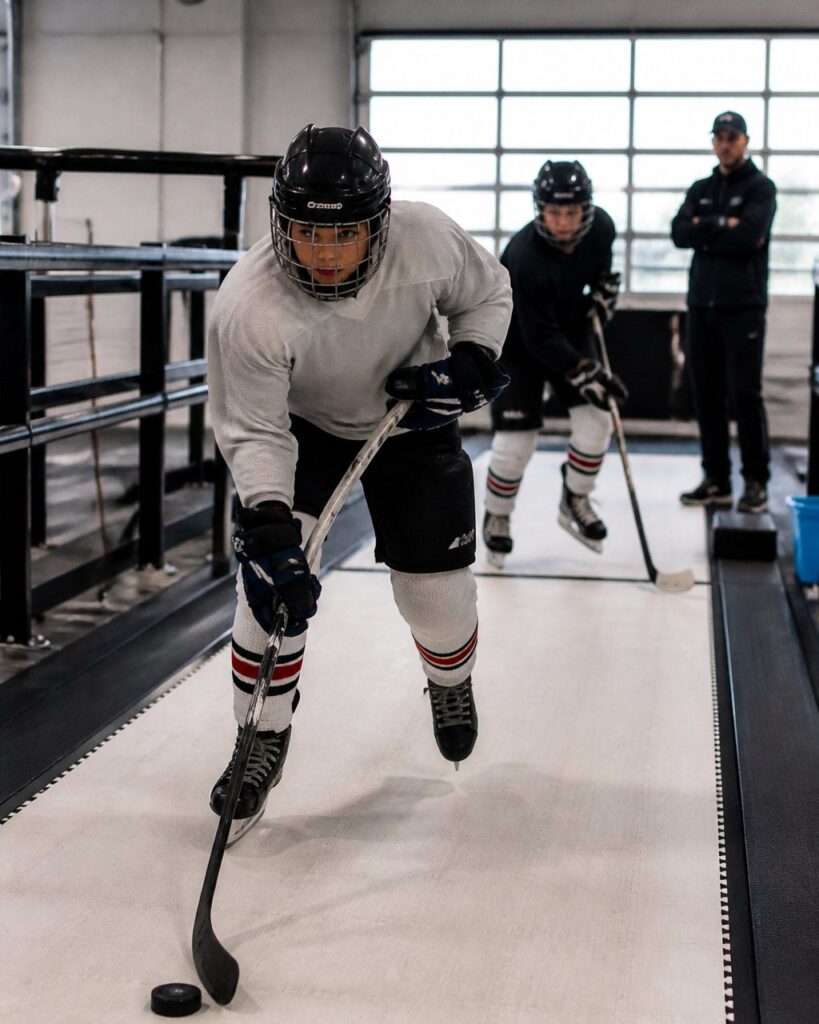
Last Updated: November 2, 2026
Quick Summary
To choose a hockey academy, start with the player’s age group, current skill level, and what they want to improve, then compare programs on coaching qualifications, coach-to-player ratio, and how progress is measured. Ask every academy the same written questions and book a trial session before committing.
- Write down the player’s age group, skill level, and goals before comparing any programs.
- Ask who is on the ice, what their coaching background is, and how feedback is given.
- A lower coach-to-player ratio generally means more individual attention per player.
- Choose a camp for short-term exposure and an academy for sustained skill progression.
- Divide total cost by coached sessions and weigh it against the coach-to-player ratio.
Table of Contents
- Start With the Player, Not the Program
- What to Look for in a Hockey Academy’s Coaching
- Why the Hockey Academy Coach-to-Player Ratio Decides Your Results
- Off-Ice Hockey Training: The Part Most Families Overlook
- Hockey Academy vs. Hockey Camp: Which Fits Your Season
- Questions to Ask a Hockey Academy Before You Commit
- Building a Total-Cost Picture Without Guesswork
- Book a Trial Session and Judge It Yourself
- Frequently Asked Questions
Start With the Player, Not the Program
Choosing a hockey academy works best when you start with the athlete, not the brochure. Before you compare facilities or coaching credentials, write down three things: the player’s age group, current skill level, and what they actually want to improve.
A player who wants a faster first three strides needs different work than one chasing a harder release. A ringette player working on shooting technique has different needs again. When you know the goal, you can judge whether a program’s structure and training schedule actually match it.
At Pro Stride Hockey, we build sessions around the individual: a 2:1 player-to-coach ratio in 1-on-1 sessions and a maximum of four players per session. That format exists because the player’s specific gap, not the group’s average, drives the plan.
If you are still mapping out what focused coaching should include, what a hockey skills academy should deliver is worth reading before you tour anywhere.
What to Look for in a Hockey Academy’s Coaching
Ask who is actually on the ice with your child, and what their coaching background includes. Instructor qualifications matter more than marketing language. Look for coaches with real playing and teaching experience, and ask how they give feedback during a session.
The best academies explain their method. They can tell you why a drill exists, what it corrects, and how progress gets measured. If a coach can’t describe the training program in plain terms, that tells you something.
You can see who our coaches are and what they bring to the ice.
One insider note: watch how a coach handles a player who is struggling. Encouragement plus honest correction is the combination that builds athletes.
Why the Hockey Academy Coach-to-Player Ratio Decides Your Results
The coach-to-player ratio is an important number to compare across academies. A lower ratio generally means more individual attention per player.
Skating technique is subtle: a dropped hip or a short recovery phase is hard to fix from across the rink.
If you are weighing formats, the case for 2-to-1 hockey coaching is worth reading.
Off-Ice Hockey Training: The Part Most Families Overlook
Off-ice training is where skating stride and shooting mechanics get rebuilt away from game pressure. A skating treadmill lets a player work on stride technique with a coach watching each repetition.
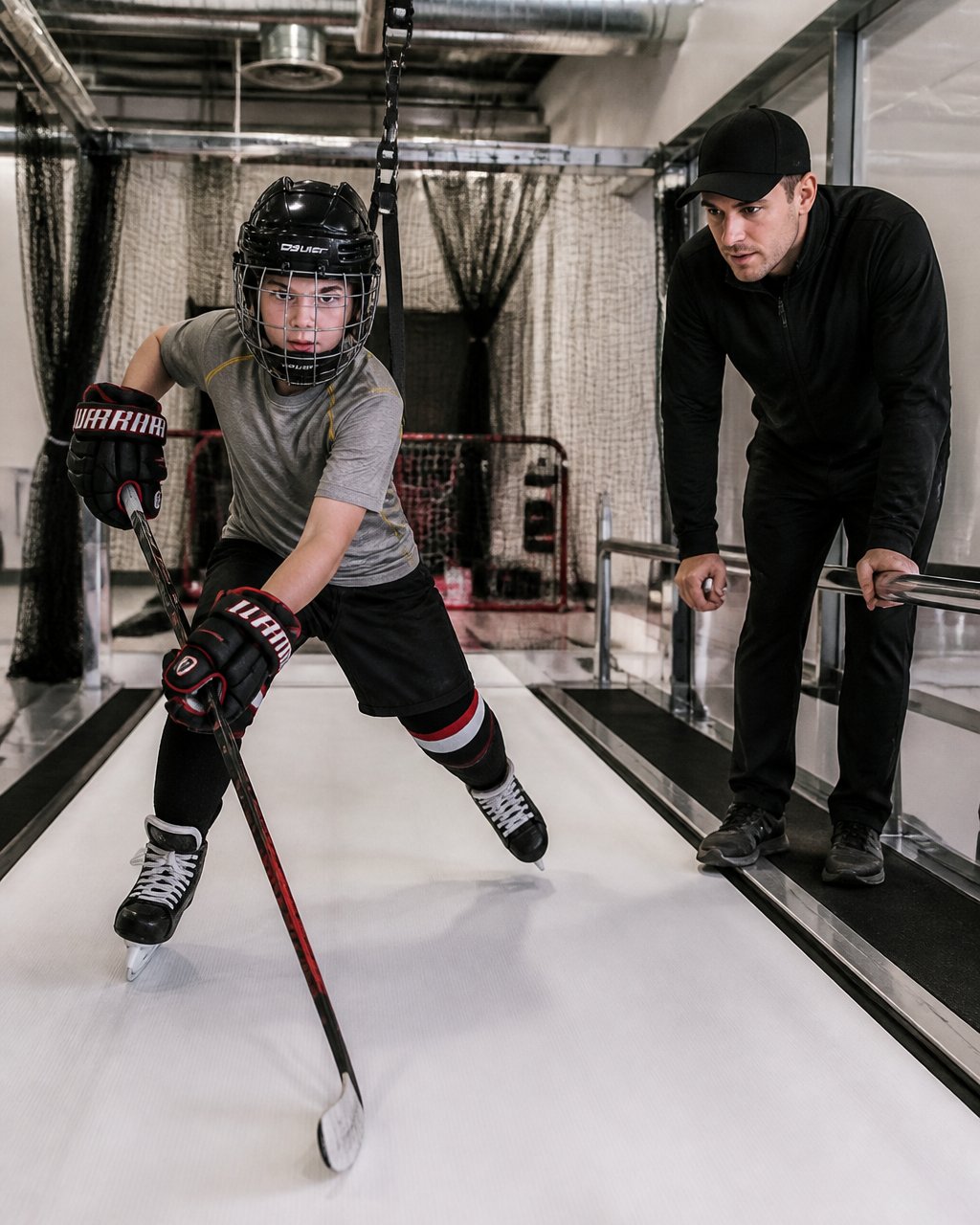
This is the part most families skip. They book ice time and stop there. But the repetition volume that changes technique happens in off-ice environments, where you can isolate one skill at a time.
Families supplementing academy work between sessions can use off-season training at home for simple drills that keep the stride sharp.
Hockey Academy vs. Hockey Camp: Which Fits Your Season
A hockey camp is usually a short, fixed block: a week or two of ice time, often in summer. Consistent growth requires bridging the gap between formal sessions and home practice, a process increasingly supported by interactive hockey apps that help players refine their technical skills independently.
Choose a camp for exposure, fun, or a specific short-term focus. Choose an academy when you want sustained work on skating and shooting technique with a coach who knows the player’s history.
The distinction matters for your calendar and your budget. A camp fits around a busy season. An academy becomes part of the season’s rhythm, which is why commitment level should shape the decision.
| Factor | Hockey Camp | Hockey Academy |
|---|---|---|
| Duration | Short block, often a week or two | Ongoing across weeks or months |
| Focus | Exposure and variety | Sustained skill progression |
| Feedback | Group-level | Individual, repetition-based |
| Best for | Trying new things | Fixing specific technique gaps |
Questions to Ask a Hockey Academy Before You Commit
Bring a written list to every tour and admissions call, and write down the answers in the same order for each program. A side-by-side comparison of identical questions is the fastest way to separate substance from sales language. The list below pairs each question with what a strong answer sounds like, so you can score responses instead of just collecting them.
On coaching and ratio
- What is the maximum number of players per session, and who is on the ice with them? A strong answer names the coach, states a hard cap, and explains why that cap exists. A vague answer (“small groups”) is a red flag.
- What is the coach’s playing and teaching background? Look for specific levels played, years coaching, and any certification. Ask whether the same coach works with your player every session or rotates.
- How do you give feedback during a session? The best programs describe a mechanism, immediate correction, video review, a written progress note, not just “we give feedback.”
On method and progress
- Walk me through a typical session start to finish. You want a sequence: warm-up, skill isolation, repetition, correction, cool-down. If the answer is “we do drills,” press for which drills and why.
- How do you measure progress, and will we see it? Strong programs track something concrete, stride length, release time, a video comparison from month one to month three, and share it with families.
- What happens when a player gets frustrated or loses confidence? Listen for a real approach: encouragement plus honest correction, a reset drill, a shorter rep set. This tells you how the coach handles the athletes who need it most.
On logistics and cost
- What is the total cost, including equipment, facility, and any tournament or travel fees? Ask for it in writing. See the cost section below for how to build the full picture.
- Can we watch a session before committing, and can we book a trial? A program confident in its coaching will say yes. Watch how much individual feedback flows and whether athletes look engaged.
On safety and welfare
- What medical support and supervision are in place? Ask about first aid coverage, emergency procedures, and who supervises off-ice areas.
- How do you prevent overuse and injury? A serious program balances repetition volume with recovery and can explain its warm-up and workload approach.
Score each answer 1-3 as you go (1 = vague, 3 = specific and verifiable). A program that scores well across coaching, method, and welfare is worth a trial; one that scores well only on price is not.
That last question, can we watch, matters most. A trial session answers more than a phone call ever will, and it lets you verify the claims you just heard.
Building a Total-Cost Picture Without Guesswork
Total cost is more than the program fee. Families who compare only the headline number routinely pick the option that costs more once everything is counted.
The line items to capture
- Program or tuition fee, the base cost of the sessions themselves.
- Equipment, skates, sticks, protective gear, and any replacement costs from higher training volume. Off-ice repetition wears equipment faster than game play alone.
- Travel and accommodation, fuel, transit, parking, and any overnight stays if the program is not local.
- Tournament and event fees, some programs bundle these; others bill separately.
- Facility or ice surcharges, ask whether off-ice and on-ice time are priced together or apart.
- Assessment or registration fees, one-time charges that are easy to miss.
- Financial aid or payment plans, ask directly; many programs have options they do not advertise.
Compare per-session value, not the sticker
Divide the total by the number of coached sessions to get a per-session figure. Then weigh that against the coach-to-player ratio. A low fee for crowded sessions is not cheaper than a higher fee with real coaching attention, because the repetitions per player, the thing you are actually buying, are lower.
Build a simple spreadsheet: one row per academy, one column per line item above, plus a final column for per-session cost at the stated ratio. The program with the best combination of low total and high attention per player is your shortlist leader, not the one with the lowest fee.
On player outcomes, ask for evidence
Cost only makes sense against results. Ask each program for evidence of progression: before-and-after video, references from families who have been through a full cycle, or a description of how they track improvement. Ask each program for references from families, and ask how it tracks improvement.
Book a Trial Session and Judge It Yourself
No guide replaces seeing a session in person. Book a trial, watch the coach work, and ask your player how it felt. Confidence and clear feedback are signals worth watching for.
Pro Stride Hockey runs sessions built on a 2:1 player-to-coach ratio, a maximum of four players per session, video analysis, and a dedicated shooting lane. If that fits your player’s goals, book a trial session and see it firsthand.
Frequently Asked Questions
What should I look for in a hockey academy?
Focus on four things: who is actually coaching, how many players share each coach, what happens off the ice, and whether the program can show evidence of player improvement. Ask about session length, weekly commitment, and how skills are transferred into game situations. A hockey academy with small groups, video review, and a clear development plan will usually serve a serious youth player better than one that sells ice time alone.
How important is the coach-to-player ratio at a hockey academy?
It is one of the strongest signals of quality. In a large group, a coach cannot see every stride fault or correct a shooting motion in real time. A hockey academy coach-to-player ratio of 2:1 or a four-player cap per session means feedback happens every rep, not once a week. Ask for the ratio in writing, and confirm it applies to the sessions your child will actually attend.
What is the difference between a hockey academy and a hockey camp?
A camp is usually a short block, often a week in summer, built around variety and fun. A hockey academy runs over a longer period with a structured plan, progress tracking, and repeatable coaching. If your goal is a quick refresher, a camp works. If you want measurable gains in stride efficiency or shooting technique across a season, an academy’s ongoing format is the better fit.
What questions should I ask a hockey academy before enrolling?
Ask who coaches the sessions and what their playing and teaching background is, what the maximum group size is, how progress is measured, and whether video analysis is included or extra. Ask how off-ice work is structured, what a typical session looks like from warm-up to finish, and whether you can watch a session before committing. Also ask what happens if the program is not the right fit after a few weeks.
Will an academy help a recreational player or only elite athletes?
Good instruction helps any player who wants to improve. The key is whether the program groups players by skill level and adjusts the workload. A recreational player benefits from clean stride mechanics and shooting fundamentals just as much as a competitive athlete. Ask how the academy places players and whether sessions are matched to age and ability rather than lumped together.
How much does a hockey academy cost?
Pricing depends on session length, group size, weekly frequency, and whether video analysis or specialized facilities are included. Rather than comparing headline rates, ask each provider for a full breakdown covering session count, hours on and off the ice, and any assessment fees. Request a quote directly from the academy so you compare total cost against total coaching time.
The hardest part of choosing an academy is knowing whether the coaching will actually move your player forward. At Pro Stride Hockey, we put the answer on the ice: small groups, real feedback, and a plan built around your athlete. Get started with Pro Stride Hockey and give your player the repetitions that change their stride and their shot.
