Table of Contents
- What Is Hockey Situational Awareness and Why It Matters
- Hockey Scanning Drills to Build Vision and Reaction Time
- How to Read the Game in Hockey: Pattern Recognition and Anticipation
- Hockey Decision-Making Drills for Faster Thinking Under Pressure
- Hockey Awareness Drills for Youth Players: Building Confidence and Cognitive Skills
- Measuring Your Improvement in Game Awareness and Decision-Making
- Frequently Asked Questions
Last Updated: October 21, 2026
What Is Hockey Situational Awareness and Why It Matters
Hockey situational awareness is your ability to understand what’s happening on the ice, where teammates and opponents are moving, and what’s about to happen next. It’s the difference between a fast skater who loses the puck and one who keeps possession.
Most young players can skate and shoot. What separates competitive players is improving hockey game situational awareness. They know where to be before the play gets there.
This skill breaks down into three parts:
- Vision and scanning: Seeing the whole rink, not just the puck
- Pattern recognition: Understanding what opponents will do based on positioning
- Decision speed: Choosing the right play in less than a second
All three are trainable; awareness improves with deliberate practice.
Hockey Scanning Drills to Build Vision and Reaction Time
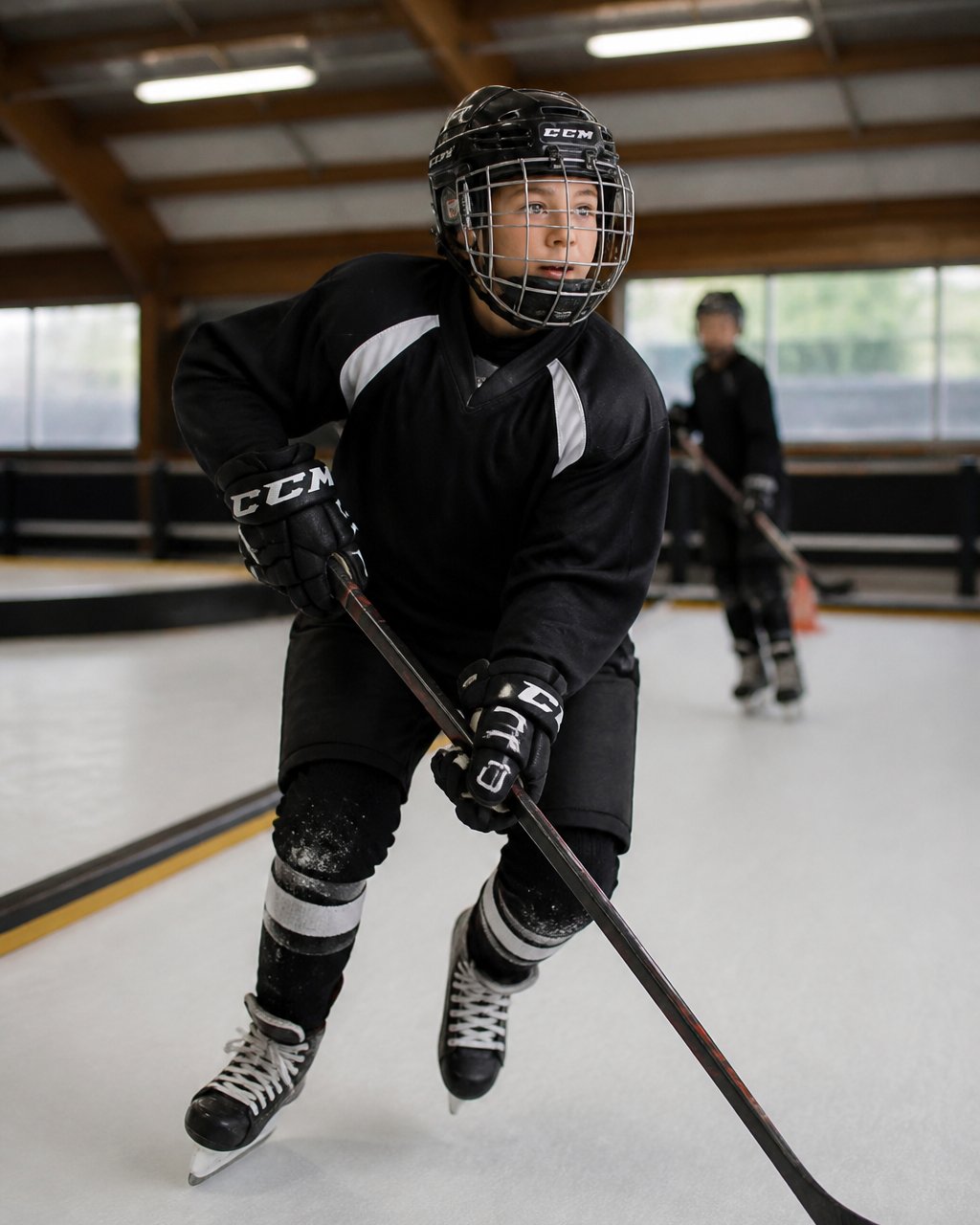
Scanning is the foundation of situational awareness. Most young players skate with their eyes down on the puck, the biggest mistake. Your eyes need to be up, scanning constantly, and that takes practice to make habitual.
Drill 1: Head-Up Skating and Peripheral Vision Work
The goal here is simple: skate forward while keeping your head up and eyes scanning left to right.
Skate in a straight line and every 2-3 seconds look left, then right, then ahead.
Add a challenge: a coach or teammate holds up fingers on either side of the ice, and you call out the number while skating.
Drill 2: Multi-Directional Scanning Under Pressure
Once head-up skating feels natural, add movement and pressure.
Set up three cones in a triangle. Skate around it while a coach passes to you randomly; catch each pass with your head up and eyes scanning. Fight the instinct to watch the puck. Do 10 passes per round, rest 30 seconds, 3 rounds. This teaches faster decisions because you already know where everyone is before you get the puck.
How to Read the Game in Hockey: Pattern Recognition and Anticipation
Reading the game means predicting what happens next from what’s happening now: a defender moving toward the boards opens the passing lane on the other side; an opponent backing up is preparing to defend, so pass quickly. This is pattern recognition. The cues differ by position, so train the ones your role actually uses.
Recognizing Positioning and Open Space
Positioning tells you where the play is going. When your teammate has the puck on the wing and a defender closes in, move to the open space the defender vacated.
Learn to recognize these patterns:
- Defender moving left = open space on the right
- Two defenders converging = pass option behind them
- Opponent backing up = time to make a play before they set
The more patterns you recognize, the faster you decide; you’re reacting to what you see, not thinking “what should I do?”
Position-Specific Cues: What Each Role Scans For
A common mistake is teaching every player to scan the same way. Each position has a different priority list; use this as a starting checklist and adjust it with your coach.
Forwards (especially centers and wingers):
- Scan the weak-side defenseman before you receive the puck on the wall: is he pinching or backing off?
- Check your centerman’s support angle: is he driving the middle lane or trailing?
- Look for the defenseman’s stick side; most defenders angle puck carriers toward their stick, so the escape is usually the opposite side.
Defenders:
- Scan the forechecker’s speed and angle before retrieving a dump-in; this determines whether you can turn up ice or must rim it.
- Check your partner’s gap and body position before stepping up. If your partner is already tight, you hold; if he’s backing off, you can pressure.
- Scan the opposing forwards’ sticks in front of your net. The most dangerous player is usually the one whose stick is already on the ice in the slot.
Goalies:
- Scan the puck carrier’s body angle and stick blade before the shot; a blade opened up means a pass is coming, not a shot.
- Track the weak-side forward entering the backdoor. Most goals against come from a player the goalie never scanned.
- Before a faceoff in your zone, scan both teams’ alignments and identify the most likely shot lane.
Build a personal scan checklist for your position. Three to five cues you look for every shift. Write them on tape on your stick or in your phone notes. Review them before each game.
Anticipating Opponent and Teammate Movement
Anticipation is prediction: where will the opponent move next, and where will your teammate pass? Watch how defenders angle themselves; angled one way means preparing to move that direction; on their heels means about to back up or turn. These cues happen in milliseconds, but if you’re scanning, you see them.
A Repeatable Film-Review Method for Reading Cues
Watching game film is only useful with a method.
Step 2, Review only the moments that cue appears. Fast-forward to faceoffs, breakouts, and puck retrievals.
Step 4, Set one focus for the next game. Write it down: “Scan the forechecker’s angle before every retrieval.”
Step 5, Repeat. Review the same cue after the next game.
Ten to fifteen minutes of focused review per week beats an hour of passive watching.
Pattern recognition is position-specific and trainable. Build a short scan checklist for your role, review film one cue at a time, and set a single focus for each game. That loop, scan, review, focus, repeat, is what turns watching into reading the game.
Hockey Decision-Making Drills for Faster Thinking Under Pressure
Decision-making under pressure separates recreational players from competitive ones, and it’s trainable through game-like situations with limited time to decide.
Small-Area Games and Reduced-Space Practice
Small-area games force faster decisions because there’s less time and space.
Set up a 30-by-30 foot area (or smaller) and play 3v3 or 4v4. The reduced space means the puck reaches you faster, you have fewer options, and you must decide immediately. After 20 minutes, full-ice play feels slower. Do them 2-3 times per week.
Game-Like Situations with Decision Cues
Set up a drill that mimics a real game moment. The Breakout Decision: your team has the puck behind the goal line, a coach signals which direction the forecheck comes from, and you must decide in 2-3 seconds whether to pass to the wing, pass to the point, or skate it out yourself while a defender closes in.
Hockey Awareness Drills for Youth Players: Building Confidence and Cognitive Skills
Young players often feel overwhelmed when everything speeds up. Build awareness gradually so confidence grows with skill. This section adds two things most guides miss: observable progress indicators you can track without a coach’s spreadsheet, and adaptations for ringette players and off-ice training.
Progressive Drill Structure by Age and Skill Level
Start simple. Add complexity slowly.
Beginner (U10-U12):
- Focus on head-up skating and basic scanning
- Small-area games with fewer players (2v2 or 3v3)
- Drills that teach one decision at a time (pass or shoot, not both)
Intermediate (U13-U15):
- Add pattern recognition drills
- Small-area games with more pressure
- Drills that combine two decisions (where to pass AND how fast)
Advanced (U16+):
- Game-film review and self-assessment
- Full-ice drills with multiple decision points
- High-pressure small-area games
This progression prevents frustration: players succeed at each level before moving up.
Observable Progress Indicators for Young Players
You don’t need advanced stats to know whether awareness is improving. Track a few simple, observable indicators over a four-week block. A parent, coach, or the player can count these from the bench or from film.
- Pre-scans before receiving the puck: Count how many times per shift the player looks over each shoulder before the puck arrives. The target is at least one scan per side before reception.
- Decision time: On film, note how long the player holds the puck before making a play. Shorter, correct decisions signal improved reading.
- Turnovers under pressure: Count giveaways when an opponent is within a stick-length. Fewer turnovers in the same drill or game situation is a direct signal.
Pick two indicators per four-week block. Count them in one game or one drill session per week. Write the numbers down. If the trend is flat, change the drill, not the player.
Keep the log short: date, indicator, count, one note. Three lines per week is enough to see a trend over a month.
Adapting Awareness Drills for Ringette Players
Ringette players face different awareness demands than hockey players, and most awareness content ignores them. The principles transfer, but the cues change.
- Ring control replaces puck protection. The ring sits flat on the ice and is harder to settle, so scanning must happen earlier, before the ring arrives, not as it arrives.
- The 30-second shot clock rewards quick reads. Ringette players should practice scanning the shooting lane and the crease before crossing the free-play line, not after.
- Passing rules mean the first look is often a pass, not a shot. Train the scan to identify the open teammate first, then the shot lane.
A simple adaptation: run the same small-area games from the hockey progression, but substitute a ring and enforce ringette passing rules. The scanning habit carries over; the decision cues become ringette-specific.
Combining Off-Ice Training with On-Ice Application
Off-ice training teaches the mechanics; on-ice drills apply them under game conditions.
At Pro Stride Hockey, we use a skating treadmill to work on stride technique and body positioning for scanning, then take those skills to the ice to practice reading the game at speed.
Off-ice work builds muscle memory for proper positioning, on-ice drills train decision-making in game situations, and together they create lasting improvement.
Awareness for young players improves fastest when it’s progressive, measurable, and adapted to the sport. Use the age-based progression, track two observable indicators per month, and adapt the drills for ringette where relevant. Confidence follows competence, and competence follows a plan.
Measuring Your Improvement in Game Awareness and Decision-Making
You can’t improve what you don’t measure. Most young players have no idea if their situational awareness is actually getting better. They just feel like they’re working hard.
Measure it. Track progress. Adjust your training based on results.
Video Review and Self-Assessment
Film yourself playing. Watch it later. Look for these specific things:
- How many times did you scan the ice per shift?
- How many times did you make a decision with your head down?
- How many times did you find open space before receiving the puck?
Count these moments, write them down, and repeat in two weeks. The numbers should improve.
This is the most accurate way to measure improving hockey game situational awareness. You’re not guessing. You’re seeing it on film.
Tracking Progress Over Time
Keep a simple log: date of review, scans per shift, good decisions under pressure, turnovers caused by poor awareness, and notes on what improved.
Building improving hockey game situational awareness takes time and deliberate practice, but it’s one of the highest-impact skills you can develop.
Pro Stride Hockey specializes in skill development through personalized coaching and video analysis.
Frequently Asked Questions
What does situational awareness mean in hockey?
Situational awareness in hockey is your ability to understand what’s happening around you on the ice in real time. It means knowing where your teammates and opponents are, recognizing open space, anticipating the next play, and making smart decisions under pressure. Players with strong hockey situational awareness keep their heads up, scan constantly, and react faster to changing conditions. This skill separates players who read the game from those who react only after the play develops.
How can young hockey players learn to read the game?
Young players build game-reading skills through progressive, game-like drills that teach pattern recognition and positioning awareness. Start with simple scanning exercises where players focus on keeping their heads up while moving. Progress to small-area games where decision-making happens quickly, forcing players to recognize positioning and anticipate movement. Video review of their own play helps them see patterns they missed in real time. Off-ice cognitive training accelerates learning by building decision-making speed and confidence.
What drills help improve hockey vision and awareness?
Effective drills include multi-directional scanning exercises where players skate while tracking multiple visual cues, small-area games that demand constant awareness, and reduced-space practice that forces faster decisions. Head-up skating drills build peripheral vision, while game-situation drills with specific decision cues teach players to recognize what matters most in each moment. Off-ice training on specialized equipment can reinforce stride efficiency, allowing players to focus mental energy on scanning and awareness. Combining these approaches builds vision faster than any single drill.
Can off-ice training improve hockey decision-making?
Yes. Off-ice training improves the physical foundation that allows better decision-making on ice. When players develop efficient stride technique and body control through specialized training, they use less mental energy on basic movement, freeing cognitive resources for scanning and awareness. Additionally, off-ice cognitive drills and video analysis train the pattern-recognition and reaction-time skills that directly transfer to game situations. Targeted cognitive training creates faster, smarter decision-making under pressure.