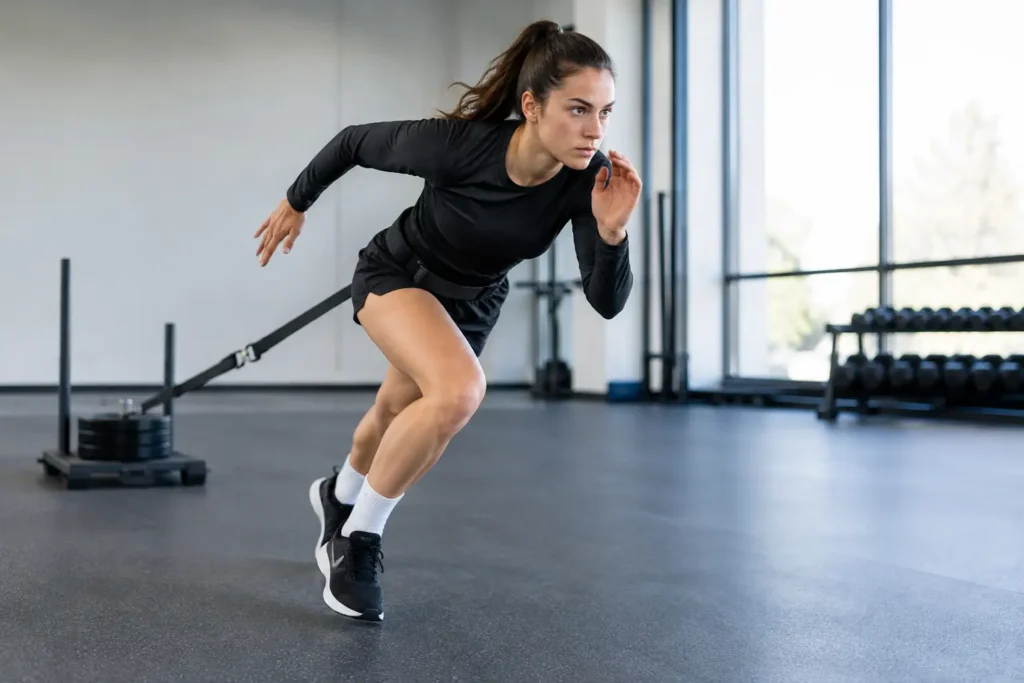
The first three strides often decide the play. A loose puck, a defensive recovery, or a race through the neutral zone rarely gives a player 50 feet to build speed. Players who win those moments know how to increase skating acceleration by creating force into the ice quickly, in the right direction, with a body position they can repeat under pressure.
For hockey players, acceleration is not simply about trying harder or taking faster steps. It is a technical skill built on posture, edge control, leg strength, and efficient recovery. When one part breaks down, energy leaks out of the stride. The good news for players and parents is that acceleration can be trained at every age when coaching focuses on the details that matter most.
How to Increase Skating Acceleration From the First Step
Acceleration begins before the skate leaves the ice. A player needs an athletic starting position: knees bent, hips loaded, chest over the knees, and weight balanced through the middle of the blades. If the player stands tall, the legs cannot push with enough force. If the chest drops too far forward, balance disappears and the first steps become choppy.
The first push should travel back and slightly out, not straight sideways. Hockey is played forward, so the force must move the player forward. Think of driving the ice behind you rather than reaching wide with the skate. A full extension through the hip, knee, and ankle creates the powerful push that starts the body moving.
The recovery matters just as much. After each push, the skate must return underneath the body quickly. Young players often let the recovery foot swing too far outside their hip. That adds extra movement, delays the next stride, and makes it hard to keep a low position. Efficient acceleration looks compact and forceful: push, recover underneath, push again.
A strong forward lean is useful, but it must come from the ankles and overall body angle, not by folding at the waist. The head stays up, the hips stay underneath the shoulders, and the player looks ready to react. That posture creates speed without sacrificing awareness of the puck, teammates, or incoming pressure.
Build Edge Power, Not Just Fast Feet
Fast feet can look impressive in a drill, but quick steps without edge pressure do not automatically create separation in a game. The inside edge is especially important during the first few strides because it gives the player something to push against. A player who slips off the edge, rolls onto a flat blade, or barely finishes each push will need more steps to reach the same speed.
Start with controlled edge work at a slower pace. Players can practice deep knee bends while gliding, then take deliberate forward strides where they feel pressure build through the inside edge. Once the edge holds consistently, increase the pace. Quality comes before volume. Repeating poor mechanics at top speed only makes the error more automatic.
Single-leg balance also has a direct impact on acceleration. Each stride requires a player to stabilize over one leg while the other leg recovers. If that standing leg collapses inward or wobbles, power is lost before the next push begins. Balance drills, controlled one-leg glides, and lateral strength work help athletes own that position.
Skate setup can affect this work as well. Dull edges reduce confidence in the push, while an inappropriate hollow or poorly fitted skate can make it difficult for an athlete to access an edge consistently. Equipment is not a replacement for technique, but it should support the player rather than create an unnecessary obstacle.
Train the Positions That Create Explosive Strides
Off-ice training is valuable when it reinforces the positions a player needs on the ice. The goal is not to make every workout exhausting. The goal is to build stronger legs and hips, improve coordination, and teach the body to apply force quickly.
Squats, split squats, lateral lunges, and controlled single-leg movements are useful because skating demands knee bend and stability from side to side. Young athletes should focus first on clean movement patterns and body control. Older players who have learned proper technique can progressively add resistance and explosive work under qualified supervision.
Short jumps and lateral bounds can also carry over to skating acceleration because they train quick force production. The landing is as important as the jump. Athletes should land quietly, with knees aligned over toes and hips ready to load again. A player who cannot control the landing is not ready to chase more height or distance.
Core strength deserves attention too, although hockey players do not need endless crunches. They need a trunk that can stay stable while the legs drive hard and the upper body handles a stick, contact, or a puck. Carries, planks, and controlled rotational exercises can improve that connection.
Speed training should include plenty of recovery. Acceleration work is high quality work. If an athlete is exhausted, technique usually fades and the drill becomes conditioning. Use short efforts, rest enough to repeat them well, and stop before mechanics unravel. Conditioning has a place in hockey development, but it should not replace focused speed training.
Use Drills That Transfer to the Game
The best acceleration drills have a clear purpose. A straight-ahead sprint can develop basic mechanics, but players also need to accelerate from realistic hockey positions: a puck-protection stance, a crossover, a stop, a pivot, or a battle along the boards.
A productive progression starts with three-stride starts. The player begins in a strong loaded position, takes three powerful strides, and holds the glide to feel whether the body is moving efficiently. This exposes common issues quickly: standing up too soon, stepping instead of pushing, or failing to recover the feet under the hips.
From there, add a reaction. A coach can point left or right, call a color, or move a puck into space. The player must recognize the cue and explode without losing posture. This is closer to game acceleration, where players rarely get to choose the perfect starting moment.
Later, use drills that connect acceleration to a hockey skill. Accelerate out of a tight turn, win a race to a puck, make a pass after three strides, or shoot after driving through a lane. The technical goal stays the same, but the player learns to use speed while making decisions.
Correct the Mistakes That Steal Speed
Many athletes work hard but leave speed on the ice because of a few repeat errors. The most common is taking short, rapid steps with no complete extension. Another is rising out of the knees after the first stride, which removes the loaded position needed for continued power.
Some players push too wide and create side-to-side movement instead of forward momentum. Others reach backward with the recovery skate, making each stride late. These habits are difficult to feel in the moment, especially for younger athletes. Immediate video feedback can be valuable because a player can see the difference between what they intended to do and what their body actually did.
Coaching should match the player’s developmental stage. An introductory player may need one simple cue, such as keeping the knees bent through three strides. An advanced player may be ready to refine hip extension, edge angle, and recovery timing. Trying to fix everything at once usually creates overthinking. Address the largest limiter, repeat the movement with purpose, then layer in the next detail.
Measure Progress Beyond a Stopwatch
Timed starts are useful, but acceleration improvement also shows up in game behavior. Does the player get to loose pucks earlier? Can they separate after a turnover? Do they recover faster when an opponent gains a step? Are they able to accelerate while carrying the puck rather than skating fast only when it is absent?
Track short-distance times over five or 10 meters, but also watch video and note technical changes. A slightly slower repetition with cleaner mechanics may be more valuable than a fast repetition built on a flaw that will limit the player later. Consistency is the real benchmark. A player should be able to produce a strong first three strides repeatedly, not just once when fresh.
At Pro Stride Hockey, small coaching ratios and skating treadmill work create an environment where athletes can receive immediate correction, build purposeful repetitions, and see their movement on video. That individual attention helps turn a general instruction like “skate faster” into a clear, athlete-specific plan.
The next time a player works on speed, do not ask only how fast their feet are moving. Ask whether they are loaded, balanced, driving force in the right direction, and recovering efficiently. Those details are where explosive first steps are built – and where a player starts arriving first when the game demands it.