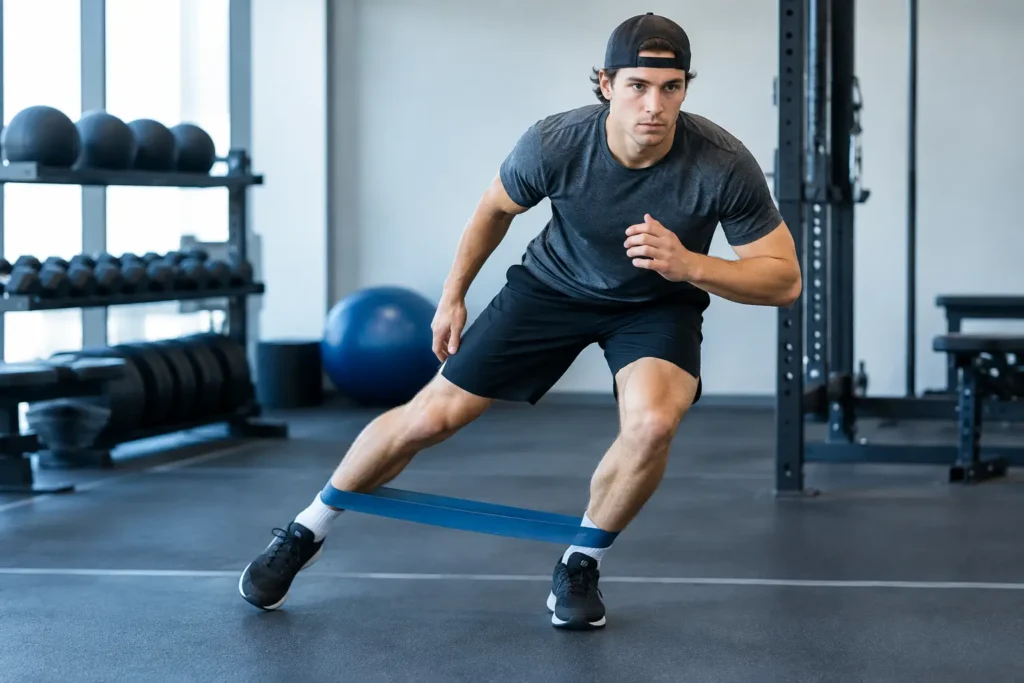
A powerful stride is not built by simply doing more sprints. Hockey players need to create force sideways, control one leg at a time, and transfer power through the ice without losing posture. The top skating power exercises train those exact demands, helping athletes push harder, recover their stride faster, and accelerate with more confidence.
For young players, the goal is not to chase heavy weights or complicated drills. It is to build clean movement patterns, then add speed, resistance, and challenge as the athlete earns it. Quality repetitions matter. A strong off-ice program should make an athlete more explosive on the ice, not leave them too sore to skate well.
What creates skating power?
Skating power starts from the hips and legs, but it depends on more than leg strength. A player needs a stable trunk, strong single-leg balance, hip mobility, and the ability to direct force laterally. Unlike running, where athletes primarily push backward into the ground, a skating stride requires a forceful push to the side and slightly back.
That is why a traditional gym routine built only around straight-ahead squats and jogging can miss part of the picture. Squats still have value, but hockey players also need unilateral strength, lateral movement, and explosive intent.
The right exercise depends on the athlete. A younger player may need to learn how to land, squat, and balance before performing jumps. An older player with a solid training base may be ready for more load, more speed, or more advanced single-leg work. Technical control always comes before intensity.
8 top skating power exercises for hockey players
1. Lateral bounds
Lateral bounds are one of the best off-ice exercises for teaching the side-to-side force used in a skating stride. Start on one leg, push sideways, land softly on the opposite leg, and hold the landing briefly. The landing knee should stay in line with the toes while the chest remains tall and controlled.
This is not a contest to jump as far as possible. A controlled landing is the standard. Once an athlete can consistently absorb force and stay balanced, increase the distance or move into continuous bounds. Perform two to three sets of five to eight bounds per side.
2. Rear-foot elevated split squats
Hockey is a single-leg sport. During each stride, one leg drives while the other recovers. Rear-foot elevated split squats build strength through the front leg while challenging hip stability and posture.
Keep most of the pressure through the full front foot. Lower under control, with the front knee tracking cleanly over the toes, then drive up with purpose. Bodyweight is an excellent place to begin. Dumbbells can be added when the athlete owns the movement. Two to four sets of six to 10 repetitions per side works well for most players.
3. Squat jumps
A squat jump teaches athletes to produce force quickly. Begin in an athletic stance, lower into a quarter or half squat, then jump vertically with a fast, aggressive extension through the hips, knees, and ankles. Land quietly and reset before the next repetition.
The reset matters. Continuous sloppy jumps often turn into conditioning rather than power work. For skating performance, each rep should look sharp. Use three to five sets of three to five quality jumps, with enough rest to keep the effort explosive.
4. Single-leg Romanian deadlifts
The single-leg Romanian deadlift develops the hamstrings, glutes, and balance systems that help players maintain a strong skating position. It also exposes a common issue in young athletes: the hips opening or rotating when one leg has to do the work.
Stand on one leg, soften the knee, and hinge at the hips while the free leg reaches behind the body. Keep the back long and hips square to the floor. The athlete should feel tension in the hamstring and glute of the working leg, not strain in the low back. Start with bodyweight or a light dumbbell for two to three sets of six to eight reps per side.
5. Skater squat to a target
A skater squat to a target is a practical progression for players who need more single-leg control before advancing to deeper pistol-style movements. Stand on one leg and sit the hips back toward a bench, box, or pad. Lightly touch the target, then stand back up without collapsing at the knee or shifting the torso excessively.
This exercise develops the ability to control the knee and hip during a deep, athletic position. It is particularly useful for players who lose posture in turns, struggle to stay low, or have difficulty generating a strong first few strides. The target height can be adjusted to match the athlete’s mobility and strength.
6. Lateral lunge
The lateral lunge strengthens the adductors, glutes, and quads in a position that closely resembles loading into a stride. Step to one side, sit into the hip of the stepping leg, and keep the opposite leg long. Push the floor away to return to the starting position.
Players often rush this exercise and let the working knee cave inward. Slow the lowering phase down, own the bottom position, then drive back with intent. For athletes new to lateral strength work, bodyweight lateral lunges are demanding enough. Complete two to three sets of six to 10 reps per side.
7. Wall acceleration drives
First-step speed needs more than strong legs. Athletes must understand shin angle, body position, and how to direct force into the ground. Wall acceleration drives offer a simple way to teach those details.
Lean into a wall with the body in a straight line from head to heel. Drive one knee up while the opposite leg pushes back into the floor, then switch with a quick, controlled rhythm. The athlete should feel the glutes and core working while maintaining a strong forward lean. Use short sets of five to eight drives per side or timed intervals of 10 seconds.
8. Broad jumps with a stick landing
Broad jumps train horizontal force production, which supports acceleration. From an athletic stance, swing the arms, jump forward, and land in a stable hockey-ready position. Hold the landing for two seconds before walking back.
The stick landing turns this into a power-and-control drill. If an athlete lands loudly, falls forward, or cannot hold the finish, reduce the distance. Three to four sets of three to five jumps are enough when every repetition is explosive.
How to build these exercises into a week
For most youth hockey players, two off-ice power sessions per week are plenty during the season. Each session can take 20 to 35 minutes when it follows a good warm-up. Choose one jumping exercise, one lateral exercise, one single-leg strength exercise, and one acceleration or core-control movement.
A simple session might include lateral bounds, rear-foot elevated split squats, wall acceleration drives, and a single-leg Romanian deadlift. Another day could use squat jumps, lateral lunges, broad jumps, and skater squats. Keep power exercises near the beginning of the workout, when the athlete is fresh and can move with speed.
More is not always better. If a player has multiple games, hard practices, or signs of fatigue, reduce the volume rather than forcing every planned set. Growth, recovery, sleep, and nutrition all influence how well young athletes adapt to training.
Make the strength transfer to the ice
Off-ice work produces the best results when athletes understand the connection to their stride. After lateral bounds, ask whether the player can feel the push coming from the hip. After wall drives, connect the forward body angle to the first three steps out of a stop. Those simple coaching cues help players carry a gym movement into a game situation.
At Pro Stride Hockey, athletes can pair off-ice power development with skating treadmill work and immediate video feedback to see how their body position affects stride length, recovery, and force production. A coach can identify whether a player has the strength to create power but is losing it through inefficient mechanics, or whether the movement pattern itself needs attention first.
The strongest training plan is the one a player can perform consistently with excellent technique. Build the foundation, train with purpose, and let every quality repetition move the stride closer to more power, better skill, and maximum speed.