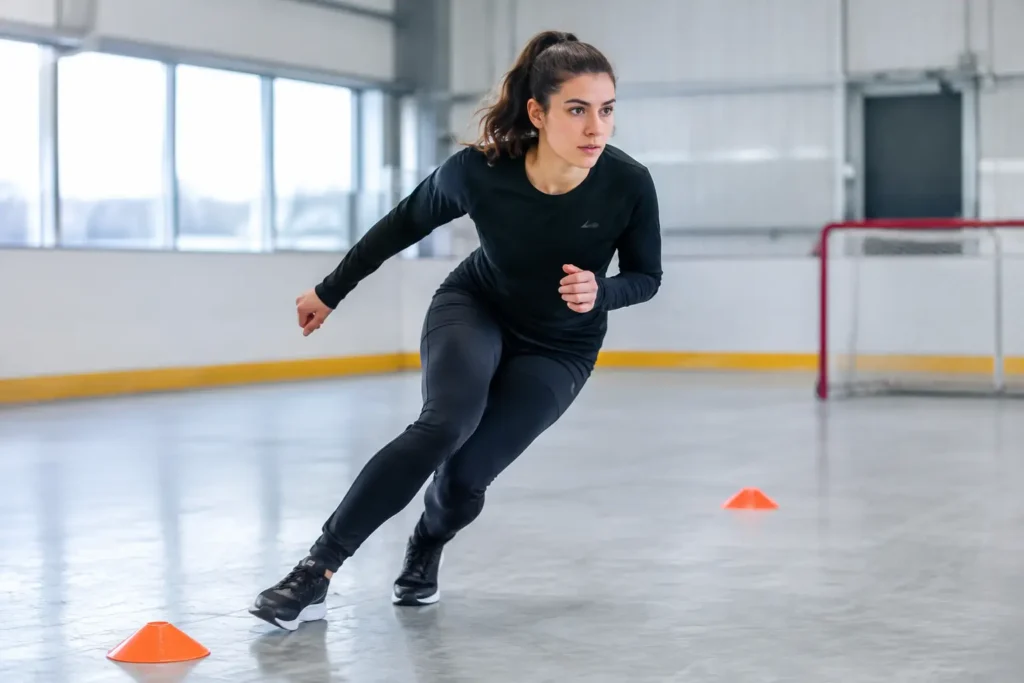
Crossovers are where a player stops simply skating around the rink and starts creating separation. A strong crossover lets a defenseman hold the blue line, helps a forward attack wide with speed, and gives every player a faster route through a turn. Learning how to develop skating crossovers is not about moving your feet faster first. It is about building edge control, body position, and enough repetition to make the movement automatic under pressure.
For young hockey players, crossovers can feel awkward because the body is asked to lean, balance on one skate, and generate force with the other – all while maintaining speed. That discomfort is normal. The goal is not to rush past it. The goal is to train the movement correctly until power and confidence show up together.
How to Develop Skating Crossovers With Stronger Edges
Every effective crossover starts with the edges. The outside edge of the inside skate carries the player through the turn, while the inside edge of the outside skate creates the powerful push that adds speed. If either edge slips, flattens, or fails to engage, the player will drift through the turn instead of accelerating out of it.
Start by teaching the athlete to feel the lean. On a left turn, the body should lean slightly left from the ankles, not collapse at the waist. The knees stay bent, the chest stays tall, and the head remains up. Players who stay too upright usually cannot access their edges. Players who lean only with their shoulders often lose balance because their skates remain flat underneath them.
A useful progression is a controlled circle. Skate a large circle in one direction with both skates on the ice, then gradually reduce the circle while maintaining knee bend and balance. Once the player can hold the arc, add a crossover step. The crossing skate should step over with purpose, not reach far across the body. A long, uncontrolled step often pulls the hips out of position and slows the next push.
The push underneath matters just as much as the step over. After one skate crosses, the skate underneath should drive laterally into the ice. Think push, recover, cross – not step, step, step. That underneath push is where much of the speed comes from.
Build the Position Before Adding Speed
Players often try to develop crossovers by racing around circles. Speed has value, but it can hide poor mechanics. A player may get through the drill quickly by standing tall, swinging the arms, or taking choppy steps. Those habits become harder to fix as the athlete gets older.
A stronger approach begins at a controlled pace. The athlete should establish a loaded stance: knees flexed, hips low, weight balanced through the middle of the blade, and hands in front of the body. The shoulders should stay relatively level through the turn. A slight inside lean is necessary, but dropping the inside shoulder can cause the player to tip, rotate excessively, or look down.
Watch the player’s recovery skate. After the crossover step, the skate should return underneath the body rather than land wide behind it. A wide recovery creates unnecessary movement and delays the next stride. Efficient crossovers are compact. The feet move quickly, but the body stays quiet and balanced.
For hockey, posture must also support the stick. A player who lets the hands swing across the body during crossovers may lose puck control or become less prepared to receive a pass. Train some repetitions with a puck or ball only after the skating pattern is stable. The puck should challenge the athlete’s posture, not replace the technical work.
Drills That Transfer to Hockey
The best crossover drills have a clear purpose. They should teach edge pressure, reinforce body position, and eventually connect to a game situation. Rather than collecting dozens of drills, use a few progressions consistently and measure improvement over time.
Circle crossovers with a pause
Have the player complete two or three controlled crossovers, then hold a glide on the outside edge of the inside skate. The pause reveals whether the athlete can actually balance on the edge or is relying on rapid foot movement to stay upright. Work both directions. Most players will have a stronger side, and ignoring the weaker side creates a limitation opponents can expose.
Figure-eight crossovers
Set up two markers several feet apart and skate a continuous figure eight around them. This drill requires the player to transition from left-turn crossovers to right-turn crossovers without stopping. Focus on keeping the head up and the knees loaded through each change of direction.
As the athlete improves, reduce the distance between the markers. Tighter turns demand better edge angle and faster foot recovery. If technique breaks down, widen the pattern again. The right challenge level depends on age, strength, and skating experience.
Crossover acceleration exits
Place a marker at the end of a turn. The player performs three to five quality crossovers around the marker, then explodes forward for several strides. This teaches a critical game skill: using crossovers to build speed before attacking open ice.
The exit should be powerful, not rushed. If the player comes out of the turn leaning too far inside or with their feet too close together, they will lose the first acceleration stride. Encourage them to finish the turn balanced and ready to drive forward.
Blue-line and corner routes
Once the basic pattern is consistent, add hockey routes. A forward can carry a puck through a wide turn at the top of the circle before driving toward the net. A defenseman can use crossovers along the blue line, then open up to receive a pass or move laterally into a shooting lane.
These drills connect skating mechanics to decisions. The athlete learns that crossovers are not a separate skill performed in a circle. They are a way to maintain speed while reading pressure, protecting the puck, and creating options.
Common Crossover Mistakes to Correct Early
The most common issue is skating too tall. Without knee bend, the athlete has little ability to press into the ice or lean through the turn. Ask the player to feel their hips over their skates and keep their knees flexed from the first stride to the exit.
Another common mistake is stepping over without pushing underneath. The player’s feet may look busy, but there is no acceleration. Slow the drill down and draw attention to the outside skate driving into the ice. Video feedback is especially valuable here because athletes can see the difference between crossing over and generating force.
Players also tend to look down when the pattern gets challenging. Looking down affects posture, balance, awareness, and puck skills. Use a coach’s hand signal, a colored target, or a simple passing task to give the athlete a reason to keep their eyes forward.
Finally, do not let arm swing become the source of momentum. The arms should support balance and hockey posture, not rotate wildly across the body. Controlled upper-body movement helps the skates do their job.
Train Crossovers Off the Ice With Purpose
Off-ice development can speed up on-ice progress when it mirrors the demands of the movement. Lateral strength, single-leg balance, hip mobility, and ankle control all affect a player’s ability to hold edges and push with force.
Simple bodyweight work can help younger athletes build awareness: lateral squats, controlled single-leg holds, low athletic-position jumps, and side-to-side bounds. Quality matters more than high volume. A player who cannot control their knee over their foot during a slow single-leg movement will likely struggle to control edge pressure at speed.
Skating treadmill training adds another layer because it creates repeated opportunities to isolate stride mechanics. At Pro Stride Hockey, athletes can use immediate video analysis to see body position, recovery path, and edge-related movement in real time. That feedback matters because a correction becomes more useful when the player can feel it, see it, and repeat it right away.
Progression Comes From Quality Repetitions
Crossovers improve when players train them often enough to build confidence, but not so carelessly that poor habits become permanent. Younger players may benefit from short, focused blocks of clean reps. Advanced players need more game-speed work, tighter turns, puck pressure, and decision-making added to the pattern.
Parents should look for progress beyond raw speed. Better crossovers show up when an athlete stays balanced through a turn, exits with more acceleration, keeps their head up, and uses both directions with confidence. Those changes carry into races for loose pucks, defensive gaps, offensive-zone routes, and every shift that requires a player to turn without giving up momentum.
Give the movement the patience it deserves. One clean crossover around the outside edge, repeated with intent, can become the habit that helps a player arrive first when the game gets fast.