Table of Contents
- Why Hockey Shooting Lane Facilities in Edmonton Matter for Player Development
- What to Look For in Shooting Lane Facilities
- Indoor Rinks and Arenas with Off-Ice Hockey Shooting Practice Areas
- Hockey Shooting Accuracy Drills You Can Run in a Dedicated Lane
- Hockey Shooting Equipment That Belongs in Your Training Bag
- Youth Hockey Skills Training: Age-Appropriate Shooting Development
- How to Choose the Right Facility for Your Training Goals
- Frequently Asked Questions
Last Updated: October 13, 2026
Why Hockey Shooting Lane Facilities in Edmonton Matter for Player Development
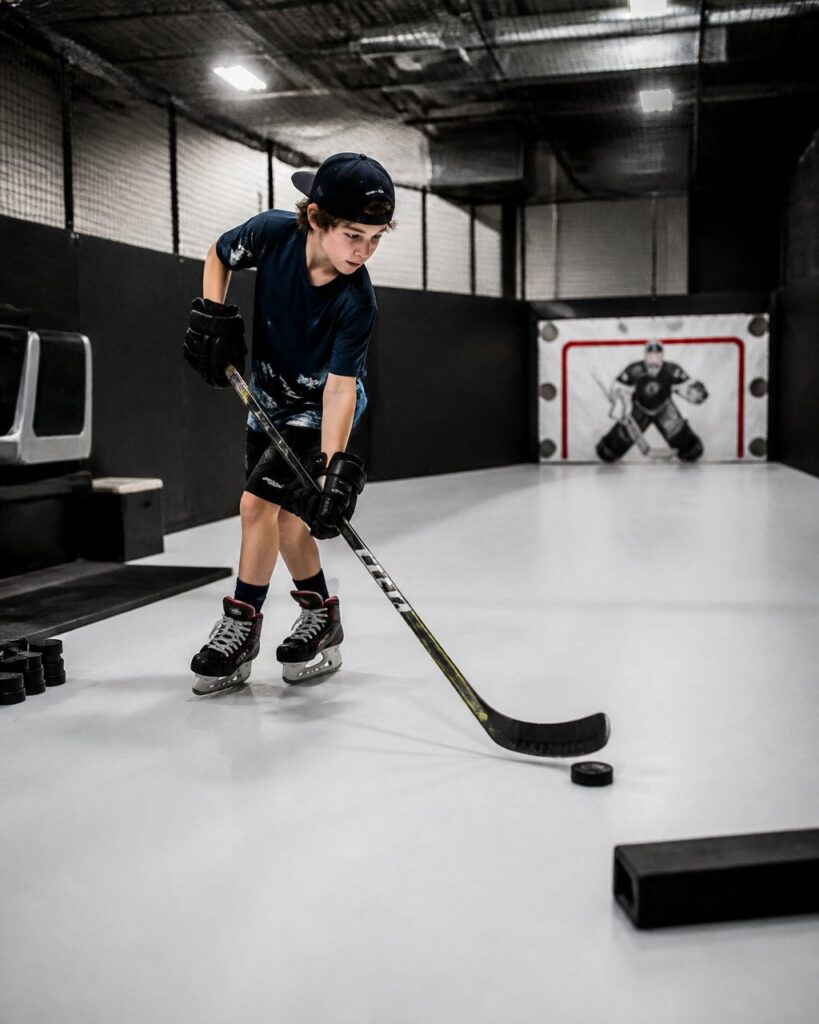
A shooting lane is a dedicated off-ice space built for one job: letting a player repeat the same shot hundreds of times without chasing the puck. For families weighing hockey shooting lane facilities in Edmonton, the appeal is simple.
At Pro Stride Hockey, we built our shooting lane for exactly this reason.
Here is the part most parents miss. A rink lets your child skate. A shooting lane lets your child fail safely, adjust, and try again in seconds. That loop is where real skill gets built.
Repetition without recovery time is the whole point. A shooting lane removes the skating, the lineups, and the puck retrieval so a player can take 200 shots in the time a rink session allows 20.
What to Look For in Shooting Lane Facilities
Good shooting lane facilities share a few traits: the right surface, enough room to shoot at full power, and coaching that turns reps into habits. Skip any one of those and you are paying for noise.
Surface, Space, and Shooting Distance
The surface decides how the puck behaves. A synthetic shooting pad or smooth tile lets the puck glide, so a player learns a true release instead of fighting friction. Space matters too. You want enough lane length to load a full shot and enough width to work on angles.
Check these before you book:
- Surface type: synthetic ice, shooting tiles, or smooth concrete
- Lane length: room for wrist, snap, and slap shots
- Net and targets: real net, shooter tutor, or corner targets
Coaching Support and Session Structure
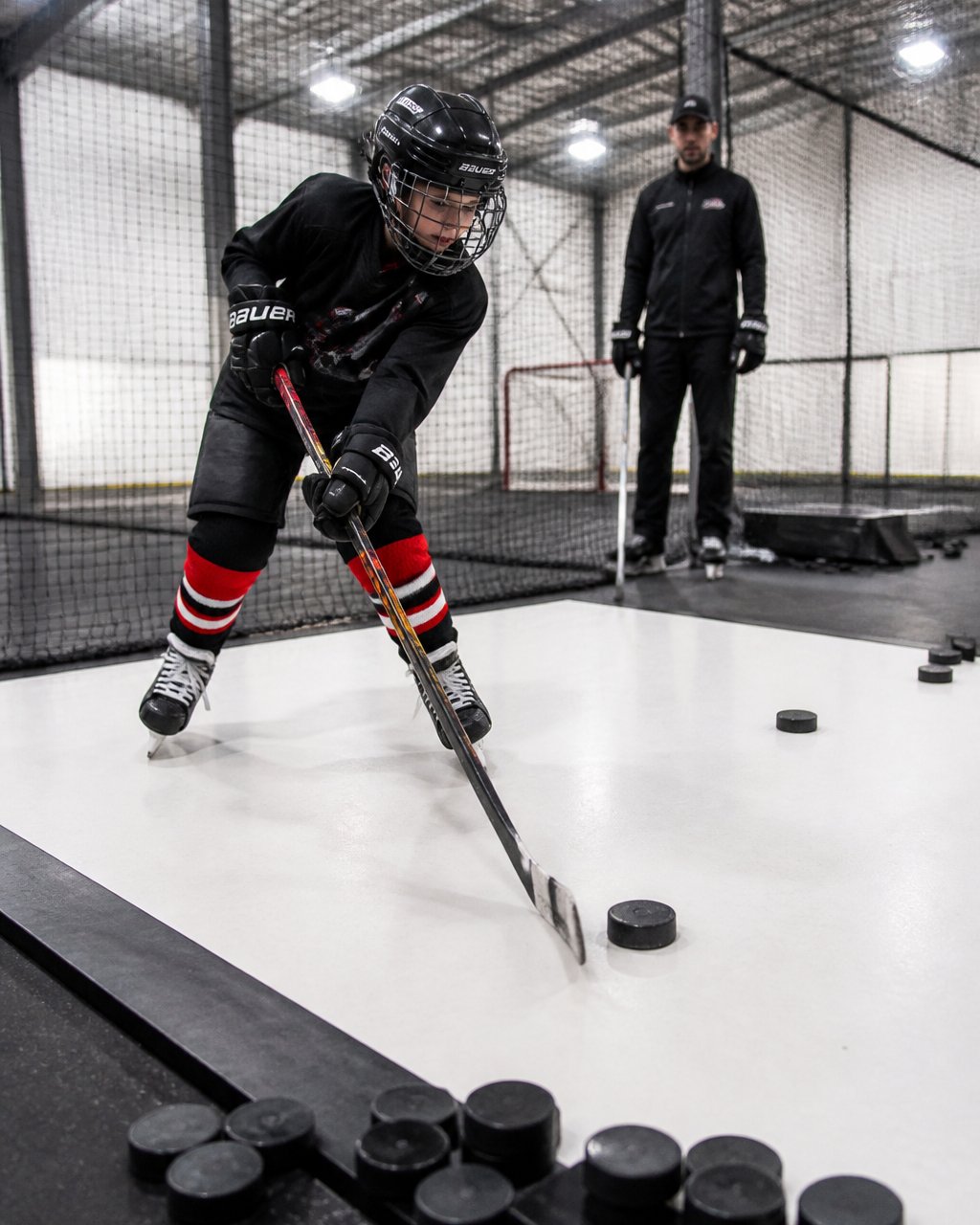
A lane by itself is just a room. Coaching turns it into training. Look for small group sizes, clear feedback, and a plan for each session.
Ask how many players share a coach. Ask whether video analysis is part of the program. Ask if the coach corrects your child’s hand position, weight transfer, and follow-through, or just counts reps.
Ask one question before you sign up: “Can I watch a session first?” A facility that teaches proper technique will happily let you see how a coach corrects a player mid-drill. That ten-minute visit tells you more than any brochure.
Indoor Rinks and Arenas with Off-Ice Hockey Shooting Practice Areas
Most arenas in the city sell ice. Far fewer pair that ice with a genuine off-ice shooting area, and the ones that do rarely advertise it.
When you call a facility, ask what the off-ice space actually contains. A few rubber mats and a net are not a shooting lane. You want a defined area with a smooth surface, a proper net, and enough room to shoot without waiting in line.
What Separates a Real Shooting Lane from a Warm-Up Corner
Use these specs as your filter. If a facility cannot answer them, it does not have a dedicated lane.
- Surface: synthetic ice panels or smooth shooting tiles. Bare concrete scuffs pucks and kills glide; carpet and rubber matting grab the puck and teach a false release.
- Lane length: enough run-up for a full wrist or snap shot, and ideally enough for a slap shot. Short lanes force players to shorten their motion, which builds bad habits.
- Width and angles: room to shoot from the left and right, not just straight on. Angle work is where accuracy actually develops.
Sorting the Options You Will Find
| Space Type | What It Offers | Best For |
|---|---|---|
| Dedicated shooting lane | Smooth synthetic surface, real net, targets, coaching, on-site pucks | Repeatable shot work with feedback |
| Arena off-ice room | Basic pad and net, limited length | Pre-game warm-ups, quick reps |
| Outdoor rink or pond | Real ice, open space, weather-dependent | Free skating and shooting in season |
| Multi-sport complex | Shared floor time, portable net | Team and group sessions |
| Off-ice training studio | Skating treadmill plus shooting lane | Combined stride and shot development |
Booking, Access, and Season Timing
Availability shifts hard with the season. Community arenas tend to open off-ice rooms alongside their ice schedules, while dedicated training studios run booked sessions year-round. A few practical rules:
- Confirm hours and booking rules directly with the facility before you travel. Posted schedules lag behind reality.
- Ask whether the lane is bookable by the hour, by the session, or only as part of a program.
- Ask about walk-in versus reservation. Walk-in lanes are rare; most dedicated spaces run on a booked schedule.
Access by Age and Skill Level
Not every lane suits every player. Beginners need a coach close enough to correct hand position and weight transfer before bad mechanics set in. Older players chasing a competitive roster need lane length, target variety, and pressure drills. Ringette players need space and coaching that respects a different release motion, the ring comes off the stick differently than a puck, and a lane that only drills puck technique leaves half the work undone.
Verify before you drive. Off-ice rooms get repurposed for meetings, dryland sessions, and storage with little notice. A quick call the same day saves a wasted trip across the city.
Hockey Shooting Accuracy Drills You Can Run in a Dedicated Lane
Accuracy comes from a repeatable release, not from shooting harder. These drills work in any lane with a net and a few targets.
- Corner targets: Place targets in all four corners. Take 20 wrist shots, calling your target before each one.
- Quick release: Stand with your back to the net, receive a pass, turn, and shoot in one motion.
- Weight transfer: Start on your back foot, load, and shift forward as you release. Ten reps per side.
Keep sessions short and focused. Twenty quality reps beat a hundred sloppy ones. Track one thing at a time, like release speed or target accuracy, so you can see progress.
Do not let your child chase power before accuracy. A hard shot that misses the net ends the play. Build a repeatable, accurate release first, then add power once the motion is consistent.
Hockey Shooting Equipment That Belongs in Your Training Bag
The right gear makes lane time productive. You do not need much, but the gear you bring should match what the lane already provides, and what it does not. Ask the facility what is on site before you pack, because hauling your own net or tiles to a lane that already has them wastes a bag and a back seat.
What Most Lanes Provide vs. What You Bring
| Item | Usually On Site | Bring Your Own |
|---|---|---|
| Net and targets | Yes | No |
| Synthetic surface or tiles | Yes | Only if the lane surface is bare |
| Pucks | Sometimes | Yes, 20 to 30 |
| Shooter tutor | Sometimes | Optional |
| Cones | Rarely | Yes |
| Stick | No | Yes, the one you game with |
| Gloves | No | Yes |
| Ringette rings and stick | Rarely | Yes, for ringette players |
Why the Stick You Game With Matters
A lane teaches muscle memory. If you practice with a different stick than you compete with, you are training a release that does not transfer to the ice. Bring the stick you actually use, with the same lie, flex, and curve. If your child is between sticks, pick one and stay with it through a training block so the reps compound instead of resetting.
Pucks, Rings, and Surface Behavior
Pucks glide differently on synthetic ice than on real ice, and differently again on shooting tiles. That is fine, the point of a lane is repetition, not perfect simulation.
For ringette players, the gear list changes. Rings behave differently than pucks. They sit flatter, they can wobble, and the release motion is its own skill. Bring rings and a ringette stick, and practice the low, controlled release that ringette rewards.
Gear Maintenance That Protects Your Release
Small gear problems quietly change your shot, and you will not notice until game night.
- Pucks: replace cracked or chipped pucks. A damaged puck flies unpredictably and teaches you to compensate for a fault that is not yours.
- Stick blade: check for cracks, delamination, and worn tape. A soft blade changes how the puck comes off.
- Gloves: worn palms reduce grip and force you to squeeze harder, which tightens your release.
- Tape: retape before a training block, not after. Fresh tape gives consistent feel.
Building a Bag That Works for Both Puck and Ring
If your household has both a hockey player and a ringette player, build one bag that serves both. Two sticks, one set of gloves each, a shared puck and ring supply, cones, and a water bottle. Label the rings separately so they do not get lost among the pucks. The goal is a bag you can grab and go, because the training that happens is the training you actually show up for.
Gear should remove friction, not add it. If packing the bag takes longer than the warm-up, simplify the bag.
Youth Hockey Skills Training: Age-Appropriate Shooting Development
Younger players should build fundamentals before power.
For ages 6 to 9, focus on hand position, balance, and a clean release.
For ages 10 to 13, add accuracy drills, shooting in motion, and quick release work.
For teens chasing competitive spots, layer in power, one-timers, and shooting under pressure.
A common mistake is pushing heavy slap shots too early. It builds bad mechanics and can strain growing bodies.
How to Choose the Right Facility for Your Training Goals
Match the facility to the goal. If your child needs skating speed, a skating treadmill program beats a shooting lane.
Work through this checklist:
- Does the facility have a true shooting lane, not just a net?
- Are group sizes small enough for real feedback?
- Does coaching include technique correction, not just reps?
- Is video analysis available to track progress?
Many families run both. Skating work builds the speed to get to the scoring area. Shooting work builds the release to finish once they arrive.
One parent put it plainly: her son’s “shooting and stride have improved so much.” Another said her daughter “gained confidence with her ringette shot.” That is the goal, measurable skill and real confidence.
Frequently Asked Questions
Where can hockey players practice shooting off the ice in Edmonton?
Edmonton has several options for off-ice shooting practice. Dedicated shooting lane facilities offer synthetic ice or shooting pad surfaces with targets and shooter tutors. Many indoor rinks and sports complexes also have dryland training areas. Pro Stride Hockey operates a specialized shooting lane facility in Edmonton designed for focused, coached shooting development. When evaluating options, look for a facility that provides enough space for a full shooting motion, quality surfaces that simulate puck glide, and coaching support to correct technique.
What equipment is useful for off-ice hockey shooting practice?
A synthetic ice panel or shooting pad is the foundation, since it lets the puck slide like it would on real ice. Add a net or shooting target, a shooter tutor for accuracy work, and a supply of pucks. Cones help you set up obstacle courses and shooting-in-stride drills. For ringette players, a ring and ringette stick are essential. Many training facilities supply this equipment, so check what is included before buying your own. Pro Stride Hockey provides shooting lane equipment as part of its sessions.
Are shooting lanes suitable for youth hockey players?
Yes. Shooting lanes work well for youth players because they let coaches break down technique at slower speeds without the pressure of a game. Younger players can focus on grip, release point, and follow-through before adding speed. Pro Stride Hockey works with athletes of all ages and uses a maximum of four players per session, which means each young player gets enough attention to build correct habits early. The key is matching drill complexity to the player’s age and skill level.
How can players improve shooting accuracy off the ice?
Accuracy improves through repetition with feedback. Set up a target or shooter tutor and track where each shot lands. Focus on a consistent release point and follow-through rather than just shooting harder. Pro Stride Hockey uses video analysis to show players exactly where their technique breaks down. Practicing three to four times per week in short, focused sessions tends to produce better results than one long session. Vary your targets and shooting positions so the skill transfers to game situations.
Finding the right training space is the hard part. Getting better is easier once you do. Pro Stride Hockey pairs a specialized shooting lane with a skating treadmill and small-group coaching, capped at four players per session with a 2:1 player-to-coach ratio. Our partnership with the Tim Turk training program and our video analysis give players clear feedback on every shot and stride. Book now with Pro Stride Hockey and turn practice reps into game-night results.