Table of Contents
- Why Goal Scoring Ability Is Built Off the Ice
- Hockey Shooting Drills You Can Do at Home
- How to Shoot a Hockey Puck Accurately Under Pressure
- Off-Ice Hockey Shooting Practice: Building a Weekly Routine
- How to Increase Hockey Release Speed
- Common Mistakes That Kill Goal Scoring Ability
- Frequently Asked Questions
Last Updated: October 12, 2026
Why Goal Scoring Ability Is Built Off the Ice
Improving hockey goal scoring ability starts long before you step on the ice. The players who score most are usually the ones who put in the most reps away from the rink, and that work is where real progress happens. At Pro Stride Hockey, we see this every week: players who train their shot off the ice arrive at games with a release that’s faster and a shot that’s more accurate. Our clients are youth hockey players and ringette players looking to improve their skating ability and shooting ability in an off-ice training environment. We use a skating treadmill to work on skating stride technique and we also teach the proper way to shoot a hockey puck and a ringette ring.
You don’t need a full rink to get better. You need a shooting pad, a net, a few pucks, and a plan.
Here’s the thing most players miss. A game gives you maybe five or six real shooting chances. Off-ice practice gives you hundreds. That gap is where goal scoring is built.
- Off-ice reps build muscle memory for your release
- Repeated shots train accuracy, not just power
- Short, focused sessions beat long, sloppy ones
- Consistent weekly work shows up in games
The Hockey Canada player development resources outline the same principle: skill comes from deliberate repetition.
Goal scoring is a trainable skill, not a talent you either have or don’t. The players who improve fastest are the ones who treat shooting like any other skill and practice it on a schedule.
Hockey Shooting Drills You Can Do at Home
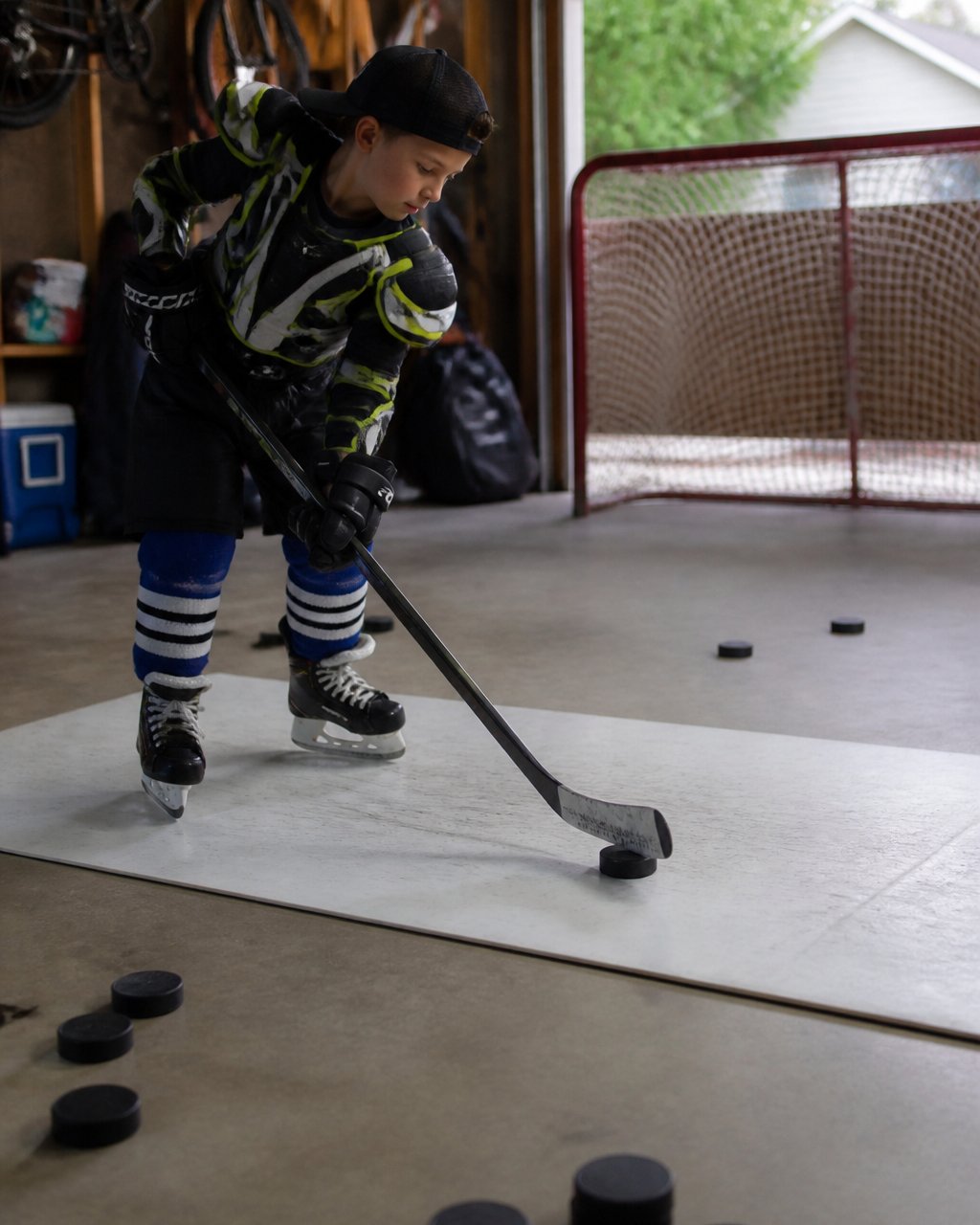
Hockey shooting drills at home are simple to set up and easy to repeat. All you need is a shooting pad, a net, and space to move. Here are two that deliver the most value for young players.
Stationary Wrist Shot Reps
The stationary wrist shot is the foundation of every other shot. Set up 15 to 20 pucks and shoot from the same spot, focusing on the same motion every time.
- Start with the puck on your back foot
- Pull it forward across your body
- Snap your wrists as you release
- Follow through toward your target
Do 50 to 100 reps per session. The goal is a repeatable motion, not speed.
Quick Release Drill
The quick release drill trains you to get the shot off fast. Place pucks at different spots and shoot each one within a second of picking it up.
- Spread 10 pucks in a small area
- Pick up and release each one quickly
- Keep your head up between shots
- Reset and repeat three times
This drill builds the habit of shooting without a long wind-up.
How to Shoot a Hockey Puck Accurately Under Pressure
To shoot a hockey puck accurately under pressure, you have to practice with pressure. Accuracy in a game comes from reps where you’re moving, rushed, and making decisions.
A common mistake is practicing only from a standstill. Games never look like that.
Try these progressions:
- Shoot while skating in a straight line
- Shoot while changing direction
- Shoot after a quick pass
- Shoot with a partner pressing you
Each step adds a bit of game-like pressure. Over time, your shot holds up when a defender is on you.
Set a target in each corner of the net and call your shot out loud before you release. Naming the target forces your eyes and hands to work together, which is exactly what happens in a game.
Off-Ice Hockey Shooting Practice: Building a Weekly Routine
Off-ice hockey shooting practice only works if it’s consistent. A short session three times a week beats one long session on the weekend.
Here’s how we’d structure a week:
| Day | Focus | Time | Reps |
|---|---|---|---|
| Monday | Stationary wrist shots | 20 min | 75 |
| Wednesday | Quick release drill | 20 min | 50 |
| Friday | Accuracy under pressure | 25 min | 60 |
| Weekend | Game-style shooting | 30 min | 40 |
Sample 4-Week Shooting Schedule
- Week 1: Focus on form. Slow, clean reps.
- Week 2: Add speed. Same drills, faster release.
- Week 3: Add movement. Shoot while skating.
- Week 4: Add pressure. Partner or timed reps.
Track your reps in a notebook or phone. Seeing the numbers climb keeps young players motivated.
Skipping warm-up reps is the fastest way to build a bad habit. Cold muscles and rushed shots teach your body the wrong motion, and that motion shows up in games.
How to Increase Hockey Release Speed
To increase hockey release speed, you need to shorten the time between picking up the puck and getting it off your stick. Release speed is less about raw power and more about how quickly you load and snap.
Three things drive a fast release:
- Grip and wrist strength. A strong snap comes from your forearms and wrists.
- Puck position. Keep the puck closer to your body before release.
- Practice speed. Train your hands to move faster than feels comfortable.
Try this: shoot 20 pucks as fast as you can without worrying about accuracy. Then shoot 20 for accuracy. Alternate the two sets. This trains both speed and control.
USA Hockey skill development guidance notes that quick hands come from repeated, game-speed reps, not slow technique work alone.
The Coaching Association of Canada also stresses that skill development for young athletes works best when sessions are short, focused, and repeated often.
Common Mistakes That Kill Goal Scoring Ability
The biggest mistake is practicing without a target. Shooting pucks into an empty net with no aim builds power but not accuracy. Always aim at a specific spot.
Other mistakes we see often:
- Too many reps, too little focus. Fifty focused shots beat 200 careless ones.
- Ignoring the follow-through. Where your stick ends up tells you where the puck went.
- Skipping weak-hand work. Your bottom hand controls the shot more than most players realize.
- Practicing only one shot. Wrist, snap, and backhand all matter.
- No feedback. Without video or a coach, bad habits go unnoticed.
At Pro Stride Hockey, our shooting lane facility and video analysis help players see exactly what their shot is doing. Our 2:1 player-to-coach ratio means every rep gets watched and corrected.
As one parent told us, “Ryan G has been fantastic for our son Matthew. His shooting and stride have improved so much.”
Frequently Asked Questions
How can I improve my goal scoring in hockey?
Goal scoring improves fastest when you train shooting mechanics off the ice between games. Focus on three things: a repeatable release, aiming at specific targets rather than the net generally, and practicing at game speed. Youth players who shoot 100 to 200 pucks several times a week typically see accuracy and confidence gains within a month. Pair shooting work with skating stride training so you arrive at scoring positions with speed and balance.
What is the best way to practice hockey shooting off the ice?
Set up a shooting pad or smooth surface with a net or target, and work in short focused blocks of 15 to 20 minutes. Alternate wrist shots, snap shots, and quick-release reps. Use a target system (corners, five-hole, low glove) instead of shooting at the middle. Add movement before each shot, such as a small lateral step or puck drag, so your off-ice hockey shooting practice mimics game situations rather than static repetition.
How can I shoot more accurately in hockey?
Accuracy comes from a consistent follow-through and keeping your head still through the shot. Point your follow-through at your target, not across your body. Practice with smaller targets than the net opening so the net feels larger in games. Most missed shots come from rushing the release or looking up too early. Slow down your reps until the puck hits the same spot five times in a row, then add speed.
How often should youth hockey players practice shooting?
Three to four short sessions per week works better than one long session. Youth players benefit from 100 to 150 quality reps per session with full focus on mechanics. Beyond that, fatigue leads to sloppy habits. Combine shooting reps with skating treadmill work or stride drills on alternate days so your legs stay fresh and your shot mechanics stay sharp throughout the season.
Goal scoring rewards the players who put in the quiet work. If your young player wants a shot that’s faster, more accurate, and game-ready, we can help. Pro Stride Hockey offers personalized coaching with a 2:1 player-to-coach ratio, a specialized shooting lane facility, and video analysis that shows exactly where to improve. Book Now and give your player the reps that turn practice into goals.