Last Updated: November 10, 2026
Quick Summary
Pro Stride Hockey Academy is an off-ice training program for young hockey and ringette players that focuses on stride technique and shot mechanics. Players use a skating treadmill to refine their stride and a shooting lane to learn the proper way to shoot a puck or ring. Sessions run one-on-one at a 2:1 player-to-coach ratio or in small groups of up to four players.
- Players refine stride efficiency on a skating treadmill while coaches watch from the side and front.
- Shooting training follows a sequence of grip, stance, weight transfer, release and follow-through.
- One-on-one sessions use a 2:1 player-to-coach ratio, and small groups are capped at four players.
- Ringette players receive specific instruction on the proper way to shoot a ring.
- Families should confirm session length, scheduling and pricing directly with Pro Stride Hockey.
Table of Contents
- What Pro Stride Hockey Academy Offers Young Hockey and Ringette Players
- Why Off-Ice Hockey Training Builds Skills Between Ice Times
- How Hockey Skating Treadmill Training Refines Stride Technique
- Hockey Shooting Technique Training From Grip to Follow-Through
- Ringette Skating and Shooting Training for Ringette Players
- Small-Group and Private Sessions: Ratios, Format and What Players Experience
- Booking Your Player’s First Session at Pro Stride Hockey
- Frequently Asked Questions
What Pro Stride Hockey Academy Offers Young Hockey and Ringette Players
Pro Stride Hockey Academy gives young hockey and ringette players a structured way to improve their skating and shooting away from the ice. At Pro Stride Hockey, the off-ice program is built around two skills that decide how a player performs during a game: stride technique and shot mechanics. Players work on a skating treadmill to refine their stride, and coaches teach the proper way to shoot a hockey puck and a ringette ring.
The academy runs sessions with a 2:1 player-to-coach ratio in one-on-one training, and never more than four players per session. That structure matters for young athletes, because it gives each player enough repetitions and enough individual feedback to actually change a habit.
Pro Stride Hockey Academy is not built around a single gimmick. The program combines technique work, video review and a dedicated shooting lane, so players see what they are doing and why it matters. Readers comparing options can start with the Hockey Skating Treadmill Benefits: 2026 Training Guide for more detail on the method.
Why Off-Ice Hockey Training Builds Skills Between Ice Times
Off-ice hockey training is structured skill work done away from the rink, aimed at a specific movement or habit. Most players only get a limited number of ice sessions each week, and much of that time goes to team systems, scrimmages and conditioning. Off-ice work gives a player a dedicated block of time to repeat a single technical element until it becomes automatic.
Repetition with precise feedback is a widely recognized way to change how a movement is performed. A treadmill or a shooting lane lets a coach isolate one variable, such as foot placement or follow-through, and hold a player to it across many attempts.
Off-ice priorities can shift with age. A younger player and an older player may benefit from different emphases. A general age-based outline looks like this:
Off-ice work also has limits. It cannot replicate the friction, balance demands and puck pressure of a live game, so it works best as a complement to ice time. A useful way to think about it: off-ice sessions fix the mechanics, and ice sessions test whether those mechanics hold up under pressure. Watch out: a player who only trains off-ice and never tests the changes in a game can look sharp on the treadmill but revert to old habits under pressure, so the two environments need to be paired.
How Hockey Skating Treadmill Training Refines Stride Technique
A skating treadmill lets a player push off and glide in a fixed position while the coach watches the stride from the side and front. The belt moves, the player works the edges and the push, and the coach can correct a problem as it happens. Pro Stride Hockey uses this setup to work on stride efficiency, the length and angle of each push, and how the skater recovers between strides.
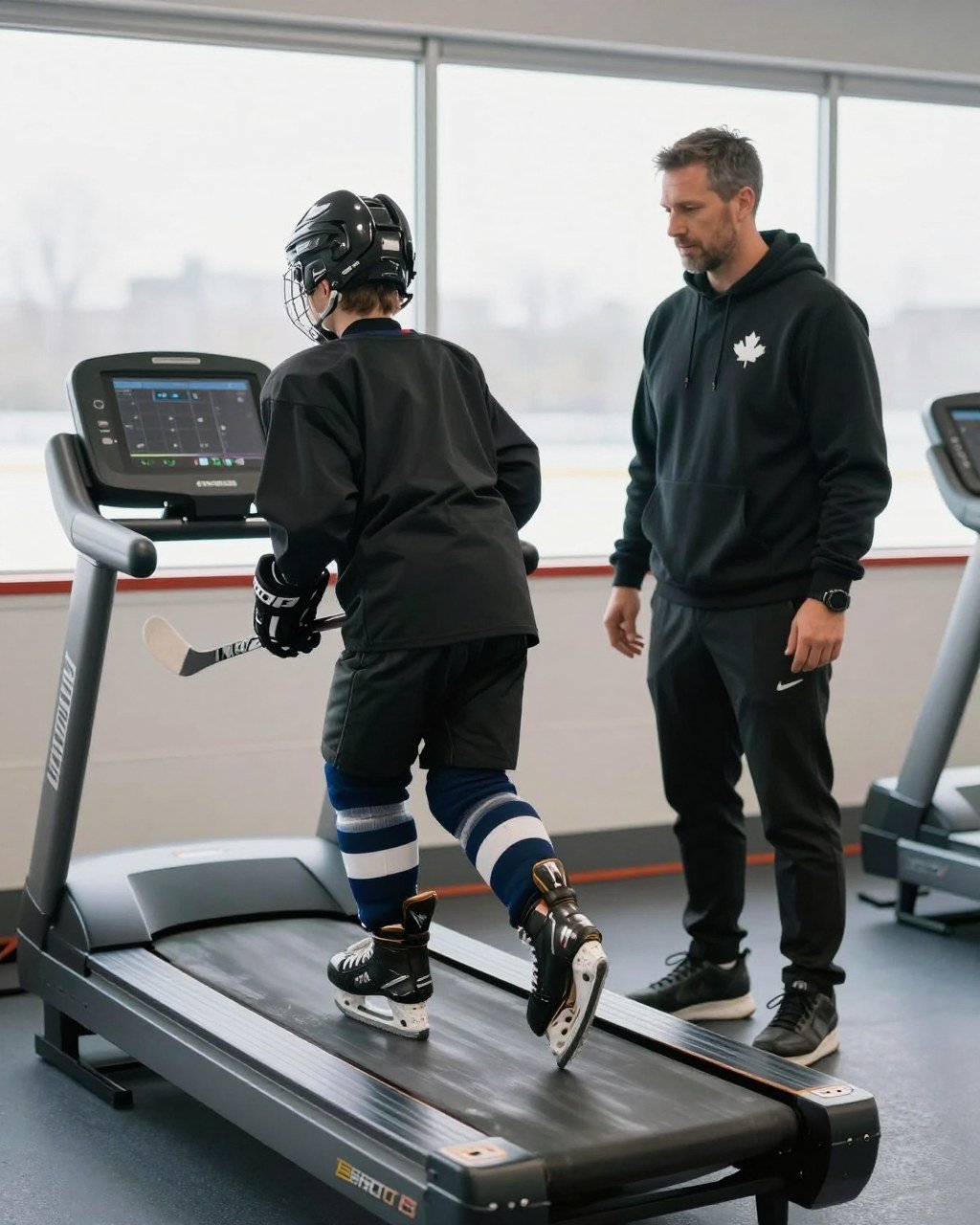
Stride efficiency is a practical target, not an abstract one. A player who pushes straight back instead of out to the side loses speed and wastes energy on every stride. Working on the treadmill lets that correction happen repeatedly and in a controlled setting before the player tries it at full speed on the ice.
Players often describe the first sessions as harder than expected, because the treadmill exposes weaknesses that are easy to hide in a game. Lindsay Axelson, a Pro Stride Hockey client, said she had never been on a skate treadmill before and that Adrienne taught her a lot about stride efficiency.
What Coaches Look for in a Skating Stride
A coach evaluating a stride looks at the push first. The skate should drive out and back through a full range, with the blade staying on its edge rather than sliding flat. Next comes the glide: a good stride keeps the knees bent, the chest over the knees and the head steady, so the player stays balanced while the other leg recovers.
Common faults include short pushes, a rigid upper body and a recovery leg that drags instead of tucking in. Each fault costs speed, and each one can be corrected with a specific cue. A coach might ask a player to hold a deeper knee bend for five strides, then check whether the glide length improved. Small, measurable targets like this keep the work focused.
Hockey Shooting Technique Training From Grip to Follow-Through
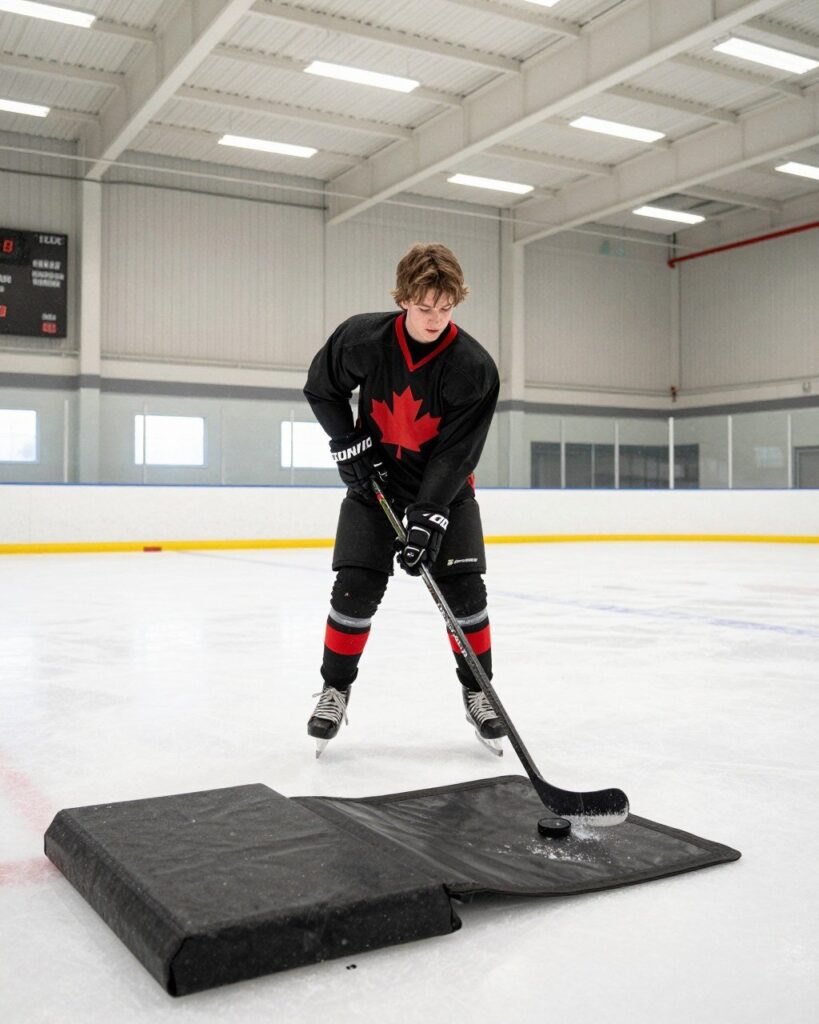
A reliable shot depends on a sequence: grip, stance, weight transfer, release and follow-through. Pro Stride Hockey coaches teach each step separately before combining them, because a shooter who rushes the sequence usually loses accuracy first. The shooting lane gives players a consistent target and a repeatable setup, so they can track improvement over a session.
Grip and stance are where many young players lose power. A hand position that is too loose or a stance with weight on the heels both reduce how much energy reaches the puck. Once the setup is correct, the coach moves to weight transfer, teaching the player to shift from the back leg to the front as the stick loads and releases.
Follow-through is the step players skip most often. A shot that ends early pulls the puck off line, even when the release looked clean. Holding the stick finish toward the target for a beat after the release is a simple cue that improves accuracy noticeably. A parent in the program reported that Ryan G’s work with their son helped both his shooting and his stride.
Ringette Skating and Shooting Training for Ringette Players
Ringette uses a ring rather than a puck, and the shooting and passing mechanics differ from hockey. Pro Stride Hockey teaches ringette players the proper way to shoot a ring.
A parent in the program reported that her daughter gained confidence with her ringette shot after working with the academy. For ringette players, the combination of skating and shooting training addresses two skills that are otherwise difficult to isolate during team practice.
Small-Group and Private Sessions: Ratios, Format and What Players Experience
Pro Stride Hockey offers one-on-one sessions with a 2:1 player-to-coach ratio and small groups capped at four players.
Sessions can use the skating treadmill for stride work and the shooting lane for puck and ring mechanics, with video analysis available to review technique.
Exact session length and scheduling should be confirmed directly with Pro Stride Hockey.
One parent noted that the coach encouraged her son and pushed him outside his comfort zone.
The academy’s format is built around a few concrete limits that shape each session.
| Format | Limit | Note |
|---|---|---|
| One-on-one training | 2:1 player-to-coach ratio | Individual feedback on every repetition |
| Small group | Maximum four players | Shared treadmill and shooting lane time |
| Stride work | Skating treadmill | Stride efficiency and push angle |
| Shot work | Shooting lane | Puck and ring mechanics |
| Review | Video analysis | Available to review technique |
Booking Your Player’s First Session at Pro Stride Hockey
The first step is deciding what the player needs most: stride work on the treadmill, shot development in the lane, ringette-specific training or a combination. Pro Stride Hockey can match a player to the right format based on that goal. Pricing depends on the session format and schedule, so families should check current rates and availability directly with Pro Stride Hockey.
Parents who want to see the program in action can review the Skating Treadmill Training Edmonton page for local session details, or book a session through Pro Stride Hockey’s website.
Players who want focused, individual feedback on stride and shooting can contact Pro Stride Hockey to get started.
Frequently Asked Questions
What is Pro Stride Hockey Academy?
Pro Stride Hockey Academy is a training academy in Edmonton that works on hockey and ringette skills with youth and adult athletes. The program focuses on skating stride technique, shooting mechanics and athletic confidence. Sessions are kept small, with a 2:1 player-to-coach ratio in one-on-one sessions and no more than four players in a group session. Families who want current program details or pricing should contact Pro Stride Hockey directly through its website.
What skills can players work on at Pro Stride Hockey Academy?
Players can work on skating speed and stride efficiency using a skating treadmill, along with shooting technique and goal-scoring ability in a dedicated shooting lane. Video analysis helps players see their own mechanics and track changes over time. Ringette players can work on their skating and shot as well. The program also addresses athletic confidence and emotional maturity.
Does Pro Stride Hockey Academy offer private training sessions?
Yes. One-on-one sessions follow a 2:1 player-to-coach ratio, and small-group sessions cap at four players. Smaller groups let the coach give each athlete individual feedback on stride and shooting. For current availability and session pricing, contact Pro Stride Hockey through its website, since pricing depends on the session format and schedule.
What should a player expect during an off-ice hockey training session?
A session can include focused skill work on the skating treadmill or in the shooting lane, depending on the athlete’s goals, with video analysis available to review technique. Players can expect to be pushed out of their comfort zone.
