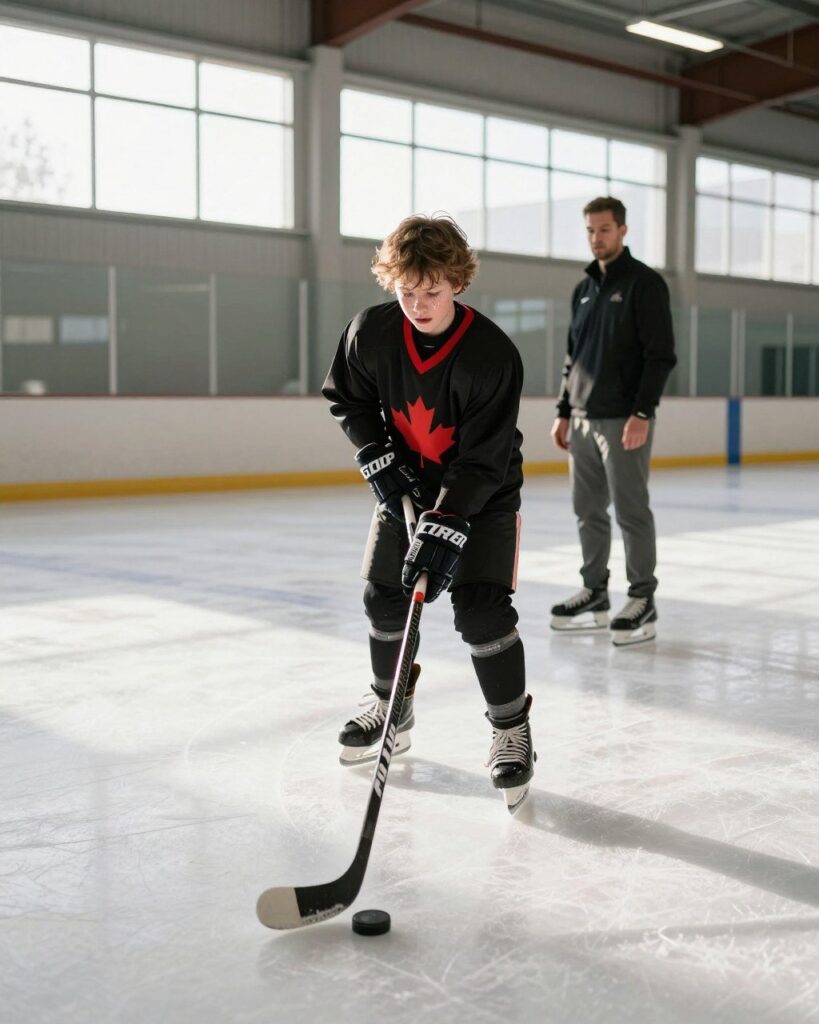
Last Updated: November 8, 2026
Quick Summary
PROSTRIDE is Pro Stride Hockey’s approach to building skating stride and shooting technique off the ice. Sessions run as 1-on-1 or small-group training, with no more than four players per session. It suits youth hockey and ringette players, parents, teams, and adult players.
- Skating treadmill sessions let coaches freeze, correct, and restart stride flaws within seconds.
- Stride training follows four stages: posture hold, single-leg push, recovery under the hips, then full stride.
- A repeatable wrist shot release matters more than raw power, so start with controlled reps.
- Off-ice training supplements ice time and does not replace it.
- Small-group sessions keep coaching personal, with no more than four players per session.
Table of Contents
- What PROSTRIDE Training Is and Who It Is For
- How Skating Treadmill Training Refines Your Stride
- Hockey Shooting Technique: Building a Repeatable Release
- Ringette Shooting Technique: Wrist Shots and Accuracy
- Why Small-Group Hockey Coaching Accelerates Progress
- Common Mistakes Players Make in Off-Ice Training
- Booking Your First PROSTRIDE Session
- Frequently Asked Questions
Pro Stride Hockey runs one of the few off-ice programs in Edmonton built around the two skills that decide most youth hockey games: how a player skates and how a player shoots. Off-ice training lets a young player repeat stride and release mechanics many times in a session, without needing ice time. This guide explains how that training works, who gets the most from it, and what to look for in a program.
What PROSTRIDE Training Is and Who It Is For
PROSTRIDE is Pro Stride Hockey’s approach to building skating stride and shooting technique off the ice. Sessions run as 1-on-1 or small-group training, with no more than four players per session.
The program suits several groups, including youth hockey players and ringette players working on skating stride and shooting technique, parents of competitive players, local teams, adult players, and serious athletes who want video analysis and treadmill work.
How Skating Treadmill Training Refines Your Stride
A skating treadmill lets a player practise stride mechanics at a controlled pace. The belt moves beneath the skates, so the player can focus on posture, knee bend, and push-off without the distraction of gliding across open ice. Coaches can stop, adjust, and restart the drill as often as needed, which is the real advantage: a flaw can be frozen mid-stride, corrected, and repped again within seconds rather than being chased across a rink.
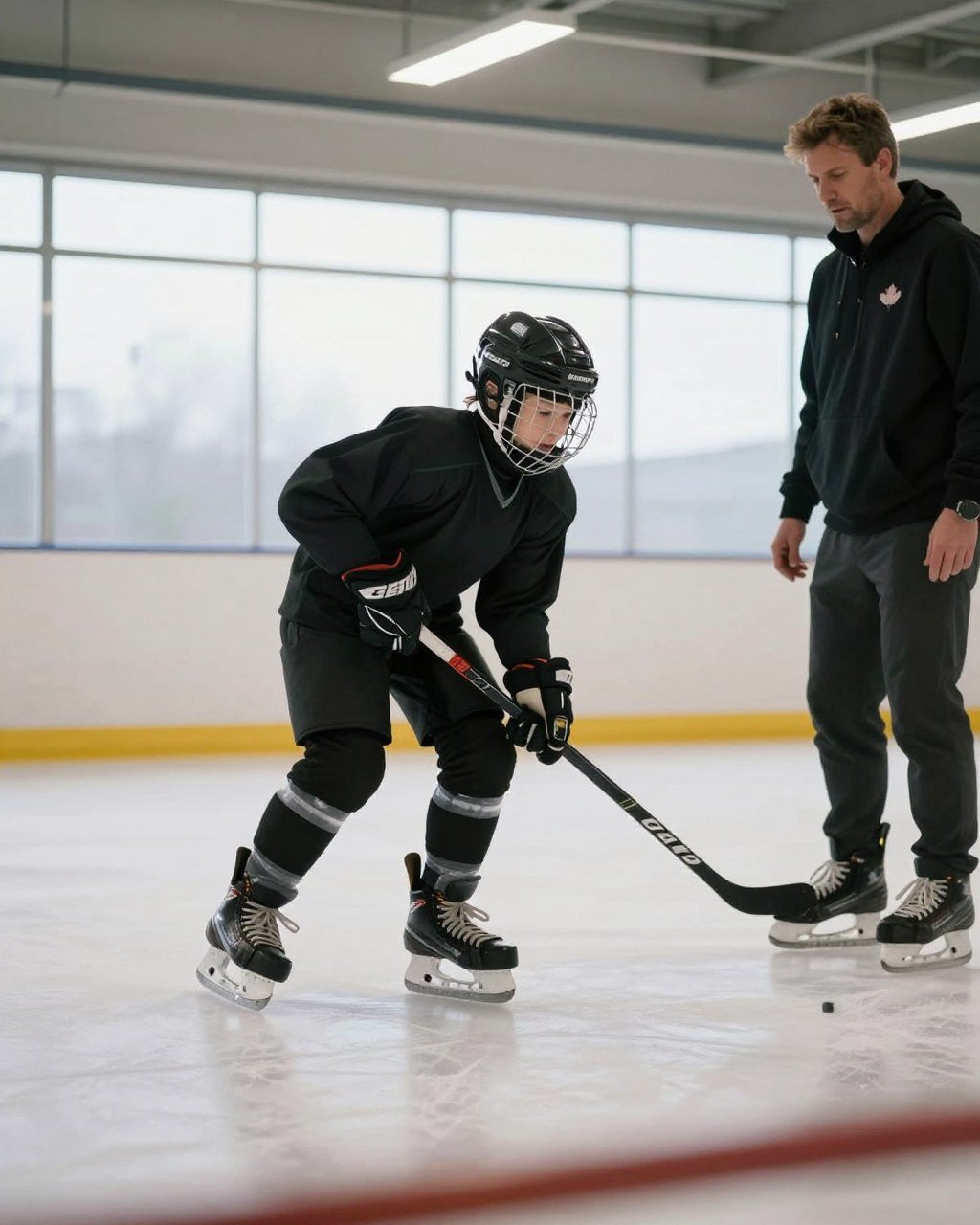
The treadmill removes glide and momentum from the movement, so a player’s stride mechanics are easier to see and correct.
Stride Mechanics Players Practise on the Treadmill
The core mechanics are a low, balanced knee bend, a deliberate push from the inside edge, and a recovery that returns the skate under the hips. Players work through each element in short blocks, with video feedback to show them what they are actually doing compared with what they think they are doing. A typical progression runs in this order:
- Posture and knee bend hold. The player skates at a slow belt speed with hands in a stable position and eyes up, holding a deep knee bend for timed blocks. This builds the base position before any speed is added.
- Single-leg push isolation. The coach has the player push with one leg while the other stays light, so the inside-edge push and full extension can be felt and corrected without the other leg compensating.
- Recovery under the hips. The player focuses on bringing the skate back beneath the body rather than letting it trail, which is the difference between a stride that generates speed and one that just moves the legs.
- Full-stride integration at controlled speed. Only once the pieces hold does the belt speed rise, and even then the coach watches for the mechanics breaking down before adding more.
A common mistake is rushing the stride to chase speed. Slower, controlled repetitions build the pattern first.
Why Off-Ice Stride Work Transfers to the Ice
The treadmill builds the movement pattern, but the value only shows up when the player takes it back to the ice. Consistency matters: regular sessions are more useful than a single long block.
Transfer is easiest to see in three places: the first three strides out of a stop, the crossover entry into a turn, and the recovery leg coming back under the body during a straight-line rush. Coaches and parents can watch for those moments in games as a practical check on whether the off-ice work is carrying over.
Because the treadmill is a training tool and not a substitute for ice time, it is best used alongside normal on-ice practices.
The article breaks the treadmill stride work into four progressive stages, each with a clear focus.
| Stage | Focus | Key cue |
|---|---|---|
| 1. Posture and knee bend hold | Base position at slow belt speed | Deep knee bend, eyes up |
| 2. Single-leg push isolation | Inside-edge push and full extension | One leg pushes, other stays light |
| 3. Recovery under the hips | Bringing the skate back under the body | Recovery under the hips, not trailing |
| 4. Full-stride integration | Full stride at controlled speed | Watch for breakdown before adding speed |
Hockey Shooting Technique: Building a Repeatable Release
A reliable shot depends on a repeatable release more than raw power. The sequence starts with weight transfer from the back foot, continues through a hip and shoulder rotation, and ends with the blade square to the target at release. Players who learn this order can shoot accurately under pressure, because the shot stops depending on timing and starts depending on a pattern the body already knows. A release built on a repeatable pattern gives scouts a clearer view of a forward’s shooting habits, which is one reason those habits matter on a pro scouting checklist.
Off-ice shooting lanes let players repeat this sequence without chasing pucks across the ice. Pro Stride Hockey offers a specialized shooting lane facility and works with the Tim Turk training program. Players who want to focus on placement can also work through hockey shot accuracy drills that target specific corners of the net.
Breaking the Wrist Shot Into Coachable Pieces
A wrist shot is easier to fix when it is split into parts rather than practised as one motion. A workable off-ice progression looks like this:
Diagnosing Common Shooting Faults
- Shot sails high or wide. Usually the blade opens at release or the follow-through drifts. Correction: slow the release and finish with the toe pointed at the target.
- Shot lacks speed. Often the weight stays on the back foot or the wrists roll too early. Correction: exaggerate the forward weight shift and delay the wrist roll until the release point.
- Shot is inconsistent side to side. Usually the head moves or the eyes leave the target before release. Correction: hold the head still and track the aim point through the follow-through.
- Shot breaks down under pressure. Usually the player has only practised at one speed. Correction: add a quick catch-and-release rep so the pattern holds when time is short.
Watch out: practising only full-power shots early reinforces whatever fault the player already has, because power masks poor mechanics. Controlled reps first, power later.
Building Accuracy Under Game-Like Conditions
Parents and coaches can track progress simply by counting how many reps hit the chosen target out of a set of ten, then repeating the set every couple of weeks. That gives a concrete read on whether the release is becoming repeatable rather than just feeling better.
Ringette Shooting Technique: Wrist Shots and Accuracy
Ringette shooting differs from hockey shooting because the ring is not a puck and the stick is used differently. The wrist shot relies on a smooth wrist roll through the release and a follow-through that points the blade at the target. Accuracy comes from keeping the head still and the eyes on the target until the release is complete.
Why Small-Group Hockey Coaching Accelerates Progress
Small groups keep the coaching personal, with no more than four players per session.
Players are pushed out of their comfort zones with personalized coaching.
Common Mistakes Players Make in Off-Ice Training
The most frequent error is treating off-ice work as a substitute for practice rather than a supplement. Off-ice training refines mechanics, but players still need ice time to apply them under game conditions.
Other mistakes include:
- Training at full speed before the mechanics are stable
- Skipping video review and relying only on how a movement feels
- Inconsistent attendance, which slows the pattern-building process
- Ignoring recovery, which leads to sloppy technique late in a session
Booking Your First PROSTRIDE Session
Pro Stride Hockey offers personalized sessions in Edmonton for youth players, ringette players, adults, and teams. Our team can recommend a starting point based on your current level and goals. Pricing depends on the session format and schedule, so contact us or visit our website for current rates and availability.
To get started, book a skating treadmill session or explore the Tim Turk shooting program to see which fits your goals best.
Frequently Asked Questions
What is PROSTRIDE?
PROSTRIDE is an off-ice training program from Pro Stride Hockey in Edmonton that uses a skating treadmill to refine stride technique and teaches the proper way to shoot a hockey puck or ringette ring. Sessions are coached in small groups, with a 2:1 player-to-coach ratio in 1-on-1 sessions and a maximum of four players per session. Players can work on skating mechanics and shooting form without needing ice time, which makes the training useful during the off-season or between games. For current availability and pricing, contact Pro Stride Hockey directly or visit its website.
Can hockey and ringette players train together?
Players from both sports work on the same core skills at PROSTRIDE, including stride efficiency and shooting mechanics, though the shooting instruction is tailored to the puck or the ring. A hockey shot and a ringette shot differ in equipment and release, so coaching focuses on the specific motion each sport requires. Small group sizes, capped at four players per session, allow the coach to give each athlete individual feedback regardless of sport.
Does off-ice training really transfer to the ice?
Off-ice training works best when it targets the same movement patterns used on the ice. A skating treadmill lets a player practise stride mechanics such as knee bend and weight transfer in a controlled setting. Shooting drills in a controlled lane allow players to practise their release and follow-through.
What should a young athlete expect in a first session?
A first session typically includes guided drills on the skating treadmill and in the shooting lane, and the coach explains corrections as they are made. Video analysis is available as part of the program. Players should arrive ready to work, and parents can contact Pro Stride Hockey for session times and current pricing.
