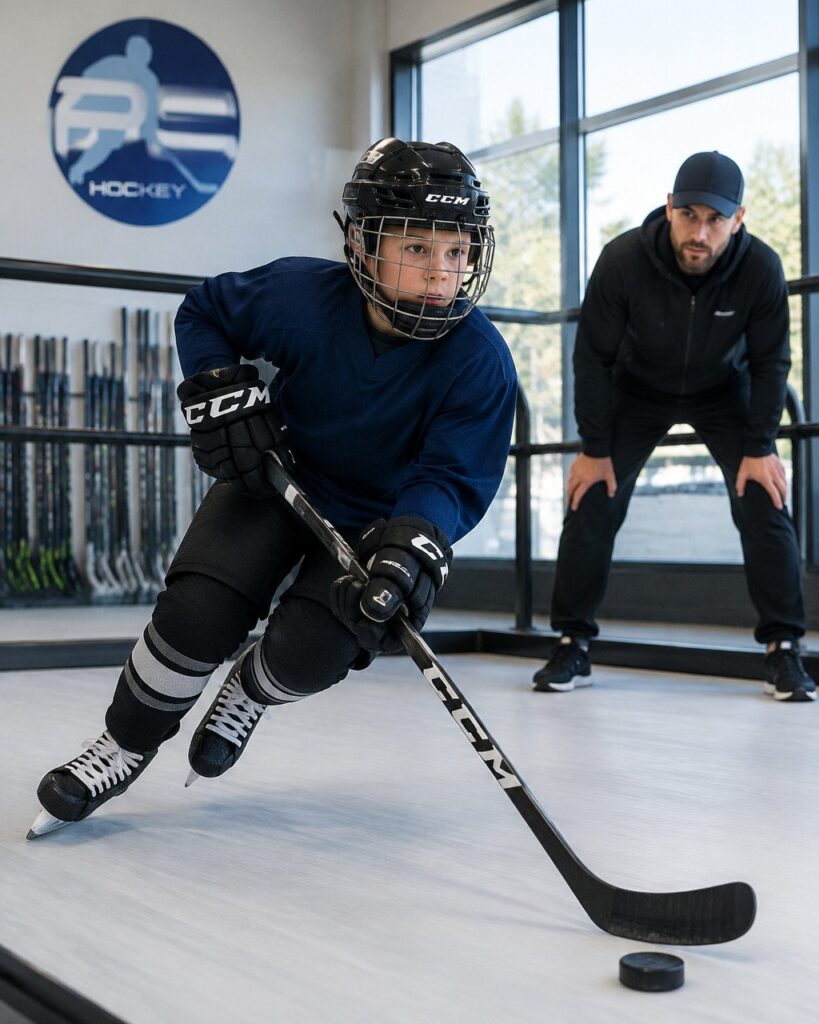
Last Updated: November 22, 2026
Quick Summary
Hockey skating and shooting training for kids works best when it isolates one skill at a time, starting with balance and stride fundamentals before adding speed. Build the shot in layers, from grip and stance to weight transfer and release, and only add movement once the mechanic is repeatable. Short, daily reps beat one long weekend session.
- Start every session with balance work, such as one-leg holds of 20 to 30 seconds per side, before speed.
- Cue chest over knees to fix a player who stands tall through the push.
- Keep the bottom hand loose on the stick so the wrists can snap through the release.
- Set a target and count accurate shots out of ten from a fixed spot to score progress.
- Ten focused minutes a day at home builds the habit and muscle memory together.
Table of Contents
- Why Off-Ice Training Builds Better Young Hockey Players
- Youth Hockey Skating Drills That Build Stride and Edge Control
- Hockey Shooting Drills for Kids: Technique Before Power
- Skating Treadmill Training: What It Does for Young Strides
- Off-Ice Hockey Training for Kids at Home
- Age and Ability: Matching Drills to Your Child’s Level
- Safety, Equipment Fit, and Supervision
- How to Measure Progress in Skating and Shooting
- Frequently Asked Questions
Why Off-Ice Training Builds Better Young Hockey Players
Off-ice training gives young players a controlled setting to repeat the same movement hundreds of times, which is hard to do on crowded ice.
Hockey skating and shooting training for kids works best when it isolates one skill at a time.
The payoff is confidence. A player who has repeated a clean stride on a skating treadmill steps onto game ice already knowing what the movement feels like.
Youth Hockey Skating Drills That Build Stride and Edge Control
Kids often practice skating hard instead of skating well. Speed follows technique, not the other way around.
Balance and Stride Fundamentals
Start every session with balance work before speed. A common mistake is rushing into fast laps before a player can hold a single-leg glide.
- One-leg balance holds, 20 to 30 seconds per side
- Slow stride pushes with a full recovery, focusing on the push-out and return
- Deep knee bends through a cone course to build the stance
Coaches should watch for a player who stands tall through the push. That upright posture kills power. Cue “chest over knees” and let the player feel the difference.
Power Skating and Edge Work
Edge control separates players who can turn sharply from those who lose the puck in a corner. Inside and outside edges deserve equal time.
We build edgework in short, high-focus blocks: tight turns around cones, C-cuts on each edge, and stop-starts that force a player onto the correct edge. For a structured path, this hockey edgework progression guide lays out the order to follow. Players who want more stride power can work through these stride power drills.
Hockey Shooting Drills for Kids: Technique Before Power
Shooting technique comes before shot power, every time. A young player who learns a clean release can often outshoot a stronger kid with poor mechanics, and the clean release keeps improving as the player gets stronger.
Build the shot in layers, and do not move to the next layer until the current one is repeatable.
Layer 1: Grip, Stance, and Puck Placement
- Grip: hands away from the body, top hand near the top of the shaft, bottom hand about a third of the way down
- Stance: knees bent, weight loaded on the back leg, chest over the knees
- Puck placement: the puck starts near the heel of the blade, not the toe, so the blade can sweep through it
Gripping the stick too tight with the bottom hand can lock the wrists and reduce the snap. Cue a loose bottom hand and let the top hand do the guiding.
Layer 2: Weight Transfer and Release
- Weight transfer: push through the shot from the back leg to the front, don’t just swing the arms
- Release: the puck rolls from heel to toe and leaves the blade at the toe
- Follow-through: point the blade where the shot should go
Kids often love to wind up and slap the puck as hard as they can, and that habit can cost accuracy. Start with wrist shots and snap shots from a stationary position, aim at a target, and only add movement once the release is repeatable.
Layer 3: Target Work and Reps
Set a target against a wall or net and make accuracy the score. A workable progression:
- Ten wrist shots from a fixed spot, count how many hit the target
- Ten snap shots from the same spot, same count
- Add one step into the shot, then a full stride, keeping the target count
Short sets of ten with a rest can be more effective than long grinding sessions.
Common Mistakes and Coaching Cues
- Standing tall through the shot: cue “chest over knees” and have the player feel the difference
- Shooting off the toe: cue “heel first” and slow the rep down until the sweep is clean
- All arms, no legs: cue “push the ground away” and check the weight starts on the back leg
For ringette players, the ring release follows a similar principle: a smooth, controlled motion generally produces better accuracy than a wild swing.
Players who practice only slap shots at full power can develop accuracy problems. Keep the wrist and snap shot work as the base, and treat the big wind-up as a rare add-on, not the daily drill.
Skating Treadmill Training: What It Does for Young Strides
A skating treadmill lets a player repeat the stride under a coach’s eye, at a controlled speed, without a rink full of distractions.
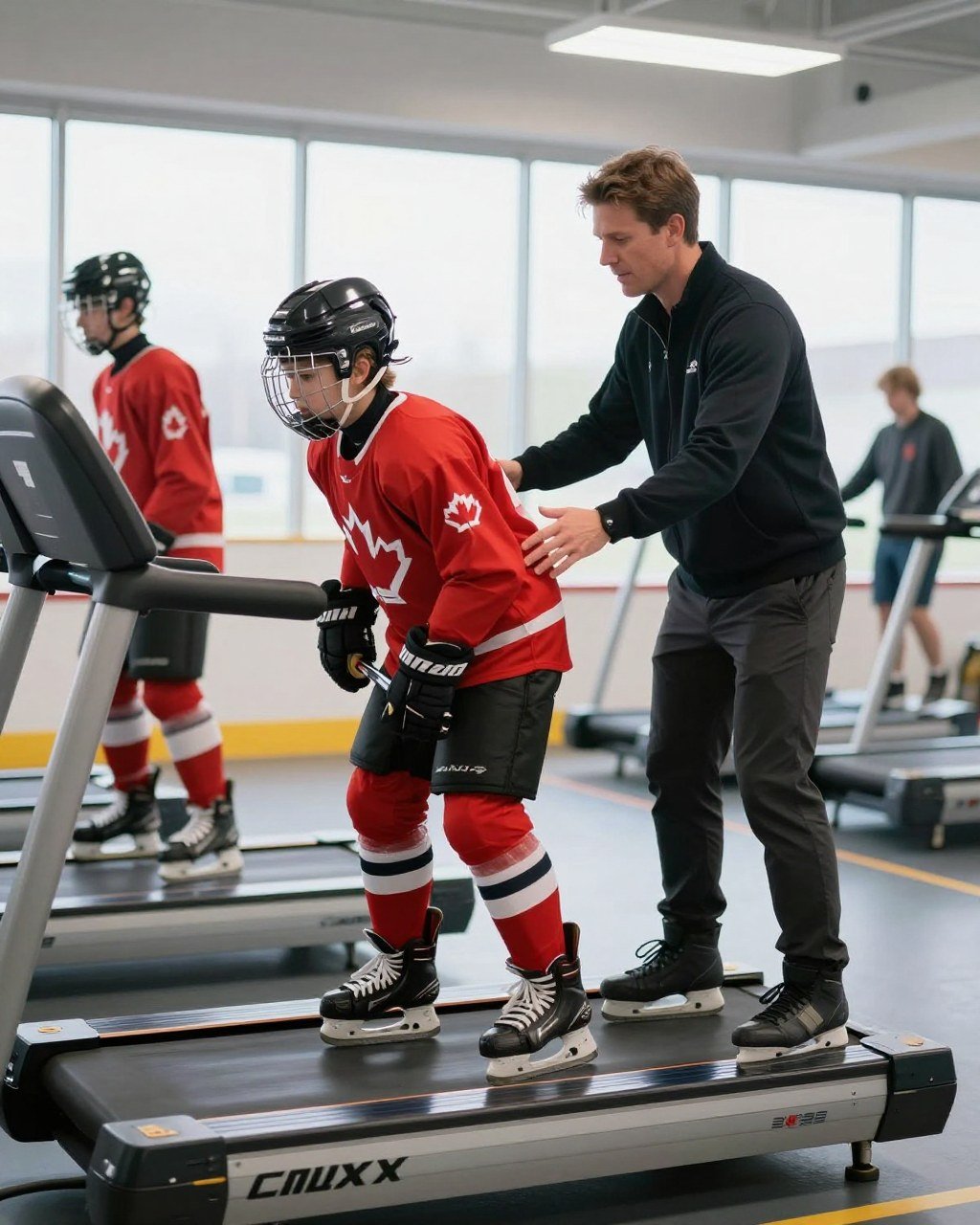
On the treadmill, we can hold a player at a steady pace and correct the push, the recovery, and the knee bend in real time. The belt keeps the player honest: a lazy stride shows up immediately. One of our skaters put it well:
“I’d never been on a skate treadmill before and Adrienne taught me a lot about stride efficiency.” — Lindsay Axelson
Before committing, parents often want the full picture. This guide to skating treadmill benefits explains what the training does for young strides, and local families can book skating treadmill training to put it to work.
Off-Ice Hockey Training for Kids at Home
Kids can build real skill at home with a small space and a few basics. Consistency beats equipment here.
- Stickhandling: use a ball or puck on a smooth floor, 10 minutes a day, moving it side to side and front to back
- Shooting: set up a target against a wall or net, focus on a repeatable release
- Balance: single-leg holds and bodyweight squats build the stance
The thing nobody tells you about at-home practice is that short, daily reps beat one long weekend session. Ten focused minutes a day builds the habit and the muscle memory together.
Age and Ability: Matching Drills to Your Child’s Level
Match the drill to the player, not to the team’s best kid. A drill that frustrates a beginner teaches nothing, and a drill that bores an advanced player builds bad habits through sloppy reps.
A useful way to sort players is by readiness rather than by birth year. Three broad bands can help sort players for off-ice skating and shooting work.
Band 1: First-Time and Young Beginners
These players are learning to balance on a single edge and to make a puck or ring travel where they aim it. Keep everything slow and stationary.
- Balance: one-leg holds for 10 to 15 seconds per side, holding a wall or stick for support at first
- Stride: slow push-and-recover on the skating treadmill at a walking pace, with the coach holding the rail beside them
- Shooting: wrist shots from a standstill, five to eight feet from a target, with the puck starting at the heel of the blade
Beginners often want to shoot as hard as they can before they can shoot straight. Hold them to accuracy first.
Band 2: Developing Players
These players can glide on one foot, stop on both sides, and release a wrist shot with reasonable control. Now you add movement and edges.
- Edges: C-cuts on the inside and outside edge, tight turns around cones, and stop-starts that force the correct edge
- Stride: treadmill work at a moderate, controlled pace with the coach correcting knee bend and full recovery on every push
- Shooting: snap shots and wrist shots with a target, adding a single step into the shot before adding a full stride
- Reps: sets of 10 to 12 with a target count, such as six of ten on net
This is the band where players can plateau if they practice at game speed before the movement is clean. Slow the rep down, fix the mechanic, then speed it back up.
Band 3: Competitive and Confident Players
These players can skate at speed under control and release a shot in motion. The work shifts to quickness, weight transfer, and shooting off a moving puck or ring.
- Edges: high-speed tight turns, quick transitions, and edge work under fatigue
- Stride: treadmill intervals that mimic shift-length bursts, with the coach watching for the stride breaking down late in the set
- Shooting: quick release in motion, shooting off a pass, and shooting while changing angle
- Reps: game-like sets that combine a skating burst with a shot, so the player learns to shoot while tired
Recreational players can benefit from clean instruction and repetition, even without the pressure of being top-tier.
Moving a player up a band too early can cause a stride or shot that looks fine in practice to break down in a game.
Safety, Equipment Fit, and Supervision
Proper equipment fit and adult supervision keep training safe and effective. A loose helmet or a stick that is too long changes how a player moves.
Check the basics before every session:
- Helmet fits snug with the cage positioned correctly
- Skates are sharpened and laced firmly
- Stick length reaches roughly to the chin in street shoes
- A coach or parent supervises treadmill and shooting work
Watch out: a player who skips the warm-up and jumps straight into fast skating is asking for a pulled muscle. Five minutes of movement first, every time.
How to Measure Progress in Skating and Shooting
Track progress with simple, repeatable tests instead of gut feeling. Numbers tell a parent what a good week actually changed.
- Time a set distance for stride speed
- Count accurate shots out of ten from a fixed spot
- Film the stride monthly and compare side by side
- Note the player’s own confidence after each block
Our guide to measuring skating speed improvement walks through a practical tracking method. A short video each month does more than memory ever will.
If your child’s stride and shot have stalled, the fix is structured repetition with a coach who can see the details.
Frequently Asked Questions
How can kids improve their hockey skating off the ice?
Off-ice work focuses on the same mechanics used on the ice: stride extension, knee bend, and weight transfer. Skating treadmill training lets a young player repeat the stride hundreds of times with a coach correcting form in real time. Dryland drills like single-leg balances, lateral bounds, and wall sits build the strength that supports a longer, more efficient stride. Combine these with regular on-ice practice and the improvements carry over quickly.
Can a skating treadmill help young hockey players improve their stride?
A skating treadmill gives players a controlled surface to repeat their stride under a coach’s eye. Because the belt keeps moving at a set speed, the skater cannot coast; they must maintain knee bend and full extension to stay balanced. This repetition builds muscle memory faster than ice time alone, where a player might take far fewer quality strides in the same session. Coaches can slow the belt to isolate a flaw, then speed it up to test the fix.
How often should kids practice hockey skating and shooting?
Two to three focused sessions per week is a practical starting point for most young players, with at least one rest day between high-intensity work. Short, consistent sessions beat long, occasional ones because skills stick through repetition. During the season, balance this against team practices and games so the player is not overtrained. A coach can help set a frequency that matches your child’s age, current fitness, and goals.
What should parents look for in a hockey skills training program?
Look for small player-to-coach ratios, because individual attention is what corrects stride and shooting flaws. Ask whether the program uses video analysis so your child can see their own mechanics, and whether it teaches shooting technique alongside skating. Confirm the coaches work with both beginners and competitive players, and ask how they track progress over a season. A clear answer to those questions tells you more than a flashy brochure.
