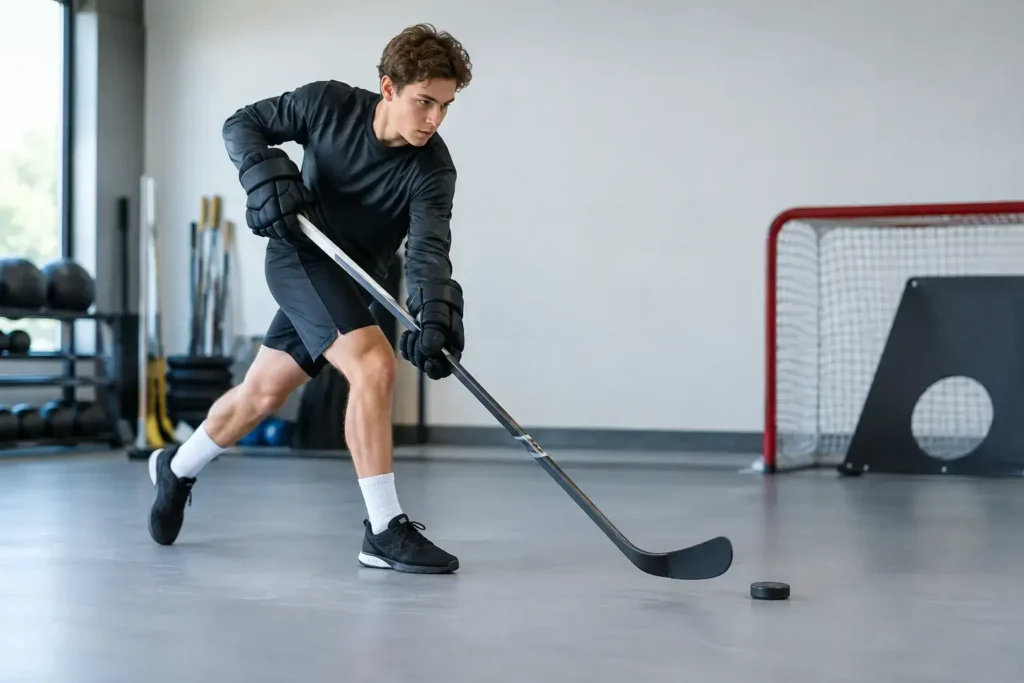
A hockey shot weakness is rarely fixed by simply taking more shots. If an athlete is off balance, loads the stick too late, pulls the puck too far behind the body, or loses their eyes before release, hundreds of repetitions can reinforce the same mistake. Real improvement comes from identifying the breakdown, correcting it at the right speed, and repeating the new pattern until it holds up under pressure.
For young players, a weak shot can show up in different ways. The puck may flutter, the release may take too long, shots may miss high or wide, or a player may avoid shooting altogether. For parents, the most frustrating part is often seeing effort without a clear result. The answer is not a one-size-fits-all shooting drill. It is a plan built around the athlete’s mechanics, strength, age, and game needs.
Start by Identifying the Hockey Shot Weakness
A shot is a sequence, not one movement. Power begins from the ice up: feet, knees, hips, core, hands, stick, and puck position must work in the right order. When one link is out of position, the release loses speed, accuracy, or deception.
A player who struggles to generate power may not have a strength problem at all. They may be shooting with their weight on the back foot, standing too upright, or failing to transfer force through the front leg. Another player may produce hard shots in a stationary drill but miss the net in games because their hands and puck position change while skating.
The first coaching question should be: what exactly is failing? A player needs more than the instruction to “shoot harder.” They need to know whether the problem is loading, balance, hand separation, puck placement, follow-through, or decision-making. Immediate video feedback is valuable here because athletes can see the difference between what they feel and what they actually do.
Power problems: force is leaking before release
A powerful wrist shot or snapshot requires an athletic base. The knees need enough flexion to create stability, the chest must stay over the puck, and the player must move weight toward the target without falling forward. If the upper body starts the shot before the lower body is stable, the stick cannot properly load.
Watch for a player whose front foot lands too close to the puck, whose hips stop rotating, or whose bottom hand stays tight against the body. These positions reduce leverage. A stronger athlete can sometimes compensate, but the shot will remain inconsistent and difficult to use at game speed.
The correction depends on the player. Younger athletes often need to learn a balanced stance and a clean weight transfer before they chase a bigger release. Older players may need to create more hand separation, use the stick’s flex more effectively, and maintain posture through contact with the puck. Power should be built from quality movement, not from swinging harder.
Accuracy problems: the puck is leaving from an unstable position
Accuracy is often blamed on the hands, but the hands are only part of the picture. A player who is leaning away from the target, opening their blade too early, or changing their head position at release will struggle to hit a small target consistently.
Puck position matters. For many wrist shots, the puck begins slightly behind the body and is released ahead of the front foot. For a quick snapshot, it may stay closer to the body to reduce the time needed to shoot. There is no single puck position for every shot, but there must be a repeatable relationship between the puck, the feet, and the hands.
Players should also learn to finish toward the target. A controlled follow-through is not just a cosmetic detail. It helps direct the blade path and gives coaches a clear clue about where the release broke down. If the stick finishes across the body while the puck misses wide, the athlete has useful information to work with.
A slow release: simplify before adding speed
A long windup gives goalies and defenders time to react. Players with a slow release often pull the puck too far back, separate their hands late, or need extra movements to set their feet. In a shooting lane, that player may still score. In a tight game, the window is gone.
The solution is not to rush every rep. First, establish the right loading position. The player should be able to receive or carry the puck with their hands prepared, knees bent, and blade ready to move through the puck. Then increase the pace while keeping the same positions.
Quick-release work should include different starting positions: stationary, moving laterally, off a pass, after a puck pull, and after a change of direction. This teaches athletes that speed comes from preparation and efficient movement, not panic.
Build Better Mechanics Through Purposeful Repetition
Repetition matters, but only when the athlete knows what each repetition is meant to improve. Ten focused shots with a coaching correction can be more productive than 100 shots taken with no feedback.
A useful shooting progression starts slowly enough for the player to feel the movement. They should understand the cue, such as “get your hands away from your body” or “finish your weight on the front leg.” Once the pattern is consistent, the athlete can add movement, reaction, and game-like pressure.
At Pro Stride Hockey, small coaching ratios make this process more personal. With no more than four athletes in a private session and a 2:1 player-to-coach ratio, coaches can identify a player’s specific shooting habit, demonstrate the correction, and give feedback before that habit becomes more ingrained.
A productive practice block can include several shot types, but it should have one main technical priority. For example, a player working on wrist-shot accuracy may use stationary shots to establish blade control, then shoot after a puck pull to maintain the same release path. A player working on snapshots may focus on getting the puck off the blade quickly without losing body position.
Avoid changing five things at once. A player who is told to bend their knees, move their hands, turn their hips, look up, and follow through differently may leave frustrated. Good coaching selects the correction that will make the largest difference first.
Match the Shot to the Game Situation
A strong shooter does not use one release everywhere. The best shot depends on distance, traffic, time, angle, and the player’s position on the ice.
From close range, quickness and deception often matter more than maximum power. A player may need to change the shooting angle, pull the puck around a defender’s stick, or release before the goalie gets set. From the blue line, puck placement and the ability to shoot through traffic may matter more than picking the top corner.
This is why off-ice shooting should not become a collection of stationary target drills. Targets are useful, especially for teaching accuracy, but athletes also need to practice scanning, changing the release point, and shooting after movement. The goal is to create a shot that transfers to a game, not just one that looks good in a controlled setting.
There is also a trade-off between power and speed. A full, heavy shot may be the right choice with time and space. A compact snapshot is usually better when a defender is closing quickly. Players improve faster when they learn to recognize that difference rather than trying to force the same shot in every situation.
Equipment Can Help, But It Cannot Fix Mechanics
Stick flex, length, lie, and blade curve influence how a shot feels. A stick that is too stiff for a younger or lighter athlete may be difficult to load. A stick that is too long can make puck control and hand placement more challenging. These details are worth reviewing, especially when a player has grown or moved into a more competitive level.
Still, equipment should support good mechanics, not replace them. A new stick will not solve a weak weight transfer or an inconsistent puck position. Before changing gear, watch the player shoot from multiple angles and determine whether the issue is truly equipment-related.
Turn Frustration Into a Measurable Plan
The most confident shooters are not the players who never miss. They are the players who understand why a shot missed and know what to adjust on the next rep. That confidence comes from patient instruction, clear feedback, and enough quality repetitions to make the correction feel natural.
For parents, progress may first appear in small details: a player stays balanced through release, hits the net more often, gets the puck off their blade faster, or chooses to shoot instead of passing away an opportunity. Those changes build toward stronger game performance.
Give the athlete one clear focus for the next practice, then watch that skill improve over time. A better shot is not built in one dramatic session. It is built one accurate, purposeful repetition at a time.