Last Updated: November 19, 2026
Quick Summary
A skating treadmill academy is an off-ice training program where young hockey and ringette players repeat stride movements at controlled belt speeds to fix technique. When choosing one near you, look at the coach’s background, the coach-to-player ratio, the session structure, and whether feedback such as video review is included.
- Off-ice sessions let a coach stop the belt and point to exact knee, hip, or blade angle problems.
- Belt speed is adjusted so players start slow and progress to faster strides as their form holds.
- Pro Stride Hockey runs 1-on-1 sessions at a 2:1 player-to-coach ratio.
- Group sessions at Pro Stride Hockey are capped at four players.
- Ask for an introductory or assessment session before committing to a schedule.
Table of Contents
- Why Off-Ice Skating Treadmill Training Works for Youth Players
- How Skating Treadmill Sessions Build Stride Technique
- Shooting Mechanics for Hockey Pucks and Ringette Rings
- How to Choose a Skating Treadmill Academy Near You
- Skating Treadmill Training Duration and Frequency
- What to Expect in a First Session
- Booking Your First Session with Pro Stride Hockey
- Frequently Asked Questions
Why Off-Ice Skating Treadmill Training Works for Youth Players
Off-ice training gives young hockey and ringette players a place to refine their stride without the pressure of a live game. A skating treadmill can slow the process down enough to fix small mechanical habits that get lost at full speed. Skating technique is built through repetition, and the treadmill lets players repeat the same movement dozens of times in one session.
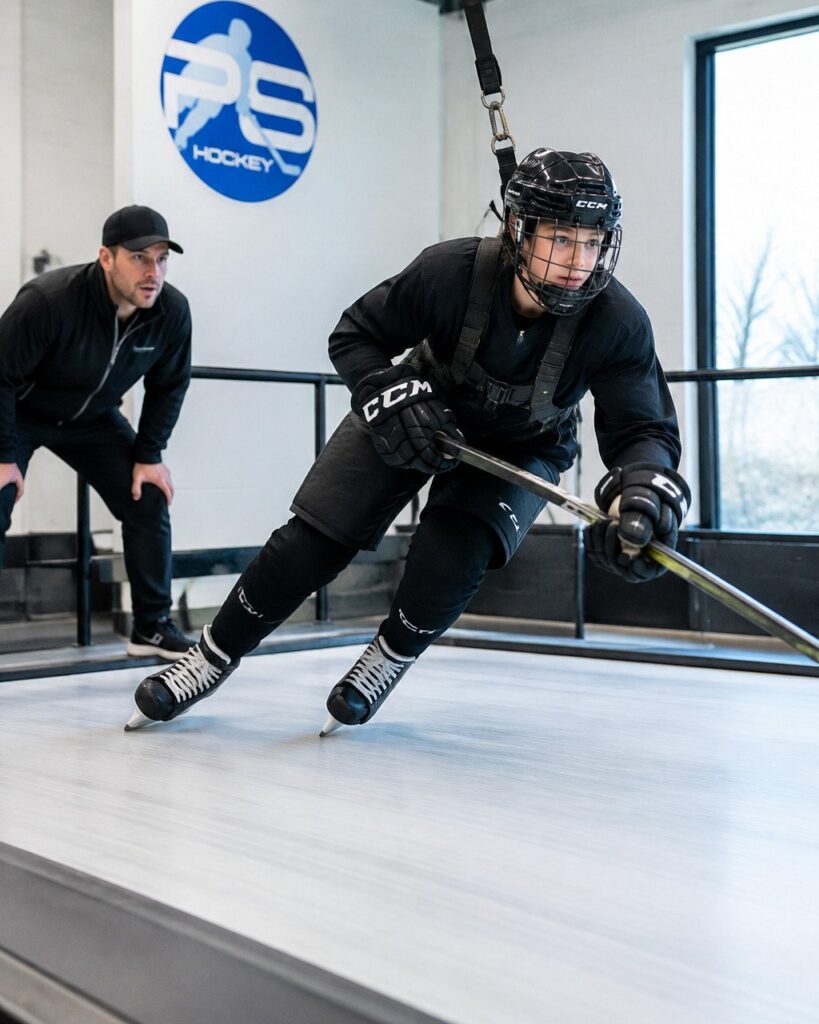
The main advantage is control. A coach can stop the belt, adjust the pace, and point to exactly what a player’s knee, hip, or blade angle is doing. On a rink, that same correction might take a full practice to notice and even longer to fix.
Off-ice work can suit the schedule of a busy young athlete, since it adds purposeful skating volume without extra ice time.
How Skating Treadmill Sessions Build Stride Technique
A skating treadmill session focuses on the mechanics that carry over to the ice: a deep knee bend, a full push-off through the inside edge, and a recovery that brings the blade back under the body. Players start with slower, deliberate strides and progress to faster, more powerful ones as their form holds.
The belt speed is the variable that makes this work. Slower speeds let a player feel each phase of the stride, while faster speeds test whether the technique still holds under pressure. Coaches move a player up and down this range based on what the player is ready for.
Repetition is what turns a correction into a habit. A player who hears “push wider” in a dozen short bursts will usually apply it in a game faster than one who hears it once on the ice.
What a Coach Looks for in Your Stride
A coach watching a stride is checking several things at once. The most common issues are a stride that stays too upright, a push that finishes early, and a recovery leg that drags instead of tucking. Each one costs speed and energy.
Video review is useful here. Filming a stride from the side lets a player see the same problems the coach sees, which makes the corrections easier to accept and remember. You can follow a step-by-step guide to reviewing your own skating video to do this at home.
Shooting Mechanics for Hockey Pucks and Ringette Rings
Shooting is a separate skill from skating, and it deserves its own practice time. At Pro Stride Hockey, we teach players how to transfer weight from the back foot to the front, how to load the stick with the shaft flexed, and how to release through the target. The same principles apply to shooting a hockey puck and shooting a ringette ring, though the equipment and release differ.
A specialized shooting lane lets players work on accuracy and repeatable mechanics.
Many players focus only on how hard they can shoot. Accuracy and consistency usually matter more, especially in a game where a shot that lands on net is worth more than a harder one that misses.
How to Choose a Skating Treadmill Academy Near You
Searching for a skating treadmill academy near you will turn up several options, and most of them will claim to improve speed and stride. The useful question is not which one sounds best but which one fits your player’s age, goals, and weekly schedule. A practical checklist makes the comparison concrete.
Coaching credentials and supervision. Ask who runs the sessions and what background they have in hockey or ringette skating instruction. A coach who understands stride mechanics can explain what they are correcting and why.
Equipment and safety setup. Ask how the belt speed is set for a first-time player and how the coach handles a stumble. For youth players, ask about age and size suitability and whether the coach has worked with beginners.
Session structure. Find out what a typical session includes and how much of it is spent on the treadmill versus shooting and feedback. A defined structure is a better sign than a general promise of ‘personalized training.’
Session formats and ratios. Ask whether private, small-group, and semi-private options exist and what the coach-to-player ratio is in each. Smaller groups mean more reps and more corrections per player. Pro Stride Hockey offers 1-on-1 sessions at a 2:1 player-to-coach ratio and caps group sessions at four players.
Feedback and progress tracking. Ask whether video review is included and how the coach measures improvement. A program that can describe how it tracks progress is easier to trust than one that only promises results.
Location, travel, and scheduling. A session you cannot attend consistently will not build technique. Check travel time and whether session times fit around school and other practices. Consistency beats intensity for young athletes.
Booking and trial options. Ask whether an introductory or assessment session is available so your player can try the treadmill before committing to a schedule.
Watch out: a low ratio or a flashy facility means little if the coach cannot explain the specific mechanics being corrected, ask for a concrete example of a stride fault and how it is fixed.
Coach-to-Player Ratio and Group Size
Coach-to-player ratio is one of the most useful things to check. Pro Stride Hockey runs 1-on-1 sessions at a 2:1 player-to-coach ratio and keeps group sessions to a maximum of four players. A smaller group means each player gets more reps, more corrections, and more time on the treadmill. Larger groups can work for players who mainly want general conditioning, but they usually give less feedback per player.
The checklist below sums up the questions worth asking before booking, using details the article already gives.
| Factor | What to ask | Example from this article |
|---|---|---|
| Coach-to-player ratio | How many players per coach | 2:1 for 1-on-1 sessions |
| Group size | Maximum players per group session | Four players maximum |
| Coaching background | Who runs sessions and their skating experience | Hockey or ringette skating instruction |
| Feedback method | Whether video review is included | Video review of stride from the side |
| Trial option | Whether an introductory session is offered | Assessment session before committing |
| Schedule fit | Whether times suit school and other practices | Consistency beats intensity |
Skating Treadmill Training Duration and Frequency
Session length and frequency depend on the player’s goals and age, and the exact length should come from the coach after an initial assessment. Shorter sessions held more often tend to build technique more reliably than one long session a month apart.
Frequency matters as much as duration. Players who practise a few times a week and reinforce corrections at home tend to hold their gains.
Consistency also means carrying the work off the treadmill. Short at-home drills, such as balance work and controlled strides on a driveway or in a basement, help a player remember the corrections between sessions.
What to Expect in a First Session
A first session is designed to reduce uncertainty, so it follows a predictable sequence. Knowing the steps in advance helps a young player arrive calm and ready to learn.
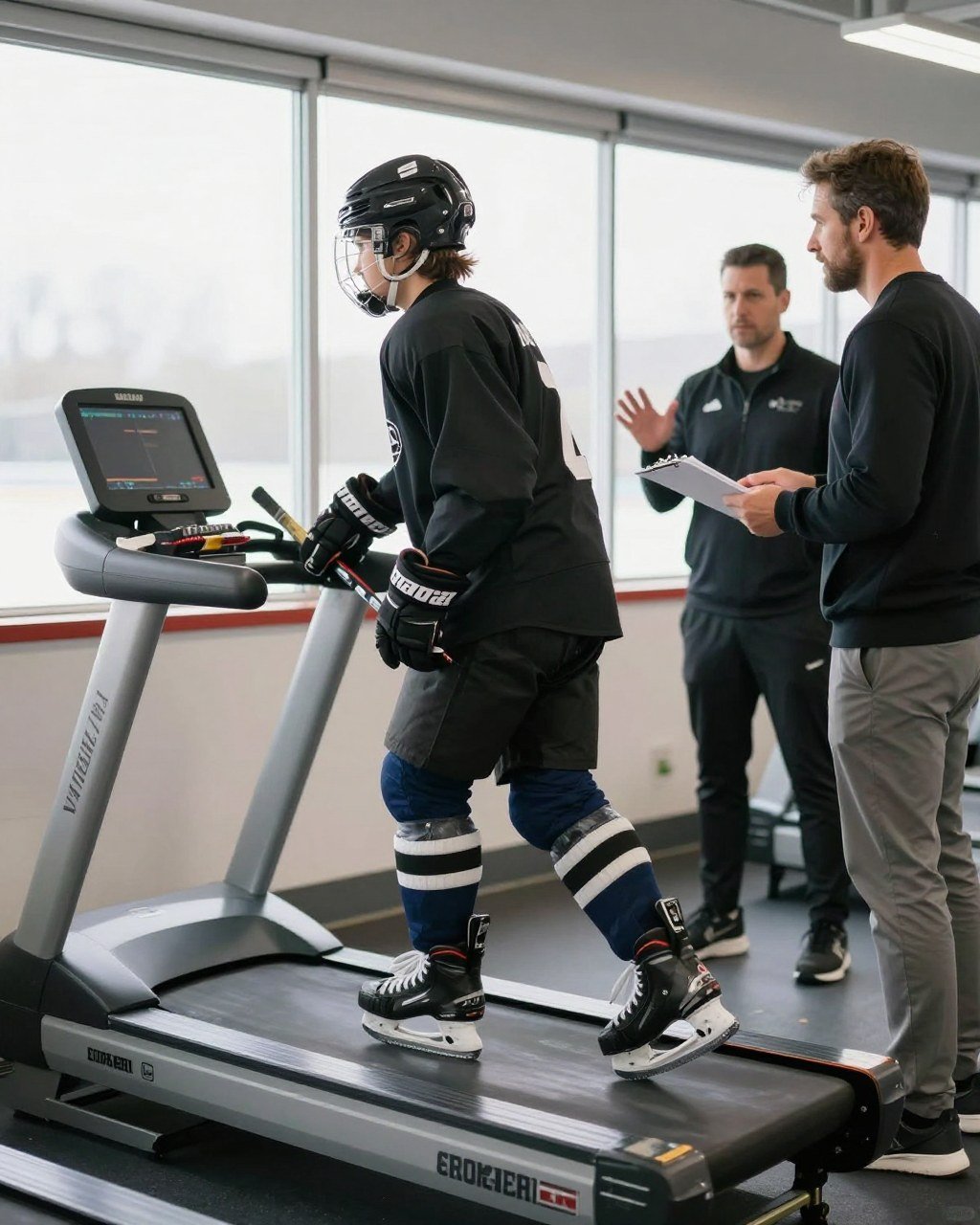
It is normal to feel unsteady on a skating treadmill the first time.
Watch out: if a player feels pain rather than ordinary muscle fatigue, stop and consult a medical professional before continuing, a coach can correct technique but cannot assess an injury.
!A young hockey player in full gear stepping onto a skating treadmill in a bright training facility while a coach watches
Booking Your First Session with Pro Stride Hockey
To book your first session, contact Pro Stride Hockey to choose a time that fits your schedule and tell the team about your goals. Pricing depends on the session type and schedule, so please check our website or request a quote for current rates.
If you are weighing this against other options, you can read our guide on skating treadmill versus ice skating to see how each builds stride mechanics, and review how youth hockey team skating sessions carry into game speed. When you are ready to act, visit our skating treadmill training in Edmonton page to find location details and book your session.
We look forward to helping your player build a stronger, faster stride.
Frequently Asked Questions
How does a skating treadmill improve hockey stride mechanics?
A skating treadmill lets a player repeat the push-and-glide motion of skating in a fixed location, so a coach can see and correct the stride as it happens. Because the player can focus on knee bend, foot placement, and edge pressure without fighting for space on a rink. Pro Stride Hockey pairs treadmill work with video analysis so players can compare their stride across sessions. Exact progress varies by player, so ask the academy how it tracks improvement before booking.
Is skating treadmill training effective for beginners or only for elite players?
Skating treadmill training suits players at many levels, from recreational players building basic balance and stride to competitive players refining speed and efficiency. Beginners usually benefit from the controlled setting, since they can practise the fundamentals without the pressure of a full rink. Elite players use the same tool for detailed technical work. Pro Stride Hockey serves athletes of all ages, so the coach can adjust drills to the player’s current level.
What is the typical player-to-coach ratio at a skating treadmill academy?
Ratios differ between academies, so compare them directly when you shortlist options. Pro Stride Hockey uses a 2:1 player-to-coach ratio in one-on-one sessions and caps sessions at a maximum of four players. Smaller groups give the coach more time to watch each player’s stride and shooting form. When you call an academy, ask how many players share a coach during a session and whether that number changes for private lessons.
How do I know if a skating treadmill academy near me is worth the cost?
Start by comparing what each academy includes, such as coach supervision, video analysis, shooting work, and session length. Pricing depends on session format, group size, and booking details, so request current rates directly from each academy rather than relying on estimates. Ask for a trial or introductory session where possible, and check reviews for consistent feedback on coaching quality. Pro Stride Hockey lists a 4.8 star rating from 38 Google reviews, and current prices are available on its website or by quote.
