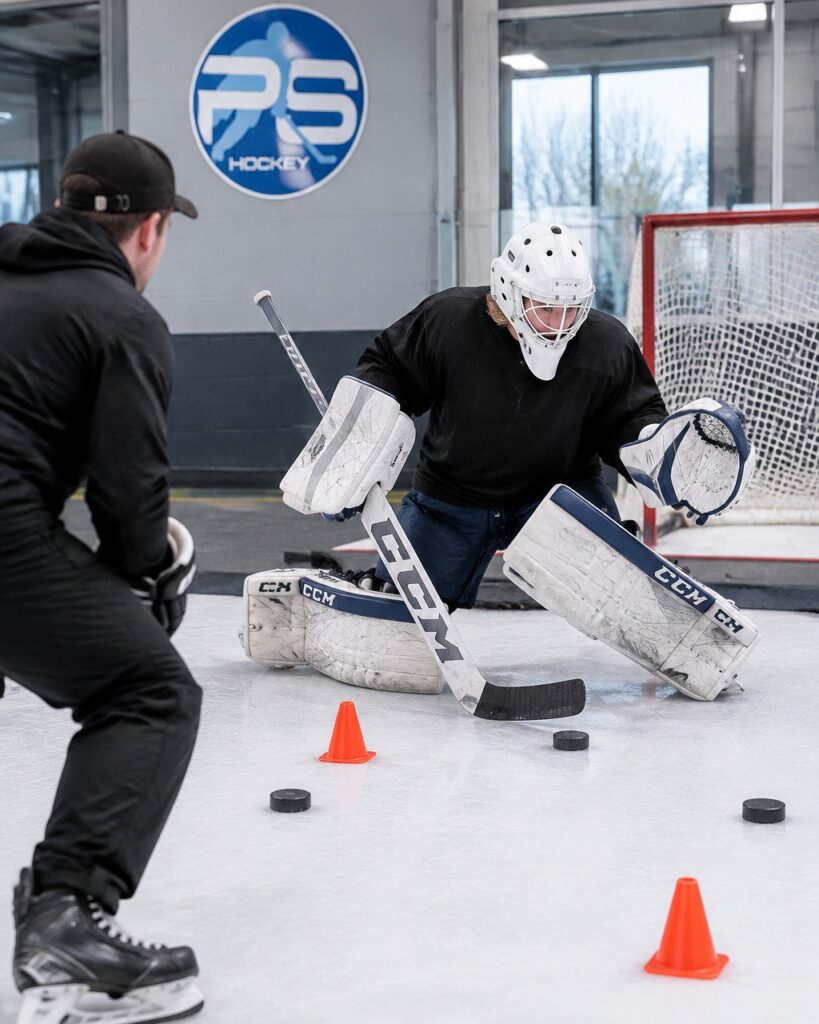
Last Updated: November 17, 2026
Quick Summary
Build a goalie warmup routine as a fixed sequence of mobility, activation, skating, and puck work that you run the same way before every practice and game. A 20 to 30 minute goalie warmup routine works for most youth and competitive goalies, and the order matters more than the exact numbers.
- Spend ten to fifteen minutes off ice on mobility and activation before you strap on pads.
- Protect the two transition windows at minutes 14-16 and 24-26, where most goalies lose the routine.
- When time is tight, cut mobility first, then puck work, then skating, but never cut activation or the final reset.
- Keep each drill short enough that form stays clean, and rest 20-30 seconds between activation sets.
- Run three readiness checks before the first puck: movement quality, visual tracking, and perceived energy.
Table of Contents
- Why a Repeatable Goalie Warmup Routine Changes Your Game
- Off-Ice Goalie Warm-Up Exercises Before You Hit the Ice
- How Long Should Your Goalie Warmup Routine Length Be?
- Goalie Warmup Drills That Build Game-Ready Movement
- Goalie Mental Preparation Before a Game
- Adapting Your Warmup for Age, Skill, and Limited Ice Time
- Building a Consistent Goalie Warmup Routine at Pro Stride Hockey
- Frequently Asked Questions
Why a Repeatable Goalie Warmup Routine Changes Your Game
A goalie warmup routine is the fixed sequence of movements, stretches, and puck work a goaltender completes before every practice and game.
The problem is rarely effort. Most young goalies warm up hard, but differently every time, so nothing gets measured or sharpened.
A repeatable routine fixes that. Same movements, same order, same cues.
Below, we break down a full warmup from arrival to first puck, including off-ice exercises, on-ice drills, and how to adapt it for age and skill.
Off-Ice Goalie Warm-Up Exercises Before You Hit the Ice
Off-ice goalie warm-up exercises prepare your joints, muscles, and nervous system before you strap on pads. Ten to fifteen minutes is enough. The goal is readiness, not fatigue.
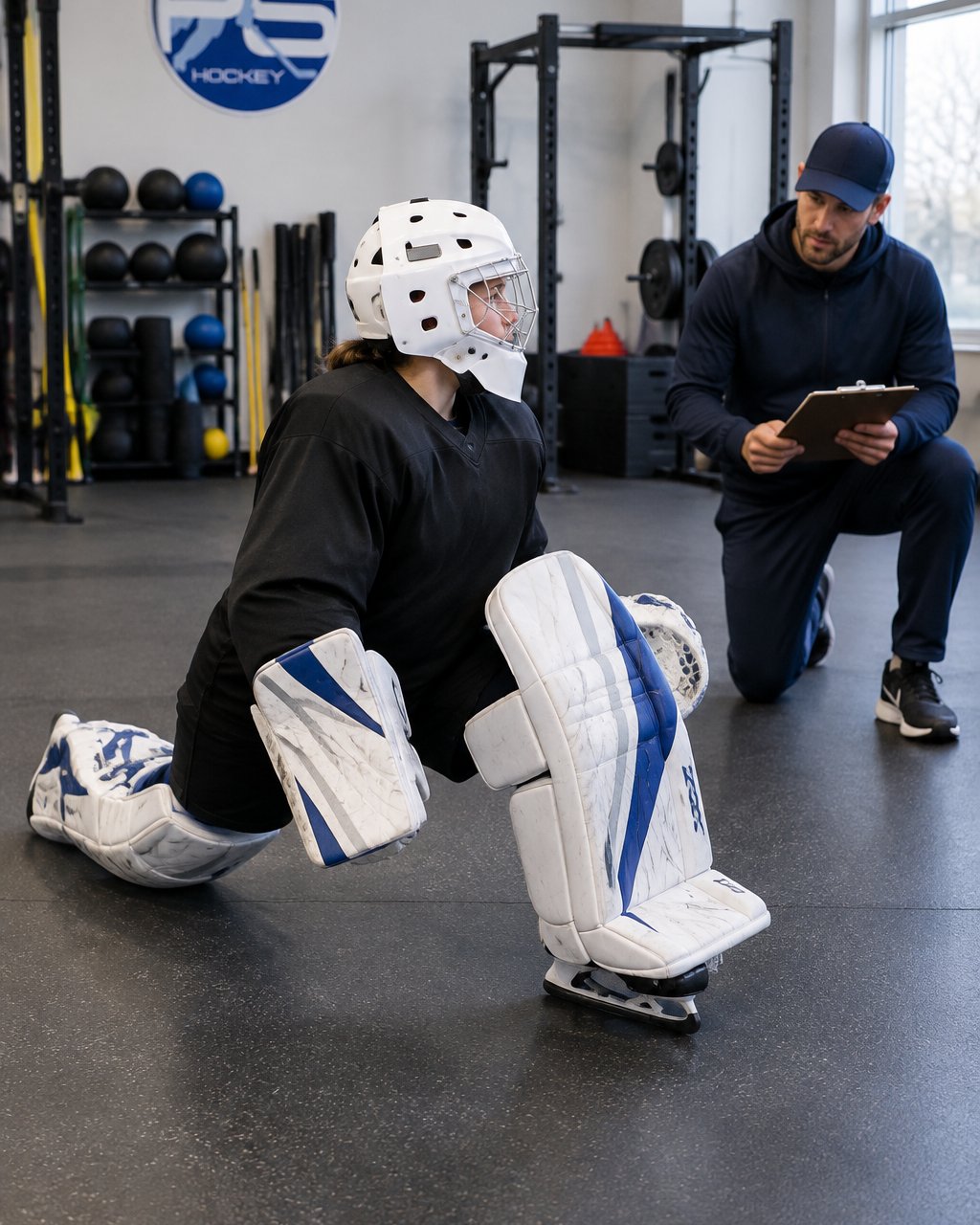
Mobility and Tissue Preparation
Start with gentle movement that takes your joints through their full range. Keep it flowing, never held.
- Knee hugs: walk forward, pull each knee to your chest, ten per side
- Quad stretch: hold each ankle behind you for a two-count, eight per side
- Lunges with rotation: step forward, twist toward the front leg, six per side
A common mistake is static stretching before activity. Save the long holds for after the skate. Before ice time, you want movement, not stillness.
Activation and Movement Preparation
Now wake up the muscles that drive a goalie’s game: hips, core, and legs.
- Lateral shuffles: stay in a low stance, push and recover, twenty seconds
- Butterfly drops: drop and recover without pads, eight reps
- Quick feet: fast small steps in place, fifteen seconds
This phase primes the central nervous system, firing fast twitch muscles before the first shot rather than during it. Goalies who skip activation often feel heavy for the first few minutes on the ice.
If you want a deeper conditioning base to pair with this work, our guide on explosive power with off-ice conditioning covers the strength side. And for joint-safe prep, these hockey injury prevention exercises for young players fit neatly into the activation block.
How Long Should Your Goalie Warmup Routine Length Be?
A goalie warmup routine length of 20 to 30 minutes total works for most youth and competitive goalies: ten to fifteen minutes off ice, five to eight minutes on-ice skating, and three to five minutes of puck work. The order matters more than the numbers, but it only becomes repeatable when you attach a clock to it.
A Timed Routine From Arrival to First Puck
This is a 26-minute template for a full pre-game. Times are targets, not stopwatch rules. Move to the next block when the clock hits the mark, even if you did not finish every rep.
| Minute | Block | What You Do |
|---|---|---|
| 0-2 | Arrival and check-in | Gear laid out, water filled, two minutes of quiet breathing and one visual walk-through of your first save |
| 2-9 | Mobility and tissue prep | Knee hugs, quad stretch, lunges with rotation, side steps, high kicks, flowing, never held |
| 9-14 | Activation | Lateral shuffles, butterfly drops without pads, quick feet, band walks |
| 14-16 | Transition to ice | Strap on pads, final cue word, no new drills |
| 16-21 | On-ice skating and crease movement | T-pushes, butterfly slides, crease pivots, lateral shuffles, post-to-post pushes |
| 21-24 | Puck handling and shooting | Close touches, settling bouncing pucks, controlled shots from the slot, passing reps |
| 24-26 | Reset and first puck | One familiar cue, one slow breath, then face the first shooter |
The two transition windows are the part most goalies skip. Minute 14-16 is where a rushed goalie loses the routine, and minute 24-26 is where a well-warmed goalie still arrives at the first shot scattered. Protect both.
Shrinking the Routine Without Breaking It
When time is tight, cut blocks in this order: mobility first, then puck work, then skating. Never cut activation or the final reset. A 10-minute version: two minutes of activation, one minute to dress, four minutes of skating, two minutes of puck work, one minute of reset.
| Situation | Off-Ice | On-Ice | Puck Work | Total |
|---|---|---|---|---|
| Full pre-game | 12-15 min | 6-8 min | 4-5 min | 22-28 min |
| Practice day | 8-10 min | 5 min | 3 min | 16-18 min |
| Late arrival | 5 min | 3 min | 2 min | 10 min |
| Shared ice, short slot | 10 min | 4 min | 2 min | 16 min |
Off-Ice
Watch out: a goalie who tries to make up lost time by sprinting through activation will feel heavy for the first five minutes on the ice, which is exactly the window where most early goals happen.
Practice Days Versus Game Days
Keep the core the same and change only the final block. On a practice day, the skating block can be longer and the puck block shorter, because practice supplies shots. On a game day, the puck block matters more, because your hands need to be settled before the first real shooter. The sequence stays fixed; the emphasis shifts.
Goalie Warmup Drills That Build Game-Ready Movement
Goalie warmup drills should mirror real game movement, not just get you sweating. Every drill below trains a pattern you will actually use in a scramble, a rebound, or a breakaway.
On-Ice Skating and Crease Movement Drills
Get your edges and crease movement sharp before shots start flying.
- T-pushes: push across the crease and set, ten each direction
- Butterfly slides: drop and slide, recover, eight reps
- Crease pivots: rotate from post to post, five each way
Keep each drill short. The point is clean technique, not exhaustion. If your legs are burning before the first shot, you have spent energy the game needs.
Puck Handling and Shooting Warmup
Settle the puck before you face real shooters. Bouncing pucks early in a warmup rattle even experienced goalies.
- Start with puck handling close to the body, small touches
- Move to settling bouncing pucks against the boards
- Take a few controlled shots from the slot, tracking the puck in
For goalies who also want to build their offensive game, our coaches teach the proper way to shoot a hockey puck and a ringette ring.
Goalie Mental Preparation Before a Game
Goalie mental preparation before a game is the part most warmups skip entirely. It should not be.
Build a short mental block into your routine:
- Two minutes of quiet breathing before you step on the ice
- One or two familiar cues you repeat every game (“track the puck,” “stay square”)
- A quick visual walk-through of your first save of the game
Familiar movements calm the mind. That is why a repeatable routine doubles as mental training.
A goalie who gets in their own head during tournaments needs more than a warmup, though. Our hockey mental toughness training tips go deeper into pre-game focus and confidence.
Adapting Your Warmup for Age, Skill, and Limited Ice Time
A routine that works for a 16-year-old competitive goalie will bury a 9-year-old recreational goalie. The fix is the same sequence with different block lengths, rep counts, and a clear rule for when to stop. Below are age bands, constraint fixes, and readiness checks so you can tell whether the routine is working.
Age and Skill Bands
| Group | Off-Ice | On-Ice | Puck Work | Key Adjustment |
|---|---|---|---|---|
| Youth recreational (roughly 8-11) | 5-8 min | 4-5 min | 2-3 min | Fewer reps, more play; keep every drill under 20 seconds |
| Youth competitive (roughly 12-14) | 8-10 min | 5-6 min | 3-4 min | Add band walks and butterfly drops; start tracking cues |
| Advanced (roughly 15+) | 12-15 min | 6-8 min | 4-5 min | Longer activation, full-speed post-to-post pushes, more shot volume |
For the youngest group, the goal is fun and movement, not fatigue. Five to eight minutes of flowing movement, a few skating drills, and some puck touches is plenty. For older goalies, extra time goes into activation and crease speed, not static stretching.
When Ice Time, Space, or the Clock Fights Back
- Late arrival: skip mobility, do activation and puck work only, and keep the final reset. Ten minutes total is enough to arrive ready.
- Shared ice: do your skating drills in a corner or along the boards, then move to shots when the slot opens. Do not fight for center ice.
- Short slot: cut reps, not phases. Two T-pushes each way still trains the pattern.
Watch out: a goalie who shares a warm-up slot and tries to cram a full 26-minute routine into 12 minutes will rush the activation block and arrive on the ice tight, which is worse than a shorter routine run in order.
Load Management and Avoiding Warm-Up Fatigue
A warm-up should leave you feeling sharper, not tired. A goalie breathing hard before the first shot has already spent energy the game will need. Use these rules:
- Keep each drill short enough that form stays clean; stop the rep when technique breaks, not when the clock says so.
- Rest 20-30 seconds between activation sets so the nervous system primes without accumulating fatigue.
- If a movement causes joint pain, swap it for a pain-free version rather than pushing through.
Readiness Checks: Is the Routine Working?
Instead of following drills without feedback, run three quick checks before the first puck:
- Movement quality: can you drop into a butterfly and recover without your knees collapsing inward?
- Visual tracking: can you follow a puck or ball from hand to hand without losing it at the edges?
- Perceived energy: do you feel sharp or heavy? Heavy means the activation block was too long or too intense.
Track those three for a few weeks. If movement quality and tracking improve while energy stays high, the routine is working. If you consistently feel heavy, cut the activation block before the skating block.
For goalies who want to build stride and movement quality off the ice, skating treadmill training lets you work on stride technique without waiting for ice time.
Building a Consistent Goalie Warmup Routine at Pro Stride Hockey
Consistency is the whole game. A routine only works if you run it the same way every time, so your body and mind learn the pattern.
At Pro Stride Hockey, we build that habit into every session.
If you want a routine you can repeat with confidence, small group training is where it starts.
Most goalies never build a real warmup. They show up, stretch a little, take a few shots, and hope the first period goes well.
Frequently Asked Questions
What should a goalie do before a hockey game?
Start with 5-10 minutes of off-ice mobility and activation, including lunges, knee hugs, and side steps, then move to the ice for 5-8 minutes of skating and crease movement. Finish with 3-5 minutes of puck handling and tracking drills. A consistent goalie warmup routine should include both physical preparation and a short mental focus segment.
How long should a goalie warm up before a game?
Aim for 15-20 minutes total. Off-ice goalie warm-up exercises take about 5-10 minutes, on-ice movement takes 5-8 minutes, and puck work takes 3-5 minutes. If ice time is limited, shorten each phase but keep the order. The goalie warmup routine length matters less than consistency. Youth goalies can use the shorter end, while older competitive goalies may extend the off-ice portion. Adjust based on available ice and energy levels.
What are the best off-ice warm-up exercises for goalies?
Focus on dynamic movements: walking lunges with rotation, knee hugs, high kicks, side steps with band resistance, and squat-to-stand patterns. These prepare the hips, groin, and legs for the butterfly and lateral pushes. Add light activation like glute bridges and band walks. Avoid static stretching before activity. A structured off-ice goalie warm-up routine raises heart rate and primes the central nervous system without causing fatigue.
How can a goalie stay focused before a game?
Use a short mental preparation block after physical warmup. Find a quiet spot, take slow breaths, and visualize three to five familiar saves: a glove save, a blocker save, a butterfly push, and a rebound control sequence. Repeat a simple cue word. This goalie mental preparation before a game builds game readiness and blocks out distractions. Keep it consistent each game so it becomes a familiar anchor, especially during tournaments.
