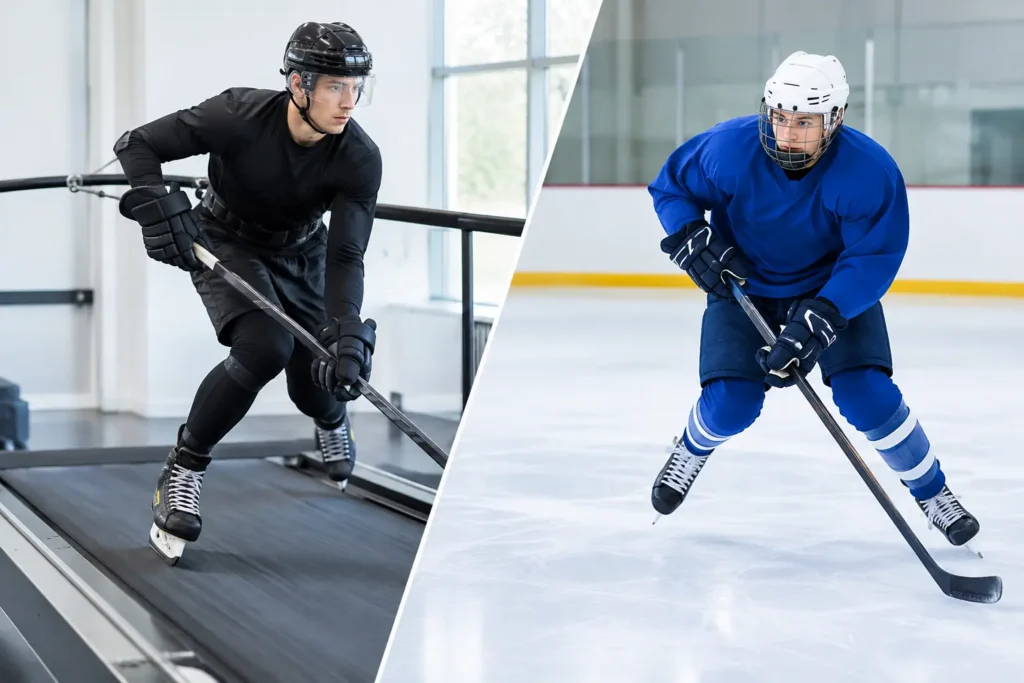
A hockey player can work hard at every team practice and still repeat the same inefficient stride for months. That is the real conversation behind skating treadmill versus ice skating. It is not a question of whether one is “better” in every situation. It is about choosing the right environment for the skill the athlete needs to build.
Ice time teaches players how to read the game, use their edges, and perform under pressure. A skating treadmill creates something team practices rarely can: controlled, high-quality repetition with a coach watching every part of the stride. For young players, competitive athletes, and families investing in long-term development, the strongest approach is usually not choosing one over the other. It is understanding what each tool does best.
Skating Treadmill Versus Ice Skating: The Core Difference
Ice skating is performance in a changing environment. The athlete responds to the puck, teammates, opponents, boards, and the flow of the drill. That is where hockey happens. Players need ice to develop edge awareness, transitions, deception, puck protection, and the ability to make decisions while moving at speed.
A skating treadmill slows the environment down mentally, even while the athlete is skating at demanding speeds. The player stays in one place while the belt moves beneath the skates. This gives the coach a clear, uninterrupted view of body position, knee bend, stride length, recovery path, arm action, and balance. Instead of watching a player take three strides and disappear into a corner, the coach can observe dozens of consecutive strides and correct the same detail in real time.
That distinction matters. On the ice, a player may know they need to “skate lower” but have little idea what that looks or feels like. On a treadmill, the coach can identify whether the athlete is standing too tall, extending behind the body inefficiently, collapsing inward at the knee, or recovering the skate too wide. Video feedback makes the lesson even more specific. Players can see their own mechanics immediately, then apply the correction on the next repetition.
What a Skating Treadmill Develops Best
The treadmill is especially valuable when an athlete needs to change a movement pattern. Better skating is not created by simply telling a player to move their feet faster. Speed begins with efficient mechanics: a stable body position, a powerful lateral push, full extension, controlled recovery, and the ability to maintain posture as fatigue builds.
Repetition Without Losing the Coaching Moment
At a busy practice, players may receive a quick reminder between drills, but they are not likely to receive continuous individual correction. The pace of team practice has to serve the group. A treadmill session serves the athlete in front of the coach.
With repeated strides under a consistent load, players have time to feel the difference between an inefficient movement and an effective one. That is valuable for athletes who are still building foundational skating habits, as well as older players trying to gain a more powerful first few steps. The goal is not to make every athlete look identical. It is to help each player move with more control, force, and confidence.
Posture, Power, and Stride Efficiency
Many young players create effort without creating much propulsion. Their feet may move quickly, but their stride lacks depth. Others lean too far forward, let their hips rise, or swing their upper body side to side. These habits can reduce power and waste energy.
A controlled treadmill setting allows coaches to focus on the details that influence acceleration and top-end speed. Players can work on maintaining knee and hip flexion, pushing through the full blade, recovering the skate under the body, and keeping the upper body quiet and athletic. When those pieces improve, players often feel more balanced and less exhausted at high speeds.
Immediate Video Analysis
Feeling a mistake is difficult, especially for a younger athlete. Seeing it can make the lesson click. Immediate video analysis lets players connect coaching language to their actual movement. A coach can pause a stride, show the athlete where their body is positioned, and explain what needs to change.
This process is not about criticizing a player’s skating. It is about giving them a clear picture and a practical next step. When athletes understand why a correction matters, they tend to take more ownership of the work.
Focused Training During Recovery and Return to Play
For players returning from an injury, controlled skating work may also be useful when it is appropriate within their medical and rehabilitation plan. The predictable setting can help an athlete rebuild confidence, monitor intensity, and clean up mechanics that may have changed during time away. That work should always complement guidance from qualified medical professionals, but it can be a valuable part of a thoughtful return-to-performance plan.
What Ice Skating Develops That a Treadmill Cannot
A treadmill can improve the engine, but hockey players still need to drive that engine on ice. The blade interacts with real ice differently, and game skating requires skills that cannot be fully replicated in a fixed training lane.
Edge control is a major example. Players need to feel inside and outside edges while turning, crossing over, stopping, pivoting, and escaping pressure. They must learn how to shift their weight through tight turns, transition from forward to backward skating, and adjust their body angle while protecting the puck. These are live, three-dimensional skills.
Ice also teaches perception and timing. A player may have a technically strong stride during a controlled session but need to apply it while scanning for a pass, avoiding a defender, or accelerating into open space. That transfer takes on-ice repetitions. Small-area games, battle drills, and game-like drills develop awareness and decision-making in ways no treadmill can replace.
The ice environment also tests whether mechanics hold up when the player is tired, distracted, or under pressure. That is the point. Hockey is rarely clean and predictable.
When Each Option Makes the Most Sense
The right training choice depends on the athlete’s current need, age, schedule, and development stage. A beginner who is still becoming comfortable on skates may benefit from both basic on-ice instruction and controlled treadmill work that teaches an athletic skating position. A player who has solid edges but lacks straight-line power may see meaningful gains through focused treadmill sessions.
For a high-level player, the answer is often more targeted. If the athlete has lost a step, struggles to maintain posture at speed, or needs more explosive acceleration, a treadmill can isolate the issue. If the player needs better transitions, stronger puck skills at speed, or more confidence in game situations, on-ice training needs to lead the plan.
Parents should be cautious of one-size-fits-all promises. More ice is not automatically better if a player keeps repeating poor mechanics. More treadmill work is not automatically better if the athlete never practices using improved mechanics in game-like situations. Development comes from purposeful repetition, quality feedback, and a plan that connects the two environments.
How Treadmill Work Transfers to the Ice
Transfer does not happen by accident. After a player learns a correction on the treadmill, they need a simple on-ice focus. For example, an athlete who has worked on deeper knee bend and a more complete push might carry one cue into the next practice: stay low through the first three strides. Trying to remember six technical points at once usually creates hesitation.
The best progression is often straightforward. First, the player learns the movement in a controlled setting. Next, they repeats it at increasing intensity. Then they use it on ice during skating drills, puck drills, and eventually game situations. Coaches and parents should expect this to take time. Changing a skating pattern requires patience, particularly when an old habit has been reinforced over multiple seasons.
At Pro Stride Hockey, that process is supported through small training groups, a maximum of four athletes in private sessions, and a 2:1 player-to-coach ratio. Those details matter because athletes need more than access to equipment. They need a coach who can identify the issue, demonstrate the correction, and hold them accountable as they build the new movement.
A Better Question Than “Which One Is Better?”
Rather than asking whether a skating treadmill or ice skating is superior, ask what is holding the athlete back right now. Is it stride mechanics, balance, power, edge control, decision-making, or confidence? A clear answer leads to better training choices.
Players do not need perfect conditions to improve. They need consistent effort, specific coaching, and enough quality repetitions for the right movement to become natural. Give the athlete a clear focus for the next session, celebrate the small technical wins, and let those better strides earn their place on the ice.