A player can have quick feet and a hard shot, but if they lose their edges on the first tight turn, their game slows down. Learning how to improve hockey balance is not about standing still on one leg. It is about staying strong, centered, and ready to make the next play while skating, stopping, battling, receiving a pass, or shooting in motion.
For young hockey players, better balance creates a visible difference quickly. They recover faster after contact, hold their skating posture deeper into a shift, and keep their head up instead of watching their feet. For advanced players, balance is what turns speed into usable speed. It allows them to attack a defender, change direction, protect the puck, and generate power without losing control.
Start With a Strong Hockey Stance
Balance begins with posture. A player who stands too tall has a high center of gravity and limited access to their edges. A player who bends only at the waist may look low, but they are not in a powerful athletic position. The goal is a controlled knee bend with the chest up, hips back, and weight centered over the middle of the skate blade.
Think of the stance as the player’s ready position. Knees should be flexed, ankles should be active, and the hands should stay in front of the body rather than hanging at the sides. The player should feel pressure through the full blade, not just the heels or toes.
A simple test is to have the athlete hold their stance while a coach or parent gives a light push from different directions. If the player folds forward, locks their knees, or needs several steps to recover, the stance needs work. Start with short holds of 15 to 20 seconds, then add movement such as small lateral shifts, stickhandling, or catching passes.
Build Edge Control Before Adding Speed
Great hockey balance depends on edge control. Every stride, stop, crossover, pivot, and change of direction requires a player to trust the inside and outside edges of both skates. Players who avoid using an edge will often make extra steps, turn wide, or lose speed when the game becomes physical.
On the ice, focus on quality repetitions before trying to go full speed. Strong edge-control drills include one-foot glides, C-cuts, inside-edge and outside-edge leans, tight circles, and controlled figure-eight patterns. The athlete should feel their blade grip the ice while keeping their upper body calm and eyes forward.
A useful progression is to skate a circle on two feet, then lift the inside foot for a one-foot glide, then switch directions. Once that feels stable, add puck control or a pass at the end of the circle. The drill becomes more game-like without asking the player to sacrifice technique.
Players should also practice both directions equally. Most athletes naturally prefer one turning side or one leg for stopping. That preference is normal, but it becomes a limitation if it is never addressed. A balanced skater can lean, stop, pivot, and accelerate off either leg when the play demands it.
Train the Recovery Step
Hockey rarely rewards perfect conditions. A player gets bumped, catches an edge, reaches for a pass, or needs to stop suddenly. The key is not avoiding every off-balance moment. The key is recovering quickly.
Practice this with controlled disruptions. During skating drills, have the athlete touch a cone, reach for a puck slightly outside their body, or make a tight stop before accelerating again. The focus should be on getting back into a strong stance immediately after the movement.
This is where video feedback can be especially valuable. Players often do not realize that they are standing up after a turn or allowing one knee to collapse inward during a stop. Seeing the movement makes the correction clear and gives the athlete one specific focus for the next repetition.
Improve Hockey Balance With Off-Ice Strength
Off-ice training gives players more control over their body position on the ice. It does not need to be complicated, especially for younger athletes. The priority is developing single-leg strength, core control, hip stability, and ankle mobility.
Single-leg exercises matter because hockey is played one leg at a time. During each stride, one skate pushes while the other glides and supports the body. Split squats, step-ups, single-leg holds, and controlled single-leg deadlifts can build the strength needed to hold a deeper skating position.
Core training is equally important, but it should go beyond high-repetition sit-ups. A hockey player needs to resist twisting and collapsing while moving their arms and legs independently. Planks, side planks, dead-bug variations, and controlled carries help athletes keep their torso stable when skating through contact or shooting off-balance.
For young players, bodyweight movements performed with excellent form are more valuable than loading heavy weight too early. For older athletes, progressive resistance can create more force and stability, but only if movement quality stays high. More weight is not automatically better if the knees cave in or the player loses a neutral spine.
Use Balance Drills That Transfer to Games
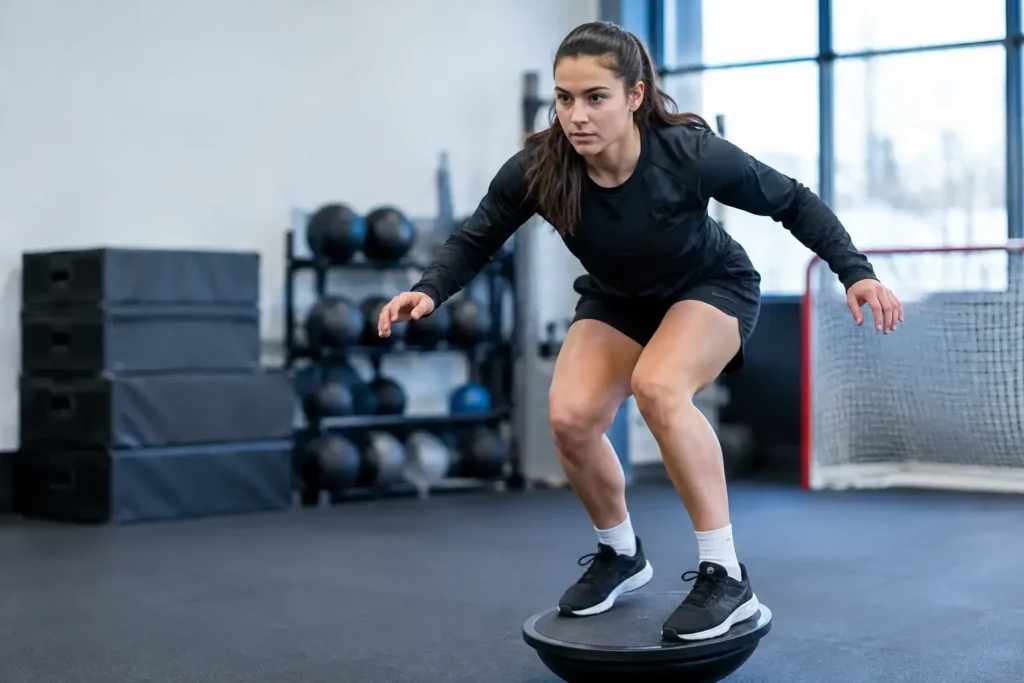
Balance training should challenge the athlete, but it must still resemble hockey movement. Standing on an unstable surface can be useful in small doses for ankle awareness, yet it should not replace skating, strength work, or athletic movement. Hockey players need to be stable while generating force, not just good at wobbling.
Use drills that require the player to control their body while making a hockey decision. Good options include:
- Single-leg stickhandling while keeping the knee bent and chest up
- Lateral hops over a line, landing quietly and holding position
- Split-stance puck protection against light resistance
- Squat holds while receiving and returning passes
- Jump-to-stick drills that teach athletes to land, stabilize, and make a play
The landing is as important as the jump. Athletes should land with knees tracking over toes, hips loaded, and their body under control. If the landing is noisy or the player needs extra steps to regain balance, reduce the distance or speed and rebuild the movement.
Add Contact and Puck Protection Gradually
Balance becomes more valuable when another player is trying to take it away. However, young athletes should not start with heavy contact. Begin with light, controlled pressure so they can learn to lower their center of gravity, widen their base when needed, and use their hips and legs to protect the puck.
A simple partner drill works well: one player carries a puck along a line while the other applies gentle shoulder-to-shoulder pressure. The puck carrier’s job is to keep their feet moving, maintain a strong knee bend, and protect the puck with body position rather than reaching with the stick. Switch roles often.
As skill improves, add turns, stops, and pass options. Players learn that balance is not just about absorbing contact. It is about staying composed enough to make the next hockey play.
Common Mistakes That Limit Balance
The most common mistake is training balance separately from skating technique. If a player’s stride is too narrow, their posture is too upright, or their edges are weak, no amount of standing on one foot will fully solve the problem. Balance must be built into the way the player skates.
Another mistake is rushing the progression. A player may be able to perform a drill slowly, but lose posture as soon as speed, pucks, or pressure are added. That does not mean the drill failed. It means the athlete has found the point where technical work is needed.
Finally, avoid coaching every detail at once. A player who is told to bend deeper, keep their chest up, move their feet, protect the puck, and look around all in one rep will usually retain very little. Choose one correction, give the athlete repeated opportunities to feel it, and build from there.
At Pro Stride Hockey, individualized coaching helps athletes identify the specific movement holding them back, whether it is ankle control, stride posture, weak edges, or recovery after a turn. Focused repetitions and immediate feedback make balance training measurable instead of guesswork.
The best balance work is consistent, challenging, and connected to the game. Give players time to build the movement correctly, then let them use that stronger base to skate faster, compete harder, and play with confidence when the puck is on their stick.