Table of Contents
- What Mental Toughness Means in Hockey
- Building Hockey Confidence Tips for Game Day
- Hockey Visualization Exercises for Peak Performance
- Developing Your Hockey Pregame Routine
- How to Recover Mentally After a Mistake
- Focus and Composure Under Pressure
- Integrating Mental Training with Your Physical Program
- Frequently Asked Questions
Last Updated: October 9, 2026
What Mental Toughness Means in Hockey
Mental toughness in hockey is your ability to stay focused, confident, and composed when the game gets hard. It’s emotional control under stress: a mentally tough player bounces back after mistakes, stays calm when trailing, and executes when it matters.
Mental toughness has three core parts:
- Focus, blocking out distractions
- Resilience, recovering quickly from setbacks
- Confidence, trusting your skills even when doubt creeps in
Mental toughness isn’t innate; it’s a skill you build through mental toughness training, deliberate practice, like your shot or stride.
Building Hockey Confidence Tips for Game Day
Confidence drives mental performance. Without it, even skilled players hesitate; with it, they execute instinctively.
Confidence comes from two sources: knowing you’ve prepared and reinforcing belief through self-talk. But how you build those sources changes with age, a 9-year-old and a 19-year-old need different confidence scripts, and treating them the same is a common mistake in mental training.
Age-Specific Confidence Building
Here’s how confidence work shifts across development stages.
Youth players (roughly ages 8-12)
At this stage, confidence is almost entirely external, kids read coaches’ and parents’ faces before their own internal state.
- Keep self-talk to one or two short, concrete phrases. “Move my feet” beats “I’m a great skater.”
- Celebrate specific actions, not results. “You backchecked hard on that shift” lands better than “great game.”
- Avoid comparing them to teammates or opponents; comparison at this age erodes confidence faster than any mistake.
Adolescent players (roughly ages 13-17)
Self-talk becomes genuinely useful here as abstract thinking develops, but social comparison also peaks, and one bad game can spiral into a week of doubt.
- Introduce present-tense, controllable self-talk. “I’m calm under pressure” and “I’m giving full effort” work because they’re within the player’s control.
- Teach them to separate identity from performance. A bad game is a bad game, not proof they’re a bad player.
- Build a written pregame script they can read on the way to the rink. Written language is stickier than mental rehearsal at this age.
Junior and collegiate players (roughly 18-22)
At this level, technical skill is largely set.
- Self-talk becomes tactical and situational: “First touch, first pass” before a shift, “Low and hard” before a shot.
- Players should have a defined reset phrase for mistakes and a defined pregame phrase for entering the game.
- Introduce video review as a confidence tool, not just a correction tool. Watching yourself execute well reinforces belief more than watching yourself fail.
Professional and elite players
Here, mental work is about consistency and load management. Confidence is maintained, not built from scratch.
- Routines become highly personalized and rarely change mid-season.
- Players often work with a sport psychologist on retainer, not just when things go wrong.
- The focus shifts to managing the mental cost of a long season: travel, media, trade rumors, contract pressure.
Using Positive Self-Talk to Reinforce Belief
Self-talk is the conversation you have with yourself before and during games. Most players let it run on autopilot, so it’s often negative. Positive self-talk isn’t lying to yourself; it’s speaking to yourself the way you’d speak to a teammate you believe in.
Here’s how to build effective self-talk:
- Make it specific, not “I’m good” but “My first pass is crisp today”
- Make it present tense, “I’m calm under pressure” not “I will be calm”
- Make it something you control, “I’m giving full effort” not “I’m going to win”
Write three self-talk statements and practice them daily: out loud in the car on the way to the rink, and before you step on the ice. Your brain believes what you repeat.
Setting Small Wins to Build Momentum
Big goals feel distant; small wins feel immediate.
Instead of “I’m going to have a great game,” target specific moments: “I’m going to win my first three puck battles,” or “I’m going to make one perfect pass in the first period.”
Hitting these targets builds momentum and shifts focus from outcome (winning) to process (what you control). You can’t control the scoreboard, but you can control your effort on each play.
Track your small wins in writing. After each game, write down three things you did well, no matter how small. This trains your brain to notice what you’re doing right, not just what went wrong.
How Parents Can Support Confidence Without Adding Pressure
Parents are a huge part of the hockey ecosystem, and most mental toughness guides ignore them. That’s a mistake, because what a parent says in the car after a game can undo a week of mental training. A few principles hold up across age groups:
- Ask about the experience, not the performance. “What was the most fun part?” opens a conversation. “How many points did you get?” closes one.
- Wait before debriefing. Give the player 30-60 minutes of silence or normal conversation before any hockey talk. Emotional processing needs a buffer.
- Let the coach coach. Parents who correct technique or tactics from the stands create a second voice in the player’s head that competes with the coach’s. That’s noise, not support.
None of this replaces the player’s own mental work, but it removes a major source of interference most programs never address.
Hockey Visualization Exercises for Peak Performance
Visualization is mental rehearsal: running the play in your mind before it happens on the ice. Research shows your brain activates similar neural pathways whether you physically perform a skill or vividly imagine it.
Mental Rehearsal Before Competition
Mental rehearsal means seeing and feeling the play before game time.
Start with a quiet space. Close your eyes. Picture yourself on the ice in detail:
- What do you see? The boards, the ice, your teammates
- What do you hear? Skates, the puck, the crowd
- What do you feel? Your equipment, the ice under your blades, your breathing
Run through the play three times, adding sensory detail each time. Do this the night before a game or 20 minutes before warm-up. Five minutes is enough; consistency matters more than length.
The most effective visualization includes all five senses. Generic mental pictures don’t work. You need to feel the ice, hear the sounds, and see the play in real time from your perspective.
Visualization for Pressure Situations
Pressure moments are where mental toughness shows up most. Pick one pressure situation you struggle with, a breakaway, a one-timer in the slot, defending in overtime. Visualize yourself handling it perfectly, staying calm and executing. Do this daily for two weeks before a big game. Your mind gets comfortable with the scenario, so it feels familiar instead of scary.
Developing Your Hockey Pregame Routine
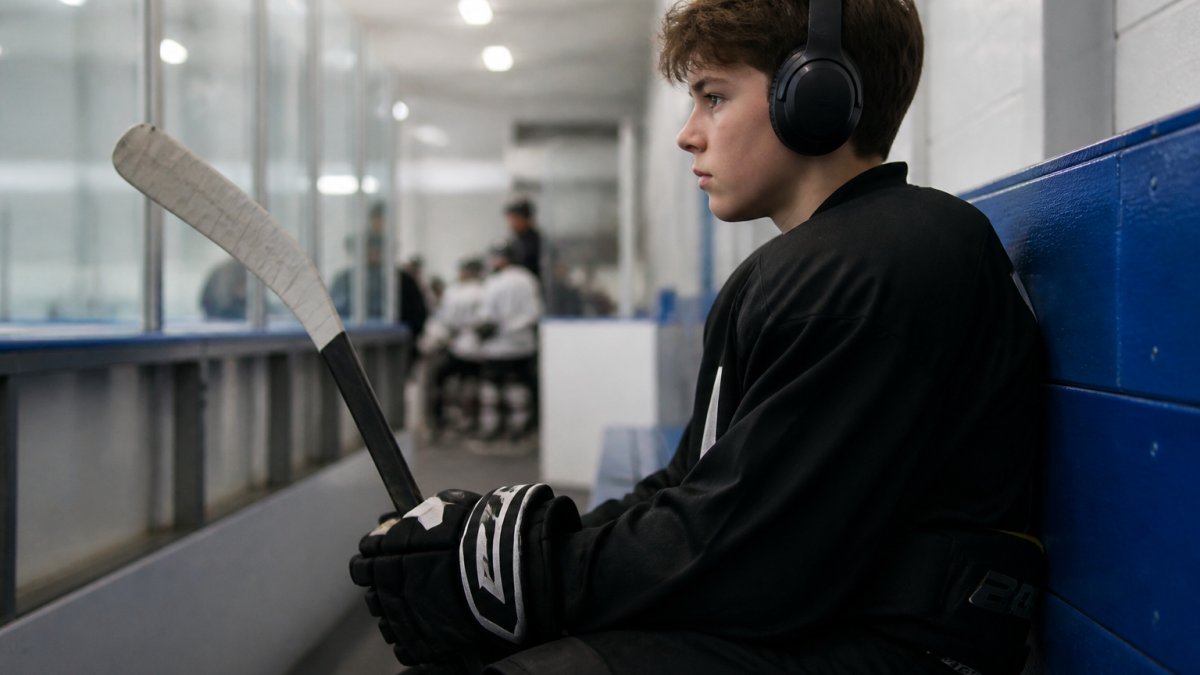
A pregame routine is a sequence of actions and thoughts that prepare you mentally and physically. The best routines are consistent, personal, and designed to get you into the right mental state.
Timing and Consistency Matter
Your routine should start the same way every time. Some players start the night before, others two hours before puck drop. The timing doesn’t matter; consistency does.
A sample pregame routine:
- Night before, review video of your team’s game plan (20 minutes)
- 2 hours before, light meal and hydration
- 90 minutes before, arrive at the rink, get dressed, do dynamic stretches
Write your routine down. Follow it exactly. Your brain learns to expect this sequence and shifts into performance mode automatically.
Combining Physical and Mental Preparation
The best routines blend physical and mental work. During warm-up, do dynamic movements that match game speed, then layer in mental focus: feel your edges grip the ice, feel your muscles activate. Your confidence grows when your body feels prepared AND your mind is locked in.
How to Recover Mentally After a Mistake
Mistakes happen every game. The difference between good and great players is how fast they recover mentally.
A missed pass, a turnover, a goal against you, these sting. But dwelling on them costs you the next play.
The Immediate Reset During Play
The moment you make a mistake, you have 3-5 seconds before the next play starts.
Use that time to reset:
- Take one deep breath, slow it down, calm your nervous system
- Say your reset phrase, something like “Next play” or “Let it go”
- Focus on the next action, what do you need to do right now
This isn’t ignoring the mistake; it’s acknowledging it and moving on before it affects your next decision. Ruminating starts a spiral, the reset stops it before it starts.
Dwelling on a mistake for more than one play will cost you multiple plays. Your brain can’t focus on two things at once. If you’re thinking about what went wrong, you’re not thinking about what’s happening now.
Post-Game Mental Recovery: The Part Almost Nobody Trains
Most mental toughness content stops at the final whistle. That’s a gap.
Post-game recovery is not the same as analysis. Analysis is about what happened.
Phase 1: The first 30 minutes (decompression)
- Eat something. Blood sugar crashes amplify negative emotion.
- Hydrate. Dehydration measurably affects mood and cognitive control.
- Change out of gear and shower. The physical transition signals to your brain that the game is over.
Phase 2: The next morning (structured reflection)
Sleep is the most powerful mental recovery tool available. A night of sleep between the game and the reflection is not optional; emotional memory consolidates during sleep, and events that felt catastrophic at 10 p.m. often feel manageable at 8 a.m. The next morning, write three things:
- One thing that went well. Be specific. “I won my first two puck battles” beats “I played okay.”
- One thing that didn’t. Also specific. “I forced a pass into traffic on the power play” beats “I was bad.”
- One adjustment for next game. One. Not five. “On the power play, I’ll look for the low seam first.”
Keep it to a paragraph. This turns a mistake into a learning moment instead of a source of shame.
Phase 3: The next practice (integration)
Bring the one adjustment into practice. Tell your coach what you’re working on and rep it deliberately.
Age-Specific Adjustments to Post-Game Recovery
The protocol’s structure is the same for everyone, but the delivery changes.
- Youth players (8-12): The parent’s job is to protect Phase 1: no post-game breakdown in the car. The player just names one thing they enjoyed. Reflection is light and player-led.
- Adolescents (13-17): Introduce the written reflection, kept short. The goal is to build the habit, not produce a scouting report.
- Junior and collegiate (18-22): Add video review to Phase 2, but only after sleep. Watching clips the night of a loss amplifies rumination rather than reducing it.
What Not to Do After a Bad Game
A few patterns reliably make things worse:
- Rehashing the game with teammates late into the night. Social venting feels good but entrenches the negative narrative rather than releasing it.
- Scrolling highlights of other players. Comparison after a loss fuels rumination.
- Skipping the next practice or workout. Avoidance reinforces the idea that the mistake is something to hide from.
This is where mental toughness compounds. Each mistake becomes data, you get smarter, make fewer, and stop carrying one bad game into the next.
Focus and Composure Under Pressure
Focus is concentrating on what matters and blocking out noise; composure is staying calm when pressure builds.
The best way to build focus is deliberate practice: during a drill, pick one thing to focus on, not five. Your first pass.
For composure, practice breathing. Slow breathing activates your parasympathetic nervous system. Box breathing works well: inhale four counts, hold four, exhale four, hold four.
Integrating Mental Training with Your Physical Program
Mental toughness doesn’t exist in isolation. A player with great mental skills but poor skating still struggles; a player with excellent technique but weak mental skills underperforms under pressure.
At Pro Stride Hockey, this integration happens through personalized coaching. We work on your skating speed and shot mechanics, and on your mental game: how you respond to pressure, recover from mistakes, and build confidence.
The 2:1 player-to-coach ratio means your coach can observe your mental responses in real time, are you staying composed when a drill gets hard? Bouncing back from errors?
Building hockey mental toughness takes time: consistent practice, honest reflection, and deliberate challenge through mental toughness training.
Pro Stride Hockey specializes in developing this mental edge alongside your physical skills. When you’re ready to develop the mental side of your game with expert guidance, Book Now to start training with us.
Frequently Asked Questions
How can hockey players build confidence?
Build confidence through consistent practice, positive self-talk, and celebrating small wins. Set achievable goals each practice and game, then reflect on what you accomplished. Visualization of successful plays before competition strengthens belief in your abilities. Confidence grows when you trust your preparation and focus on what you can control rather than outcomes.
What mental skills should hockey players practice?
Essential mental skills include visualization, self-talk management, focus techniques, emotional regulation, and resilience. Practice mental rehearsal by visualizing game scenarios before competition. Develop composure by staying present during play rather than dwelling on mistakes. Build stress response training through exposure to pressure situations in practice so your instinctual reaction becomes automatic under game conditions.
How can a hockey player bounce back after making a mistake?
Bounce back immediately by taking a breath and refocusing on the next play rather than replaying the error. Use a mental cue or reset ritual to shift your mindset. After the game, review what happened without judgment, extract the lesson, and move forward. Mental fortitude means accepting mistakes as part of competition and using them to strengthen your performance awareness and decision-making.
How do you stay focused during a hockey game?
Stay present by narrowing your focus to immediate objectives: the puck, your positioning, and your next action. Avoid mental fatigue by using breathing techniques between plays. Develop game awareness through practice so reading the ice becomes instinctual. Pre-game routines and visualization prepare your mind to stay locked in. During play, use visual cues like watching the puck or your teammate’s positioning to anchor attention.