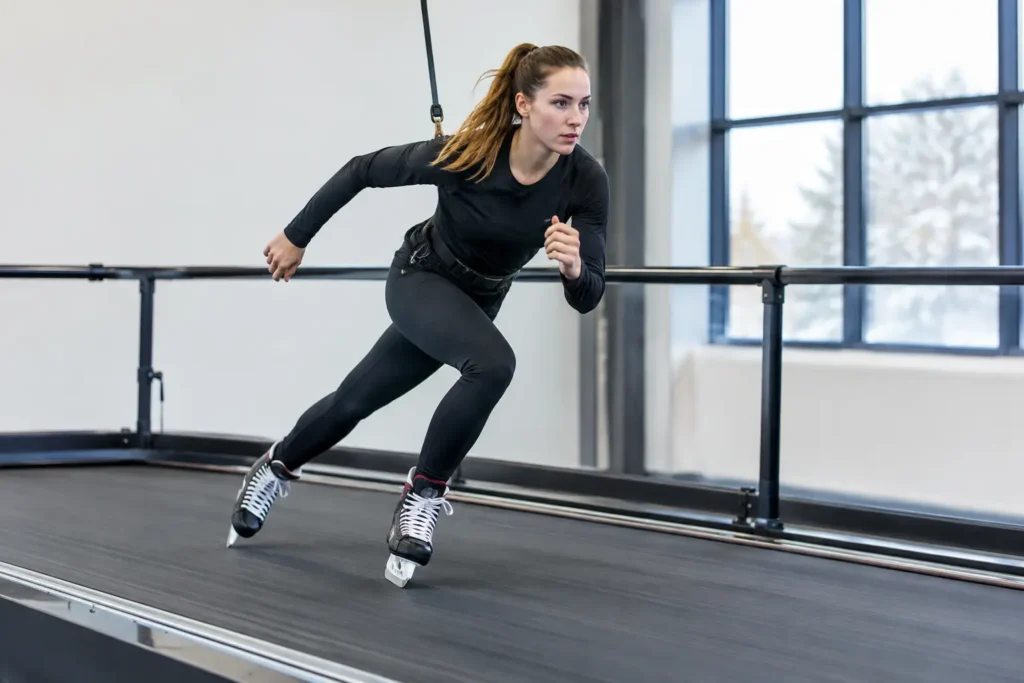
A player can be the first one through every drill at practice and still lose a race for a puck on Saturday. Often, the difference is not effort. It is stride efficiency. Skating treadmill training Edmonton athletes can access at Pro Stride Hockey gives players the focused repetitions and real-time coaching that are difficult to get during a busy team practice.
A stronger stride is not built by simply skating harder. Players need to understand where their power comes from, how their body position affects acceleration, and what small technical habits are limiting their speed. On a skating treadmill, coaches can slow the process down, identify the breakdown, and help athletes repeat the right movement until it feels natural.
Skating Treadmill Training in Edmonton: What Changes
The skating treadmill creates a controlled environment for one of hockey’s most valuable skills: skating. Instead of making a few strides, reaching the end of the rink, turning, and waiting in line, an athlete can sustain their stride while a coach watches every detail. That sustained repetition makes technical correction more productive.
For young players, the first priority may be balance and confidence. They may need to learn how to hold an athletic stance, keep their knees bent, and avoid standing too tall as they push. For an experienced player, the work may be more detailed: correcting a short recovery, improving hip extension, maintaining blade contact, or reducing unnecessary upper-body movement.
The goal is not to force every athlete into the same stride. Body type, age, strength, mobility, and current skating habits all matter. Good coaching identifies the next useful correction for that individual player, then builds from there. A U9 athlete developing comfort on edges needs a different progression than a U15 player preparing for faster competition.
More power starts with better position
Skating speed begins before the blade leaves the ice. A player who is upright, narrow, or unstable cannot consistently direct force into the ice. The treadmill gives coaches time to address posture, knee bend, core control, and weight transfer while the athlete is actively skating.
Players often think speed means moving their feet faster. Fast feet help, but a quick stride with weak extension can waste energy. Effective skating requires a strong push, full recovery, and the ability to return to a stable position for the next stride. When those pieces work together, players can cover more ice without feeling like they are fighting their own mechanics.
This is especially valuable for athletes who look strong in short bursts but fade late in a shift. Efficiency matters. A cleaner stride can help a player maintain speed while spending less energy on movements that do not create forward momentum.
Edge control builds confidence under pressure
Games are not played in straight lines. Players need to accelerate, stop, pivot, escape pressure, and change direction while handling the puck or reading the play. Those actions rely on edge control and body awareness.
Treadmill training does not replace on-ice skating or game situations. It complements them by giving athletes a place to isolate the stride mechanics that support everything they do on the ice. When players improve their balance, posture, and ability to load each leg, they are better prepared to use their edges with confidence in practices and games.
For a young athlete, that confidence can be the difference between avoiding the puck and skating into the play. For a competitive player, it can mean getting to space earlier, winning a race, or recovering faster after a change of direction.
Why Immediate Video Feedback Matters
Players do not always feel what they are doing. A skater may believe they are getting low, fully extending, or staying balanced over the blade, while video shows something different. That is not a failure. It is a valuable starting point.
At Pro Stride Hockey, athletes can see immediate video analysis on a 55-inch display. Coaches can demonstrate a correction, review the movement with the player, and have them apply that feedback right away. The connection between instruction and repetition is much stronger when the player can see the issue and test the solution in the same session.
Video is most effective when it stays simple. A coach does not need to overwhelm an athlete with ten corrections. One clear focus, such as driving through a fuller extension or returning the skate under the body, gives the player an actionable target. Once that change becomes more consistent, the next piece can be added.
Parents also benefit from this approach. Rather than hearing only that their player needs to “work on skating,” they can understand the specific skill being trained and why it matters. Progress becomes easier to recognize when the work has a clear purpose.
The Value of Small-Group Coaching
A treadmill is a powerful tool, but it is the coaching around the tool that makes the difference. Without direct feedback, players can repeat the same inefficient movement hundreds of times. More repetitions are only helpful when they reinforce better habits.
Private sessions at Pro Stride Hockey maintain a 2:1 player-to-coach ratio and cap attendance at four athletes. That format gives coaches room to observe, demonstrate, and correct without letting players disappear into a large group. It also helps athletes stay engaged. They are working, receiving feedback, and being held accountable to the details.
For families, that individual attention is often what is missing from regular team environments. Team practices must serve an entire roster. Coaches are managing drills, systems, transitions, and game preparation. There may be limited time to correct one player’s stride pattern in depth, particularly when that player needs repeated coaching to make a change stick.
Small-group training fills that gap without losing the energy of working alongside other athletes. Players can learn from demonstrations, encourage one another, and still receive instruction tailored to their own movement.
Who Benefits Most From Treadmill Sessions?
Skating treadmill training can help athletes at many stages, but the reason for training should be clear. A beginner may need to establish fundamental posture and confidence. A player returning from time away from the game may need a patient, progressive way to rebuild movement quality. A competitive athlete may be focused on acceleration, stride length, or creating more speed through a stronger skating base.
It can also be useful for players who are frustrated by a specific plateau. Maybe they are skilled with the puck but cannot separate from defenders. Maybe they work hard yet struggle to keep up in faster divisions. Maybe their coach has pointed out that they stand tall, take short strides, or lose balance when changing direction. Those are not labels. They are areas that can be trained with the right plan.
The best starting point is an honest assessment of what the athlete needs now. Speed is a long-term development goal, not a one-session promise. Young players grow, gain strength, and develop coordination at different rates. Technical changes can initially feel unfamiliar, especially for athletes who have relied on the same stride for years. Patience and consistent practice matter.
How to Get More From Each Session
Players should arrive ready to work and ready to listen. The biggest gains often come from athletes who can accept a correction, try it immediately, and stay committed even when the new movement feels awkward. That mindset is part of development.
Parents can support the process by focusing on progress rather than demanding instant results. Ask what the player worked on, what felt different, and what cue they should remember at their next ice time. A simple reminder from a session can carry into warmups, practices, and games.
Training also works best when it fits into a complete development plan. Treadmill work can improve stride mechanics, but on-ice practice is where athletes apply those mechanics under pressure, with pucks, teammates, opponents, and changing game situations. Shooting work, skills training, strength development, recovery, and rest each have a role as well.
The player who improves most is rarely the one chasing a shortcut. It is the athlete who learns to value the details: a deeper knee bend, a cleaner push, a stronger recovery, and one more quality repetition. Those details build the stride that shows up when the puck is loose, the game is close, and there is no time to think.