Table of Contents
- What Makes Elite Hockey Skill Sessions Different in Edmonton
- Private vs Group Hockey Training: Which Format Fits Your Player
- The Benefits of 1-on-1 Hockey Coaching for Skill Progression
- Inside a Session: Skating Stride, Puck Control, and Hockey IQ
- Coaching Credentials, Safety, and Injury Prevention
- What Elite Hockey Skill Sessions Cost and How to Book
- Frequently Asked Questions
Last Updated: September 28, 2026
What Makes Elite Hockey Skill Sessions Different in Edmonton
Elite hockey skill sessions are structured, small-group or one-on-one training blocks that isolate specific technical skills, skating stride, puck control, shooting mechanics, and decision-making, and drill them under qualified supervision until they become automatic. This guide from Pro Stride Hockey breaks down how to book elite hockey skill sessions in Edmonton, what separates serious programs from generic ice time, and how to judge whether your player is actually improving.
Private vs Group Hockey Training: Which Format Fits Your Player
Private vs group hockey training is the first decision you’ll make, and most developing players benefit from both at different stages. Private coaching maximizes correction density; small group instruction adds game-like pressure.
Here’s how the two formats compare in practice:
| Factor | Private (1-on-1) | Small Group (2-4 players) |
|---|---|---|
| Coach attention | Constant, every rep | High, rotating focus |
| Best for | Fixing a specific flaw | Applying skills under pressure |
| Competitive element | None | Built-in, peer-driven |
| Typical use | Stride rebuilds, shooting mechanics | Hockey IQ, offensive tactics, agility |
| Cost per session | Higher | Lower per player |
When Small Group Instruction Beats a Full Team Practice
Small group instruction beats a full team practice when the goal is technical proficiency rather than systems play. Team practices teach positioning within a structure. Small groups teach the individual skills that make the structure work.
How Player-to-Coach Ratio Changes What Your Player Learns
Player-to-coach ratio determines how many corrections your player receives per session, and that number drives skill progression more than total ice time. A 2:1 ratio means every rep gets watched; at 10:1 or higher, coaching becomes crowd management.
Ask any program how many players share a coach during a session, and ask whether that number is capped or “typical.” A cap is a commitment. A typical number is a hope.
The Benefits of 1-on-1 Hockey Coaching for Skill Progression
The benefits of 1-on-1 hockey coaching come down to uninterrupted repetition with immediate correction. With a single player, every drill can be adjusted in real time, shortening the path from “trying it” to “owning it.”
Progression in these sessions typically follows a clear arc:
- Assessment: the coach identifies the specific mechanical flaw, not the symptom
- Isolation: the skill is broken into parts and drilled slowly
- Integration: the parts are recombined at game speed
- Pressure: the skill is tested against a defender, a clock, or a constraint
Inside a Session: Skating Stride, Puck Control, and Hockey IQ
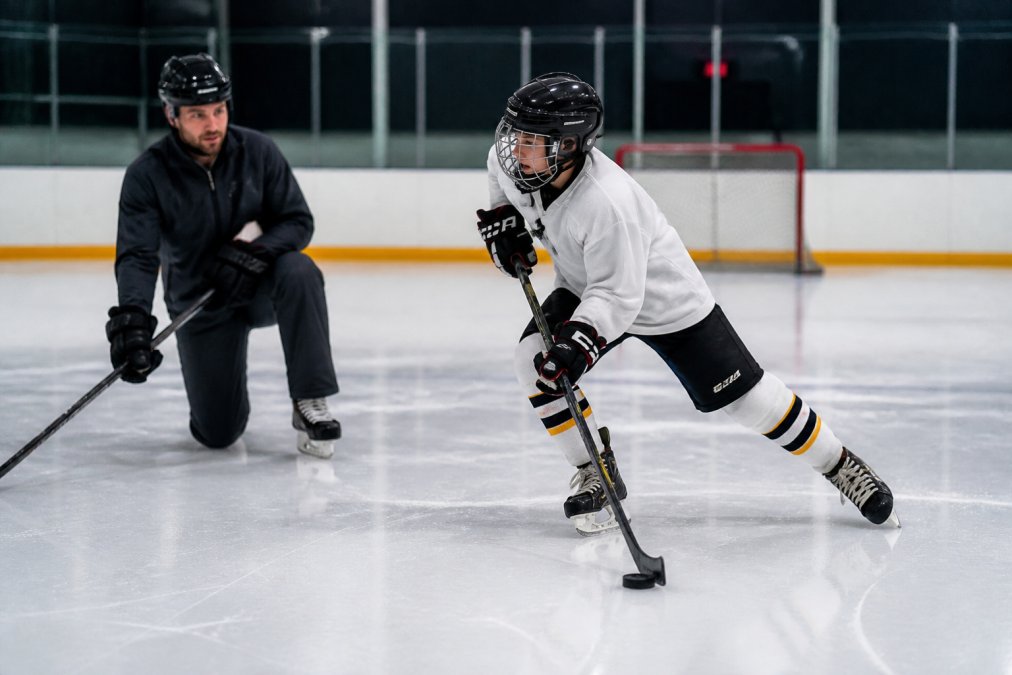
A well-built session moves through three layers: skating stride, puck control, and hockey IQ. Skating comes first because everything else depends on it, you can’t shoot accurately off a weak edge or win a puck battle if your first two strides lose the race.
What “Elite” Actually Means: An Objective Skill Rubric
Most programs use “elite” as marketing; it should be a measurable standard. Before you book, ask a coach to place your player on a rubric like the one below. A serious program will have one; a generic one will not.
| Skill domain | Developing | Competitive | Elite |
|---|---|---|---|
| Edge control | Holds inside and outside edges at moderate speed | Holds edges under contact and on tight turns | Generates speed out of any edge angle without losing balance |
| Stride mechanics | Full extension on straightaway | Full extension with recovery under the body | Stride length and frequency both improve at game speed |
| Puck control | Head up in open ice | Head up under light pressure | Head up through contact and in small-area games |
| Shooting | Accurate in a stationary lane | Accurate off a pass | Accurate off a pass, off a bad pass, and under fatigue |
| Decision-making | Reads the first option | Reads the first and second option | Reads pressure before it arrives and chooses early |
Comparing Training Methodologies: Power Skating vs. Puck Control vs. Hockey IQ
These three methodologies are often bundled and sold as one product, but they don’t produce the same results.
- Power skating rebuilds stride mechanics: edge angle, knee bend, extension, and recovery. It’s the most mechanical of the three and the most dependent on repetition quality. Progress shows up in first-step quickness and how a player holds speed through a turn.
- Puck control trains the hands under constraint. Good puck-control work forces the head up by adding a decision to every rep, not more cones. Progress shows up in how a player handles a bad pass and how quickly they move the puck after receiving it.
- Hockey IQ trains reading and choosing through small-area games and decision drills where the player processes pressure, space, and time. Progress shows up in how often a player makes the simple play instead of the forced one.
On-Ice Skill Development and Dryland Training
On-ice skill development builds technical proficiency; dryland training builds the strength and endurance that let those skills hold up in a third period. Program them together, not as separate hobbies. Consistent application of these physical demands creates the competitive foundation necessary for players to pursue college athletic scholarships as they transition toward higher levels of the game.
Dryland blocks typically cover:
- Explosive lower-body power for first-step quickness
- Core stability for balance through contact
- Conditioning that mirrors shift length, not marathon cardio
Video Analysis and Performance Metrics
Video analysis turns a coach’s opinion into something a player can see. Filming a stride or shot and reviewing it frame by frame exposes problems invisible at full speed and gives the player a reference point to measure against in three weeks.
Post-Session Development Plans: The Homework Nobody Assigns
This is the gap most programs leave open. A one-hour session is roughly 3 percent of a player’s week. If nothing changes in the other 97 percent, the session becomes a memory, not a skill.
- Two or three off-ice drills matched to the bottleneck identified in the assessment, with a stated number of reps and days per week
- One on-ice focus cue the player can carry into team practice, phrased in a single sentence
- A re-test date so the same metric is measured again and compared
The clearest sign of a serious program is that it can tell you what your player’s baseline was, what changed, and what’s next. If nobody is measuring, nobody is coaching.
Coaching Credentials, Safety, and Injury Prevention
Coaching credentials and safety protocols are where the market gets murky, so treat this as a screening checklist. Ask directly, and expect specific answers.
- Does the coach hold current certification through the national coaching program?
- Is there a documented emergency action plan for the rink?
- Are sessions capped at a stated player maximum?
- Is there a structured warm-up before high-intensity skating?
- Does the program screen for injury history before loading dryland work?
What Elite Hockey Skill Sessions Cost and How to Book
Pricing for elite hockey skill sessions depends on format, session length, and commitment, so any program quoting a flat number without asking about your goals is guessing. Private sessions typically cost more per hour than small groups, and packages often reduce the per-session rate. For current pricing, please contact us directly.
What You Should Expect to Pay
Exact rates vary by rink, coach, and season, but the market generally falls into recognizable bands. Treat these as ranges to sanity-check a quote, not fixed prices:
| Format | Typical session length | Typical per-player range |
|---|---|---|
| Private 1-on-1 | 45-60 minutes | Highest per hour; usually sold in 5- or 10-session blocks |
| Small group (2-4 players) | 60-75 minutes | Lower per player; often 30-50 percent below private |
| Semi-private (2 players) | 45-60 minutes | Between private and small group |
| Seasonal development block | 8-16 weeks | Discounted per session versus drop-in |
| What to compare | Why it matters |
|---|---|
| Player-to-coach ratio | Determines correction frequency per session |
| Session length | Short sessions limit how deep you can go |
| Assessment included | Without a baseline, progress is a guess |
| Post-session plan | Tells you what happens after the session ends |
| Video analysis | Makes technical flaws visible and trackable |
| Make-up policy | Ice time is expensive; a missed session should not vanish |
How the Booking Process Should Work
The booking process should be short. A well-run program typically follows this sequence:
- Intake conversation. Ten to fifteen minutes by phone or form covering age, position, current team level, and the specific problem the player or parent wants solved.
- Placement. The program matches the player to a session based on age and skill level, not just availability.
- First assessment. A single session where the coach establishes a baseline against a rubric and writes it down.
- Plan and schedule. The coach proposes a session count and a re-test date, and the parent books the block.
Questions to Ask Before You Commit
- Who is the coach, and what is their certification and development background?
- Is the player-to-coach ratio capped, and at what number?
- Is an assessment included, and will I receive it in writing?
- What is the make-up and cancellation policy?
- What is the re-test date, and what metric will be measured again?
Don’t book a package before your player has done one session. A single assessment tells you more about fit than any brochure, and any program confident in its coaching will let you start there.
Ready to see where your player actually stands? Book Now with Pro Stride Hockey and start with an assessment session.
Frequently Asked Questions
What is the benefit of 1-on-1 hockey training versus group sessions?
One-on-one coaching gives your player undivided attention on skating stride, shooting mechanics, and edge work. A coach can correct technique in real time instead of rotating through a group. Small group instruction still works well for game-like drills and offensive tactics, but private sessions move faster on individual weaknesses. Many families combine both formats across a season to balance cost and focused skill development.
How often should a competitive hockey player attend private skill sessions?
Most competitive players see steady skill progression with one to two sessions per week during the season and more frequent on-ice sessions in the off-season. The right frequency depends on your player’s age-specific curriculum needs, current ice time, and schedule. Consistency matters more than volume, so a weekly session sustained over months usually beats sporadic intensive blocks.
Do elite hockey training programs offer sessions for all ages?
Reputable academies build age-specific curriculum for youth hockey players through to adults. Younger players focus on hockey fundamentals, skating stride, and confidence, while older athletes work on high-performance training, offensive tactics, and defensive positioning. Ask any provider how they group players by age and skill level before booking, since mixed-age sessions can slow development for everyone.
What should I look for in a professional hockey skills coach?
Check coaching credentials, experience with competitive hockey, and whether the program offers objective skill assessment and post-session development plans. A low player-to-coach ratio, video analysis, and a clear skill progression path are strong signals. Ask what happens after each session: the best coaches send players home with specific drills and performance metrics to track before the next ice time.