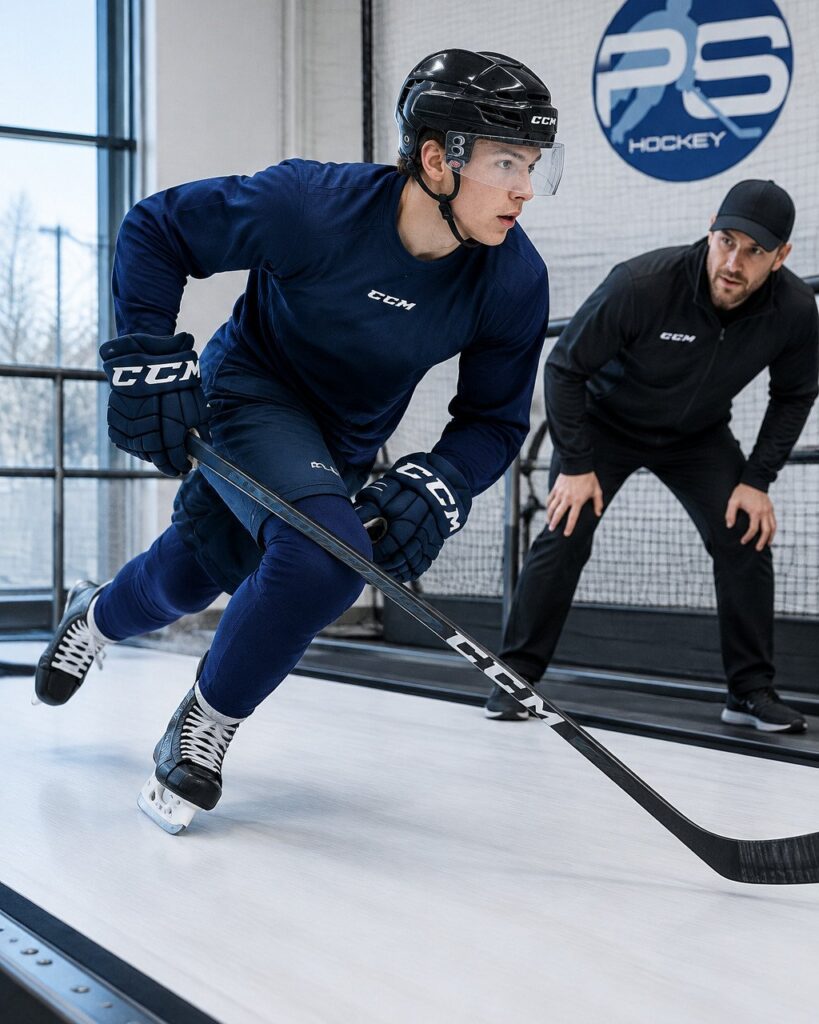
Last Updated: November 28, 2026
Quick Summary
Connor McDavid’s speed comes from a chain of skills: a powerful first push, a clean stride with a strong recovery, a low body position, and sharp edge control. Young players can build the same skill through focused drills and repetition. Those who practice these skills consistently get the most out of their skating and learn how to skate faster.
- Start acceleration with weight over your toes and a short, powerful push
- Keep your strides short for the first three to five steps
- Stay low through the knees and hips, not by folding at the waist
- Count strides across the rink and aim to reduce the count while keeping speed
- Do acceleration drills at home for a few short sessions each week
Table of Contents
- What Makes Connor McDavid So Fast on the Ice
- Acceleration and First-Step Quickness
- Hockey Skating Stride Mechanics Explained
- Edge Control, Crossovers and Speed Through Turns
- How to Skate Faster in Hockey: Drills for Youth Players
- Hockey Acceleration Drills You Can Start This Week
- Using Skating Treadmill Training to Refine Your Stride
- Booking Your First Session at Pro Stride Hockey
- Frequently Asked Questions
What Makes Connor McDavid So Fast on the Ice
Connor McDavid is one of the fastest skaters in the National Hockey League, and his speed comes from a mix of technique, power and relentless repetition. At Pro Stride Hockey, we coach young players who want to build the fundamentals that help skaters pull away from defenders. This guide breaks down what those fundamentals look like and how you can start building them.
Speed in hockey is not one skill. It is a chain of skills. Your first step, your stride, your edge control and your body position all work together. When one link is weak, the whole chain slows down.
Here is the good news. Most of these skills can be trained off the ice, and they can be trained with clear feedback. That is the core idea behind how to skate faster in hockey.
Acceleration and First-Step Quickness
Acceleration is the moment that separates good skaters from fast ones. The first three to five strides decide who gets to the puck first.
A common mistake is trying to reach top speed too early. Players who stand tall and take long, flat strides lose ground right away. Instead, focus on a short, powerful push that drives you forward.
- Start with your weight over your toes
- Push hard into the ice at a wide angle
- Keep your strides short for the first few steps
- Lengthen your stride only after your body is low and driving
When you watch fast skaters, notice how low they stay at the start. Their power comes from the legs, not from leaning forward and hoping for the best.
The table below sums up the first-step fundamentals covered in this section, so you can check them at a glance.
| Element | What to do | Why it matters |
|---|---|---|
| Weight position | Start with weight over your toes | Sets up a powerful push |
| Push angle | Push hard into the ice at a wide angle | Drives you forward |
| Early stride length | Keep strides short for the first few steps | Avoids losing ground |
| Body height | Stay low while driving | Keeps power coming from the legs |
| Stride timing | Lengthen only after your body is low and driving | Builds speed without losing control |
Hockey Skating Stride Mechanics Explained
Your stride is the engine of your skating, and the difference between a fast stride and a slow one usually comes down to mechanics rather than effort. A clean stride uses the full length of the blade, with a strong push, a controlled glide and a smooth recovery under the body.
The stride has three phases, and each one has a job. The push sends power into the ice through the inside edge as the leg extends out and back. The glide carries speed while the pushing leg recovers. The recovery brings the skate back under your hips so the next push starts from a strong position rather than from behind you.
A useful way to think about it: the push is where you create speed, the glide is where you keep it, and the recovery is where you set up the next push.
Body Position and a Low Skating Stance
Body position controls balance, power and the ability to change direction. A low stance keeps your center of gravity over your skates, which lets you push at a sharper angle into the ice and recover faster between strides.
Many players stand too upright. That position feels comfortable, but it shortens the push, wastes energy and makes you easy to knock off balance. Bend your knees, keep your back flat and keep your head up so you can see the play. A common checkpoint is that your knees should be bent enough that you can see your toes over them without leaning your chest forward.
Watch out: dropping your chest toward your knees to look “low” actually moves your weight ahead of your skates and kills your push. Low posture comes from the knees and hips, not from folding at the waist.
Stride Length, Power and Efficiency
Longer strides are not always faster. A stride that is too long reduces power because the push does not finish properly and the recovery takes too long. The best stride length comes from full extension of the push leg, not from reaching as far forward as possible.
Efficiency matters just as much as power. Efficient skaters waste less motion, which saves energy for the third period. Two skaters can post the same top speed, but the one who reaches it with fewer, cleaner strides will still have legs left late in a shift.
A practical checkpoint for young players is stride count. Count how many strides it takes to cross the rink at full effort. If the count drops while your speed stays the same, your mechanics are improving. If the count drops but you feel slower, you are probably lengthening the recovery instead of the push.
Technique Trade-offs
No single stride shape works in every situation. A longer, more extended stride is efficient in open ice, but it is slow to recover from when you need to change direction. A shorter, quicker stride gets you moving and lets you adjust, but it covers less ground per push. Skating well is about choosing the right stride for the situation rather than defaulting to one shape all the time.
The same applies to posture. A very low stance generates more push angle and power, but it is harder to hold for a full shift and limits your reach for passes. Most players find a middle posture that they can hold while still getting a strong push.
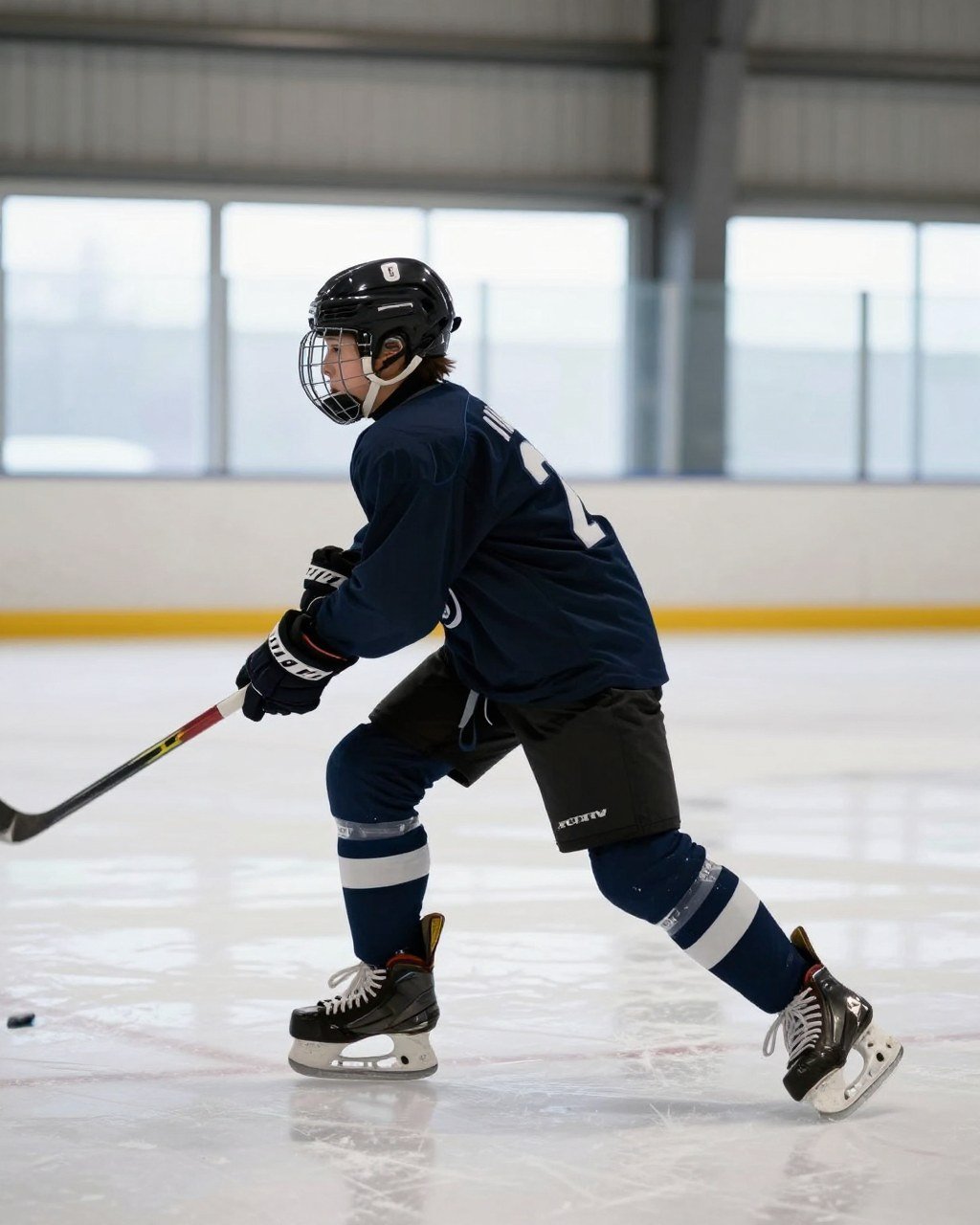
!A young hockey player in full gear mid-stride on an indoor rink
Edge Control, Crossovers and Speed Through Turns
Edge control decides how well you turn at speed. Skate on the correct edge, and you can carry speed through the turn. Skate flat, and you lose it.
Crossovers are the key skill for changing direction without losing forward momentum. Cross one skate over the other, push through the inside edge, and keep your upper body quiet.
Watch out: crossing too early in a turn can cause you to lose balance and stumble. Start the crossover only when your weight is ready to shift.
How to Skate Faster in Hockey: Drills for Youth Players
Drills turn ideas into skills. Here are simple drills young players can use at any level.
- Start-stop sprints: Sprint five strides, then stop with control. Repeat ten times.
- Crossover loops: Skate around the faceoff circle using crossovers. Switch directions every lap.
- Edge work: Practice forward and backward edges along the boards at half speed.
- Stride counts: Count how many strides it takes to cross the rink. Try to reduce the count while keeping your speed.
Start slow and focus on form. Speed comes after the technique is solid.
Hockey Acceleration Drills You Can Start This Week
You do not need a long plan to see progress.
The drills below are written for off-ice work, which means you can build the movement pattern at home or in a training space before you test it on the rink.
- Wall first-step pushes: Stand facing a wall with your hands on it, body in a low stance. Drive one leg back and out at a sharp angle, then recover it under your hips. Do ten pushes per leg, focusing on a short, powerful push rather than a long reach.
- Lateral bound and stick: Bound side to side from one leg to the other, holding a low stance and landing softly. This trains the hip and leg drive that powers the first three strides.
- Short sprint starts: From a standing start, sprint for five to ten seconds. Focus on the first three steps being short and quick, then lengthening only once you are moving.
- Crossover loops: Skate around the faceoff circle using crossovers, switching directions every lap. Keep your upper body quiet and push through the inside edge.
- Stride counts: Count how many strides it takes to cross the rink. Try to reduce the count while keeping your speed, which tells you the push is getting cleaner.
Start slow and focus on form. Speed comes after the technique is solid.
A common pattern with young players is that they try to add speed before the first step is clean, and the result is a long, flat stride that loses ground at the start.
Watch out: doing acceleration drills while tired teaches sloppy mechanics. Keep the reps short and stop the set when your form starts to break down, rather than pushing through for extra reps.
If you have access to a skating treadmill, use it to reinforce the same first-step pattern with feedback.
Using Skating Treadmill Training to Refine Your Stride
A skating treadmill lets you practice stride mechanics with repetition and feedback. Our players use it to work on push angle, stride length and body position without the distractions of a full game.
Lindsay Axelson, a player who trained with us, shared: “I’d never been on a skate treadmill before and Adrienne taught me a lot about stride efficiency.”
Treadmill training works best when you combine it with on-ice practice. Use the treadmill to build the movement pattern, then test it at full speed on the rink.
Booking Your First Session at Pro Stride Hockey
Speed takes consistent work, and the right coaching makes that work count. At Pro Stride Hockey, we keep our sessions small, with a 2:1 player-to-coach ratio in one-on-one sessions and a maximum of four players per session. Our video analysis and shooting lane facility support your training.
Ready to build faster skating mechanics? Book your first session at Pro Stride Hockey and start working on the stride that will carry you past defenders.
Frequently Asked Questions
What makes Connor McDavid such a fast skater?
Connor McDavid’s speed comes from a combination of a strong first step, a low and balanced skating stance, and efficient stride mechanics that let him push hard into the ice on every stride. Acceleration matters more than top speed in most game situations, and his ability to get moving quickly lets him create separation from defenders. Skating coaches often point to his edge control and body position as the features that make his stride look effortless. Young players can study these same fundamentals rather than trying to copy his exact style.
How can young hockey players improve their skating speed?
Improving skating speed starts with stride technique: a deep knee bend, a full push-off to the side, and a relaxed recovery phase that brings the skate back under the body. Regular acceleration drills, edge work, and crossover practice build the leg strength and balance needed to skate faster. Off-ice training with a skating treadmill lets players repeat stride mechanics with consistent feedback. Pro Stride Hockey offers personalized sessions, and you can contact the team directly or visit the website for current session details.
Can a skating treadmill help improve hockey stride technique?
A skating treadmill lets a player focus on stride mechanics without the distractions of a live game, such as traffic, pucks and changing positions. Players can slow down the movement, correct their push-off angle and check body position in real time. Repeating the same stride pattern builds muscle memory that carries over to the ice. Treadmill work is most effective when combined with on-ice practice and video review.
How does carrying the puck affect skating speed?
Carrying the puck changes balance and stride length because the player must keep the stick and puck controlled while maintaining forward momentum. Many players slow down or lift their head too early, which costs speed. Practising one-handed carries and puck protection at speed helps keep stride efficiency intact. Consistent practice with the puck builds confidence so skating speed holds up under pressure.
